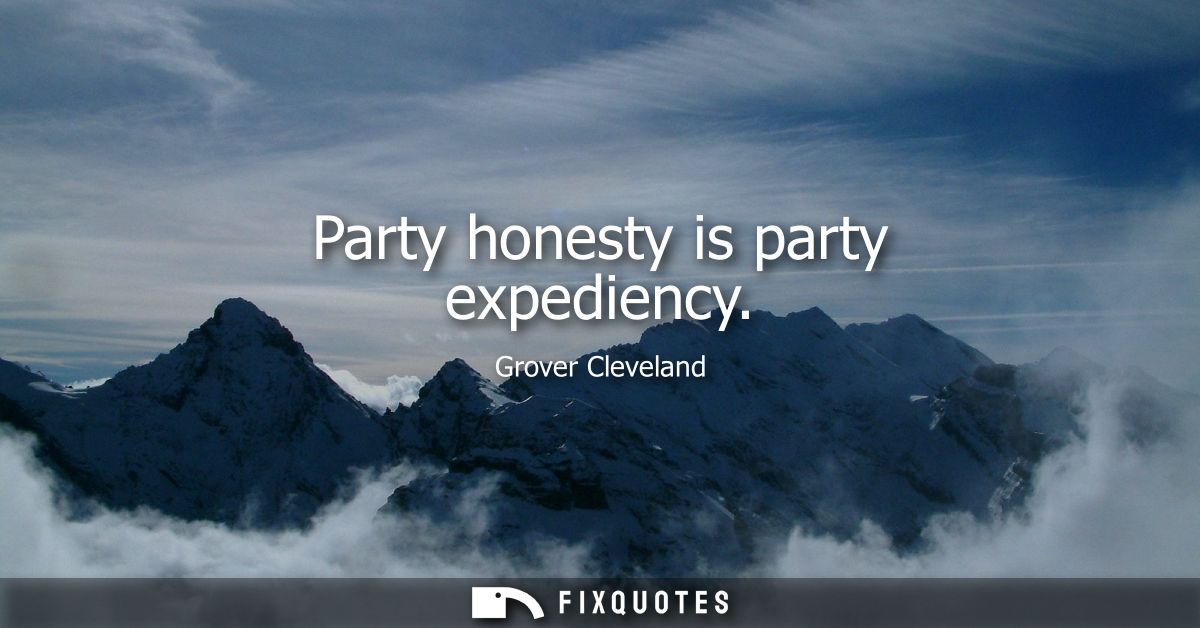
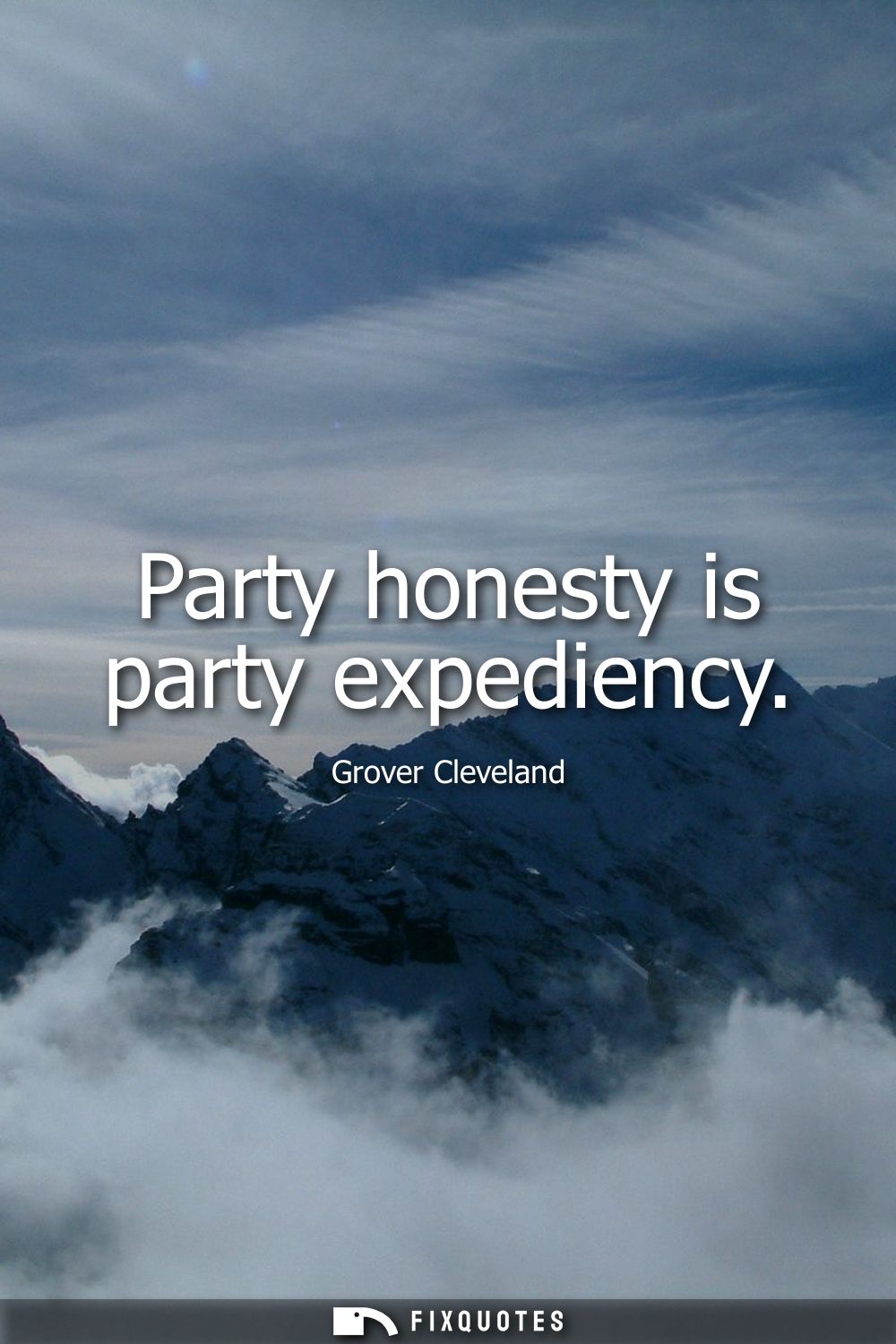
"Party honesty is party expediency"
About this Quote
“Party honesty is party expediency” lands like a moral rebuke disguised as political arithmetic. Cleveland, a president who sold himself as the antidote to Gilded Age rot, compresses a whole theory of power into six blunt words: in party politics, “principle” often survives only when it’s useful.
The intent is double-edged. On the surface, it reads like a commonsense warning: don’t mistake a party’s sudden devotion to truth or reform for a conversion experience. Look closer and it’s sharper: the machinery of party doesn’t reward honesty as a virtue; it rewards honesty when dishonesty becomes costly. Cleveland is putting “honesty” in scare quotes without needing the punctuation. He’s saying the party can sound ethical while doing what it always does - protecting itself.
That’s also the subtext of Cleveland’s brand of reformism. His career was built on positioning himself as the man who would veto favors, resist patronage, and treat government as a public trust rather than a spoils system. The line flatters him by implication: if parties are honest only when expedient, then integrity must come from individuals willing to disappoint their own side.
Context matters: late-19th-century America was thick with machine politics, railroad money, and transactional governance. Cleveland’s phrasing is spare and prosecutorial, as if he’s cross-examining the idea of party virtue itself. The sting is that it still scans: institutions don’t develop consciences; they develop strategies.
The intent is double-edged. On the surface, it reads like a commonsense warning: don’t mistake a party’s sudden devotion to truth or reform for a conversion experience. Look closer and it’s sharper: the machinery of party doesn’t reward honesty as a virtue; it rewards honesty when dishonesty becomes costly. Cleveland is putting “honesty” in scare quotes without needing the punctuation. He’s saying the party can sound ethical while doing what it always does - protecting itself.
That’s also the subtext of Cleveland’s brand of reformism. His career was built on positioning himself as the man who would veto favors, resist patronage, and treat government as a public trust rather than a spoils system. The line flatters him by implication: if parties are honest only when expedient, then integrity must come from individuals willing to disappoint their own side.
Context matters: late-19th-century America was thick with machine politics, railroad money, and transactional governance. Cleveland’s phrasing is spare and prosecutorial, as if he’s cross-examining the idea of party virtue itself. The sting is that it still scans: institutions don’t develop consciences; they develop strategies.
Quote Details
| Topic | Honesty & Integrity |
|---|---|
| Source | Help us find the source |
| Cite |
Citation Formats
APA Style (7th ed.)
Cleveland, Grover. (2026, January 15). Party honesty is party expediency. FixQuotes. https://fixquotes.com/quotes/party-honesty-is-party-expediency-158355/
Chicago Style
Cleveland, Grover. "Party honesty is party expediency." FixQuotes. January 15, 2026. https://fixquotes.com/quotes/party-honesty-is-party-expediency-158355/.
MLA Style (9th ed.)
"Party honesty is party expediency." FixQuotes, 15 Jan. 2026, https://fixquotes.com/quotes/party-honesty-is-party-expediency-158355/. Accessed 6 Mar. 2026.
More Quotes by Grover
Add to List