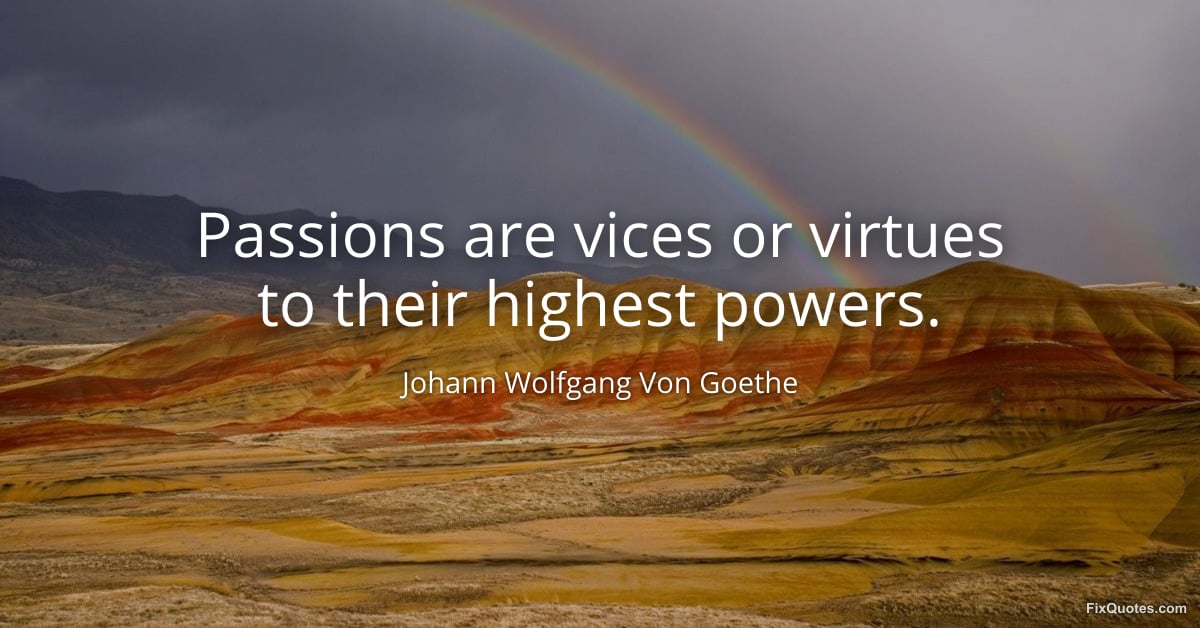
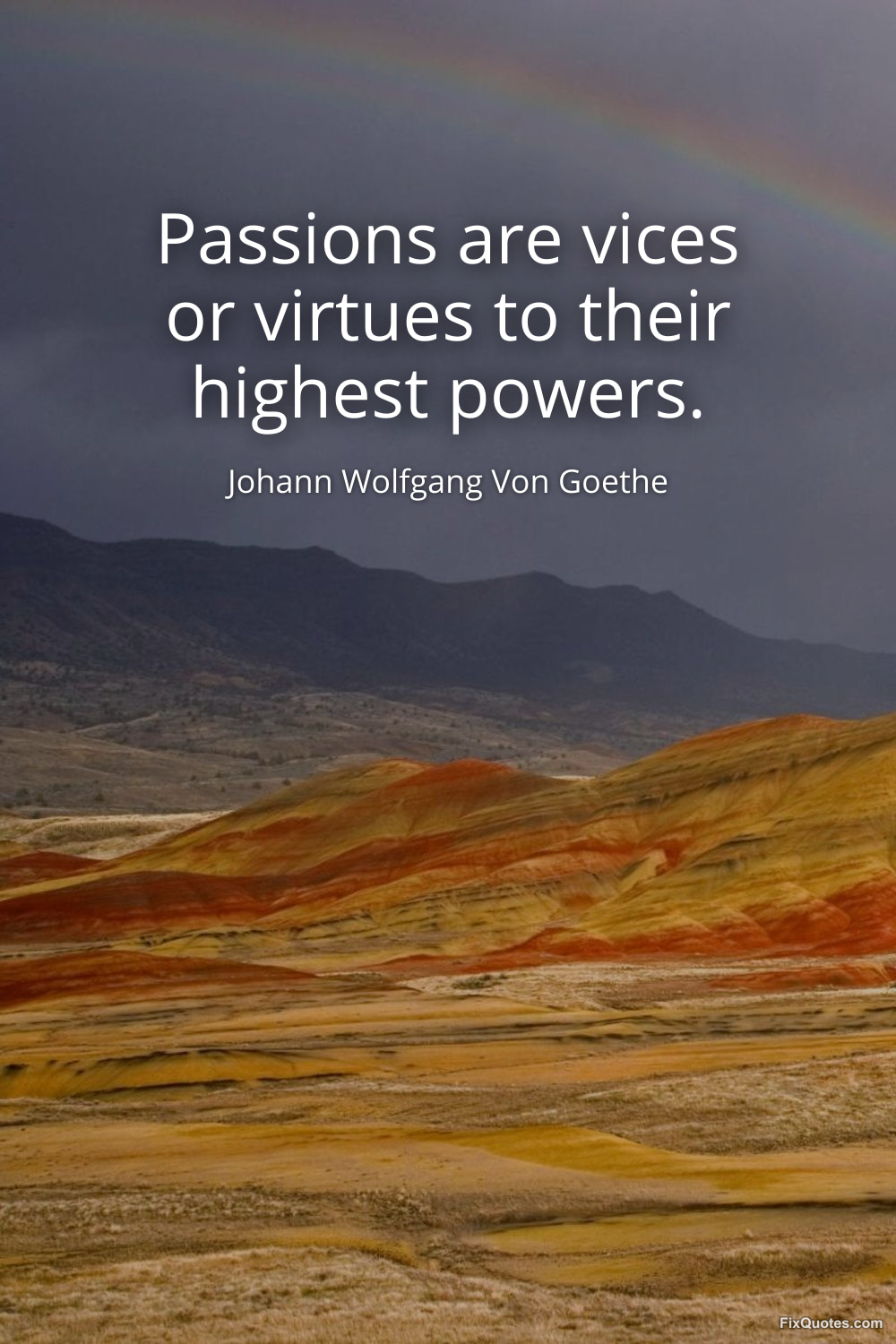
"Passions are vices or virtues to their highest powers"
About this Quote
Goethe treats passion less like a feeling than like an amplifier: it doesn’t invent moral qualities so much as turn the dial until whatever’s already there becomes impossible to ignore. The sting of the line is its refusal to romanticize intensity. In a culture that still confuses being moved with being right, Goethe suggests that fervor is ethically neutral until it attaches to an object, a habit, a character. Passion can mint saints and monsters using the same fuel.
The phrasing matters. “Vices or virtues” is a blunt binary, almost legalistic, but “to their highest powers” smuggles in a more modern psychology: the danger isn’t desire itself, it’s escalation. Passion is what happens when ordinary impulses acquire momentum and begin to reorganize a life. At that point, restraint isn’t repression; it’s governance.
Goethe writes out of the crucible of Sturm und Drang and its aftermath, when European letters were testing the emotional extremes that Enlightenment rationality had tried to discipline. His own work embodies the argument. Werther’s romantic intensity becomes self-consuming; Faust’s restless striving becomes both creative and catastrophic. The subtext is autobiographical, too: a writer who knew the seductions of excess insisting that temperament is destiny only if you let it run unexamined.
There’s also a quiet provocation aimed at moralizers. If passion can empower virtue, then cold propriety isn’t automatically goodness. Goethe is defending heat, but only with a warning label: passion is power, and power reveals.
The phrasing matters. “Vices or virtues” is a blunt binary, almost legalistic, but “to their highest powers” smuggles in a more modern psychology: the danger isn’t desire itself, it’s escalation. Passion is what happens when ordinary impulses acquire momentum and begin to reorganize a life. At that point, restraint isn’t repression; it’s governance.
Goethe writes out of the crucible of Sturm und Drang and its aftermath, when European letters were testing the emotional extremes that Enlightenment rationality had tried to discipline. His own work embodies the argument. Werther’s romantic intensity becomes self-consuming; Faust’s restless striving becomes both creative and catastrophic. The subtext is autobiographical, too: a writer who knew the seductions of excess insisting that temperament is destiny only if you let it run unexamined.
There’s also a quiet provocation aimed at moralizers. If passion can empower virtue, then cold propriety isn’t automatically goodness. Goethe is defending heat, but only with a warning label: passion is power, and power reveals.
Quote Details
| Topic | Ethics & Morality |
|---|---|
| Source | Help us find the source |
| Cite |
Citation Formats
APA Style (7th ed.)
Goethe, Johann Wolfgang Von. (2026, January 18). Passions are vices or virtues to their highest powers. FixQuotes. https://fixquotes.com/quotes/passions-are-vices-or-virtues-to-their-highest-7938/
Chicago Style
Goethe, Johann Wolfgang Von. "Passions are vices or virtues to their highest powers." FixQuotes. January 18, 2026. https://fixquotes.com/quotes/passions-are-vices-or-virtues-to-their-highest-7938/.
MLA Style (9th ed.)
"Passions are vices or virtues to their highest powers." FixQuotes, 18 Jan. 2026, https://fixquotes.com/quotes/passions-are-vices-or-virtues-to-their-highest-7938/. Accessed 30 Mar. 2026.
More Quotes by Johann
Add to List