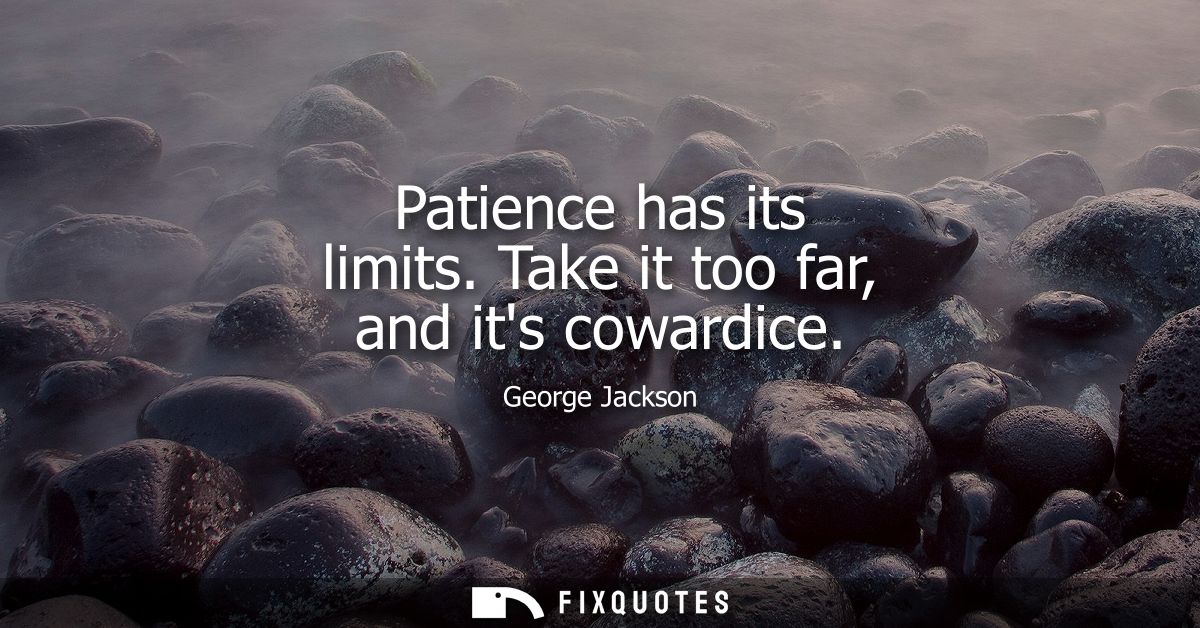
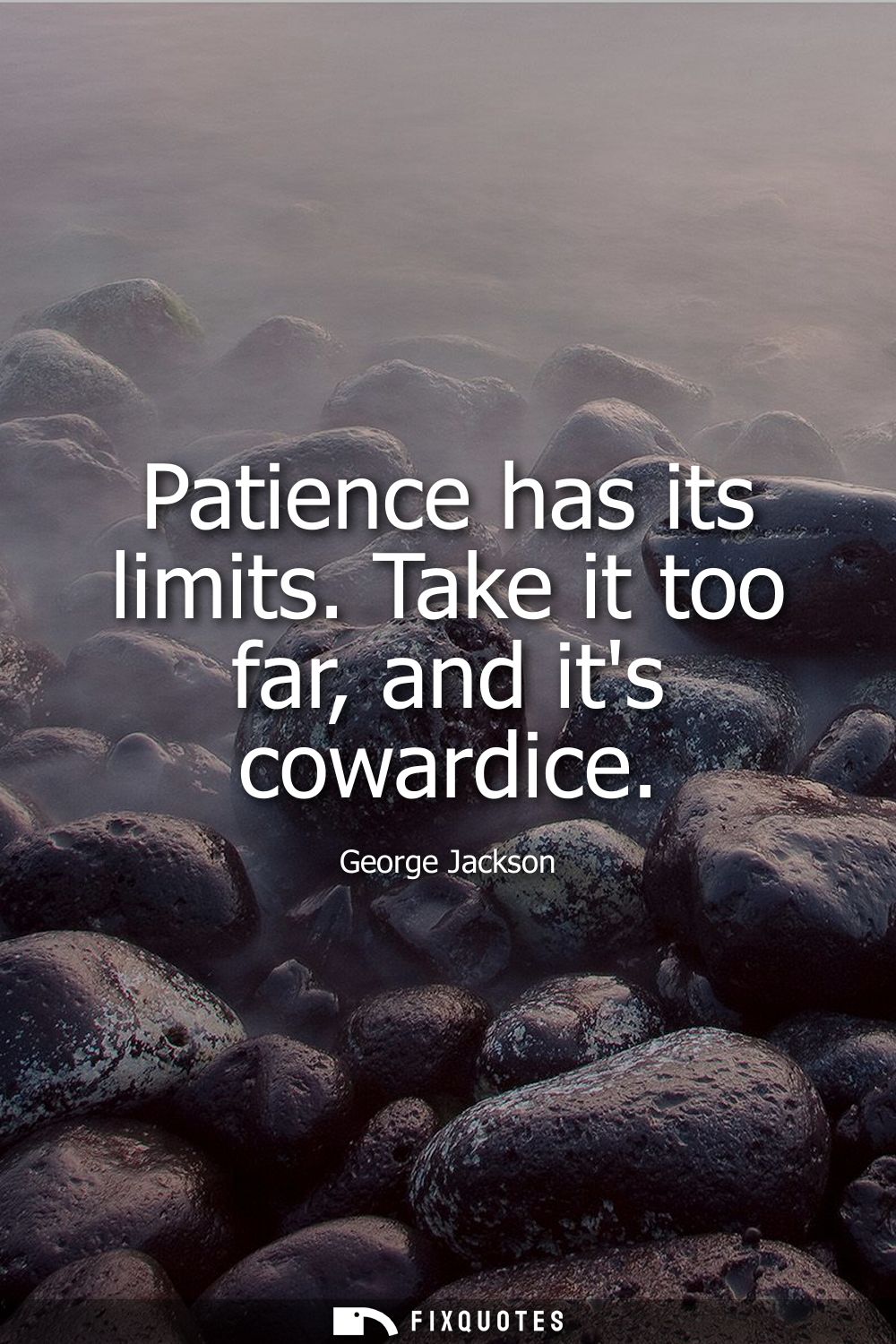
"Patience has its limits. Take it too far, and it's cowardice"
About this Quote
Jackson draws a knife-edge boundary between endurance and submission, and he does it in two blunt sentences that feel less like philosophy than a warning. The first line grants patience a kind of dignity: it is a choice, a discipline, a strategy for surviving pressure without snapping. The second line yanks that dignity away if patience becomes permanent. The pivot is moral, not temperamental. He is not critiquing people for being calm; he is indicting the social demand that the oppressed remain calm forever.
The subtext is a critique of respectability politics before the term existed. Patience is often praised by institutions that benefit from delay: courts that move slowly, reforms that arrive after the damage is done, public opinion that always needs more time to be convinced that other people deserve basic rights. Jackson reframes “wait” as an active instrument of control. If you accept endless waiting, the quote suggests, you are not being noble; you are being trained.
Context sharpens the edge. Jackson wrote from within the carceral state, where “patience” can mean tolerating violence, isolation, and bureaucratic cruelty dressed up as procedure. In that setting, the line reads like an argument for political urgency: a refusal to confuse survival tactics with a life plan. Its rhetorical power is the escalation baked into the structure: a calm opening, then a verdict. Patience is allowed, even respected, but only up to the point where it starts protecting your oppressor more than it protects you.
The subtext is a critique of respectability politics before the term existed. Patience is often praised by institutions that benefit from delay: courts that move slowly, reforms that arrive after the damage is done, public opinion that always needs more time to be convinced that other people deserve basic rights. Jackson reframes “wait” as an active instrument of control. If you accept endless waiting, the quote suggests, you are not being noble; you are being trained.
Context sharpens the edge. Jackson wrote from within the carceral state, where “patience” can mean tolerating violence, isolation, and bureaucratic cruelty dressed up as procedure. In that setting, the line reads like an argument for political urgency: a refusal to confuse survival tactics with a life plan. Its rhetorical power is the escalation baked into the structure: a calm opening, then a verdict. Patience is allowed, even respected, but only up to the point where it starts protecting your oppressor more than it protects you.
Quote Details
| Topic | Wisdom |
|---|---|
| Source | Help us find the source |
| Cite |
Citation Formats
APA Style (7th ed.)
Jackson, George. (2026, January 14). Patience has its limits. Take it too far, and it's cowardice. FixQuotes. https://fixquotes.com/quotes/patience-has-its-limits-take-it-too-far-and-its-53408/
Chicago Style
Jackson, George. "Patience has its limits. Take it too far, and it's cowardice." FixQuotes. January 14, 2026. https://fixquotes.com/quotes/patience-has-its-limits-take-it-too-far-and-its-53408/.
MLA Style (9th ed.)
"Patience has its limits. Take it too far, and it's cowardice." FixQuotes, 14 Jan. 2026, https://fixquotes.com/quotes/patience-has-its-limits-take-it-too-far-and-its-53408/. Accessed 1 Apr. 2026.
More Quotes by George
Add to List