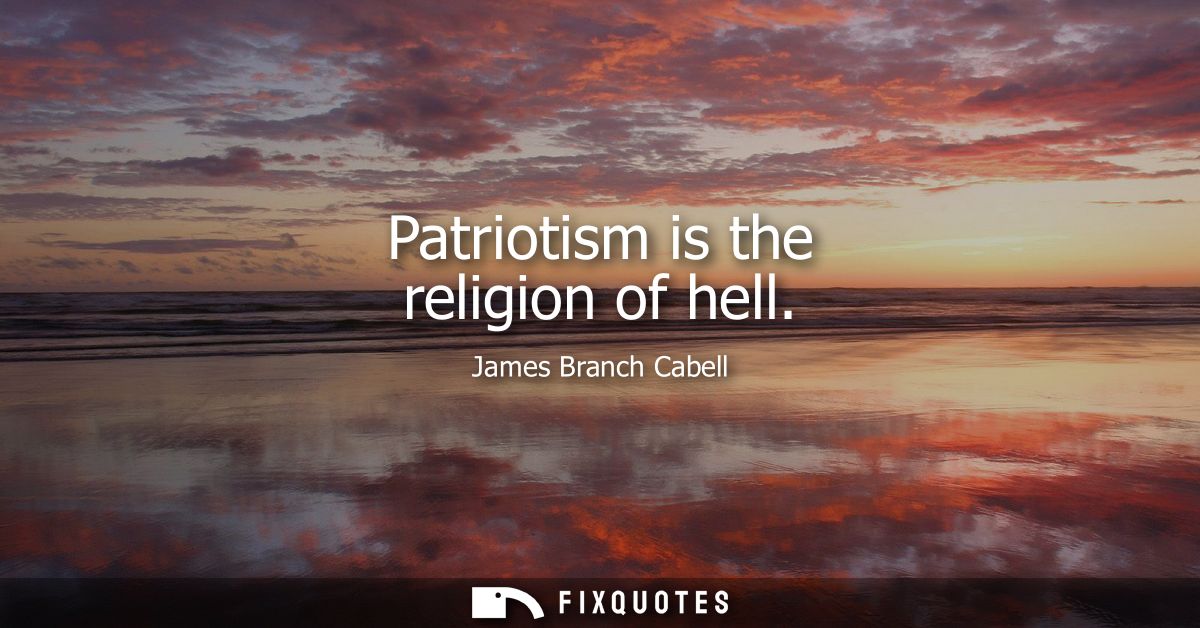
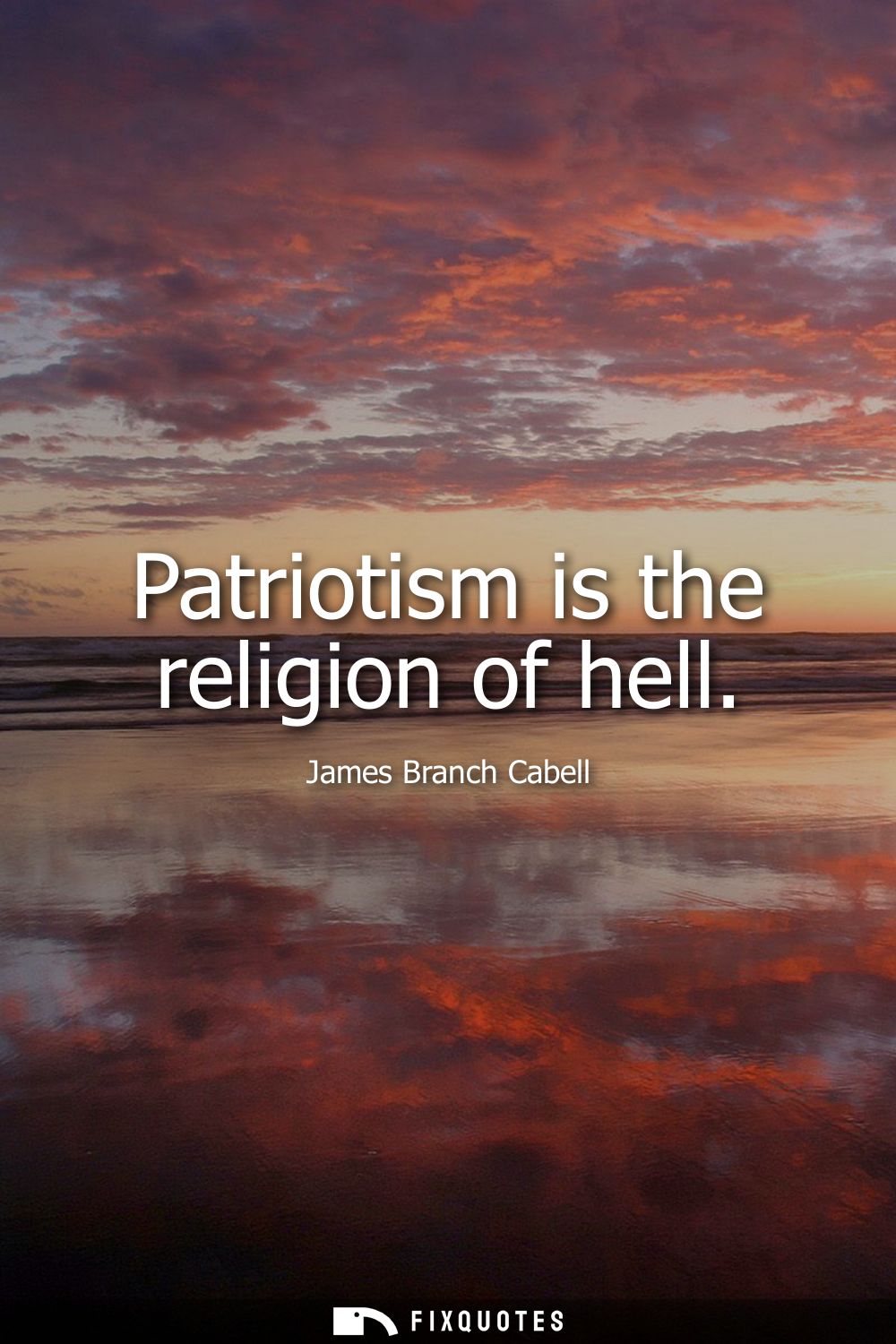
"Patriotism is the religion of hell"
About this Quote
Cabell’s line is a dagger disguised as a proverb: patriotism, he implies, doesn’t merely resemble religion - it behaves like the worst version of it. “Religion” is doing the heavy lifting here. It signals creed, ritual, purity tests, and the consolations that make people stop asking inconvenient questions. Add “of hell,” and Cabell flips the usual moral hierarchy. What’s commonly sold as noble devotion becomes a corrosive faith, one that sanctifies cruelty by laundering it as duty.
The intent isn’t to deny attachment to place or community; it’s to indict the way nationalism turns belonging into obedience. Cabell’s subtext is that patriotic fervor thrives on the same mechanics as authoritarian spirituality: an in-group promised meaning, an out-group branded as threat, and a story so totalizing it can justify almost anything. The phrase also smuggles in a warning about aesthetic seduction. Patriotic pageantry - flags, anthems, heroic myths - works precisely because it feels elevating, even when it’s recruiting you for moral compromise.
Context matters. Cabell wrote in an era when mass propaganda, world war, and the modern nation-state were tightening their grip on imagination. In the early 20th century, “patriotism” was increasingly a public performance, policed and monetized, with dissent framed as treason rather than conscience. His novelist’s instinct spots the narrative trick: once patriotism becomes a sacred story, it stops being an argument you can debate and becomes a belief you’re required to display. That’s when it starts to resemble hell - not fire and brimstone, but a closed system where questioning itself is the sin.
The intent isn’t to deny attachment to place or community; it’s to indict the way nationalism turns belonging into obedience. Cabell’s subtext is that patriotic fervor thrives on the same mechanics as authoritarian spirituality: an in-group promised meaning, an out-group branded as threat, and a story so totalizing it can justify almost anything. The phrase also smuggles in a warning about aesthetic seduction. Patriotic pageantry - flags, anthems, heroic myths - works precisely because it feels elevating, even when it’s recruiting you for moral compromise.
Context matters. Cabell wrote in an era when mass propaganda, world war, and the modern nation-state were tightening their grip on imagination. In the early 20th century, “patriotism” was increasingly a public performance, policed and monetized, with dissent framed as treason rather than conscience. His novelist’s instinct spots the narrative trick: once patriotism becomes a sacred story, it stops being an argument you can debate and becomes a belief you’re required to display. That’s when it starts to resemble hell - not fire and brimstone, but a closed system where questioning itself is the sin.
Quote Details
| Topic | War |
|---|---|
| Source | Help us find the source |
| Cite |
Citation Formats
APA Style (7th ed.)
Cabell, James Branch. (2026, January 15). Patriotism is the religion of hell. FixQuotes. https://fixquotes.com/quotes/patriotism-is-the-religion-of-hell-162042/
Chicago Style
Cabell, James Branch. "Patriotism is the religion of hell." FixQuotes. January 15, 2026. https://fixquotes.com/quotes/patriotism-is-the-religion-of-hell-162042/.
MLA Style (9th ed.)
"Patriotism is the religion of hell." FixQuotes, 15 Jan. 2026, https://fixquotes.com/quotes/patriotism-is-the-religion-of-hell-162042/. Accessed 27 Mar. 2026.
More Quotes by James
Add to List