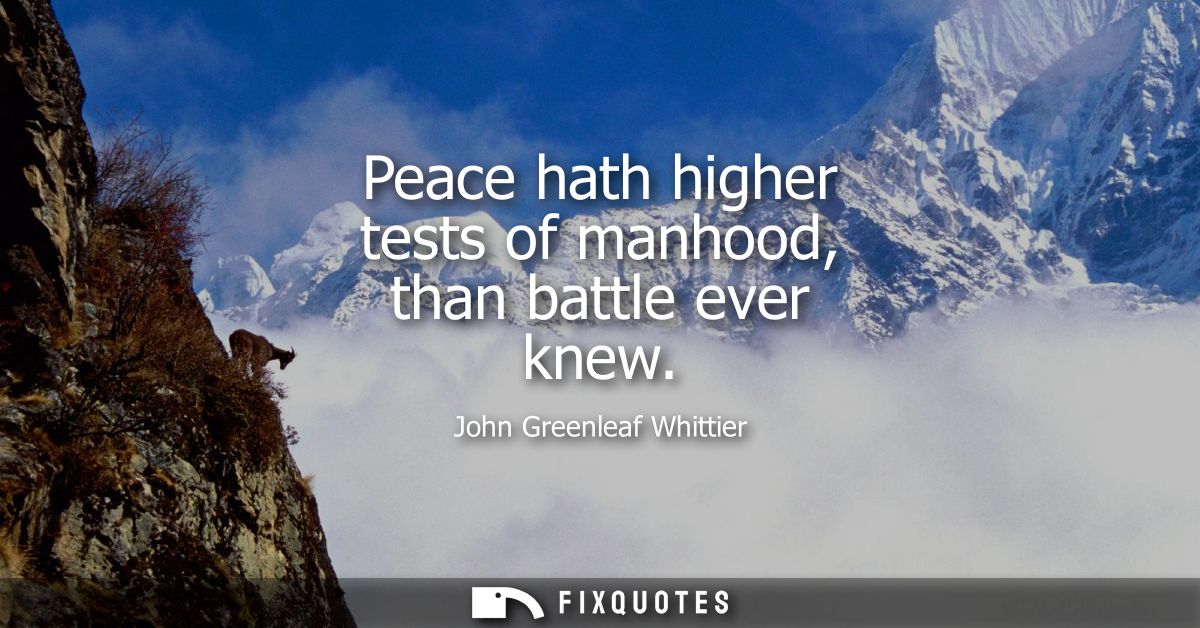
"Peace hath higher tests of manhood, than battle ever knew"
About this Quote
Whittier flips the usual Victorian valor math on its head: if you want to measure “manhood,” stop fetishizing the battlefield. The line lands because it treats war not as the supreme arena of courage but as a simplified one. Battle offers a script - clear enemies, adrenaline, public praise, a tidy story of heroism. Peace is messier. It demands endurance without spectacle, restraint when violence would be easier, and moral clarity when there’s no uniform to tell you who’s right.
The archaic “hath” and the almost legal phrasing (“higher tests”) aren’t decorative; they’re a rhetorical gambit. Whittier is claiming authority in the language of sermon and civic virtue, then using it to indict the culture that confuses masculinity with destruction. The word “tests” implies ongoing examination, not a single dramatic moment. Peace isn’t passive; it’s a long apprenticeship in self-governance.
Context sharpens the point. Whittier was a prominent Quaker-influenced abolitionist poet, writing in an America that repeatedly romanticized martial sacrifice while dodging the daily work of justice. Read against the 19th-century cult of honor, the line is quietly radical: the real bravery might be refusing vengeance, doing reconciliation, building institutions, freeing the enslaved, keeping faith with neighbors after the headlines move on.
The subtext is a dare. If masculinity is truly about strength, prove it where strength is least rewarded: in patience, civic responsibility, and the courage to live without an enemy.
The archaic “hath” and the almost legal phrasing (“higher tests”) aren’t decorative; they’re a rhetorical gambit. Whittier is claiming authority in the language of sermon and civic virtue, then using it to indict the culture that confuses masculinity with destruction. The word “tests” implies ongoing examination, not a single dramatic moment. Peace isn’t passive; it’s a long apprenticeship in self-governance.
Context sharpens the point. Whittier was a prominent Quaker-influenced abolitionist poet, writing in an America that repeatedly romanticized martial sacrifice while dodging the daily work of justice. Read against the 19th-century cult of honor, the line is quietly radical: the real bravery might be refusing vengeance, doing reconciliation, building institutions, freeing the enslaved, keeping faith with neighbors after the headlines move on.
The subtext is a dare. If masculinity is truly about strength, prove it where strength is least rewarded: in patience, civic responsibility, and the courage to live without an enemy.
Quote Details
| Topic | Peace |
|---|---|
| Source | Help us find the source |
| Cite |
Citation Formats
APA Style (7th ed.)
Whittier, John Greenleaf. (2026, January 16). Peace hath higher tests of manhood, than battle ever knew. FixQuotes. https://fixquotes.com/quotes/peace-hath-higher-tests-of-manhood-than-battle-106750/
Chicago Style
Whittier, John Greenleaf. "Peace hath higher tests of manhood, than battle ever knew." FixQuotes. January 16, 2026. https://fixquotes.com/quotes/peace-hath-higher-tests-of-manhood-than-battle-106750/.
MLA Style (9th ed.)
"Peace hath higher tests of manhood, than battle ever knew." FixQuotes, 16 Jan. 2026, https://fixquotes.com/quotes/peace-hath-higher-tests-of-manhood-than-battle-106750/. Accessed 4 Apr. 2026.
More Quotes by John
Add to List