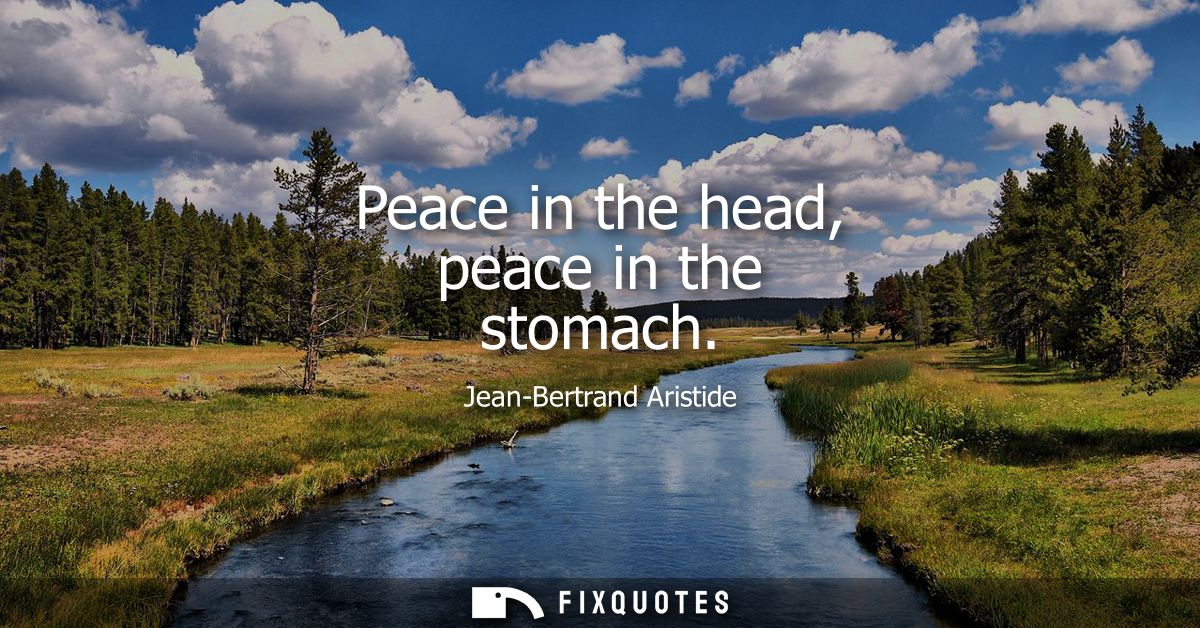
"Peace in the head, peace in the stomach"
About this Quote
Aristide’s line lands like a proverb, but it’s a political program in miniature. “Peace in the head, peace in the stomach” compresses the grand language of national reconciliation into two intimate, non-negotiable sites: the mind and the body. The phrasing is almost disarmingly plain. That’s the point. In a country where “peace” is often invoked by the powerful as a demand for quiet, Aristide reroutes the word toward human basics: psychological security and literal nourishment.
The subtext is a rebuke to performative stability. A ceasefire, an election, a photo-op with foreign dignitaries, none of it counts if people are still hungry or living with the constant dread that politics can turn violent overnight. “Head” signals more than calm; it hints at dignity, education, and the ability to imagine a future that isn’t just survival. “Stomach” drags the conversation back to material reality, where lofty rhetoric can’t hide empty shelves and wage precarity. The symmetry makes the two conditions mutually reinforcing: hunger breeds panic; panic fuels conflict; conflict worsens hunger. Peace, then, isn’t the absence of noise but the presence of conditions that make life livable.
Context matters. Aristide emerged from Haiti’s liberation theology tradition and a brutal cycle of coups, repression, and foreign pressure. In that landscape, the sentence functions as a moral claim against both domestic elites and international actors: don’t lecture Haitians about “order” while tolerating deprivation. It’s also populist in the best sense - measured in felt experience, not abstract metrics - insisting that any politics worthy of the name must feed bodies and settle minds.
The subtext is a rebuke to performative stability. A ceasefire, an election, a photo-op with foreign dignitaries, none of it counts if people are still hungry or living with the constant dread that politics can turn violent overnight. “Head” signals more than calm; it hints at dignity, education, and the ability to imagine a future that isn’t just survival. “Stomach” drags the conversation back to material reality, where lofty rhetoric can’t hide empty shelves and wage precarity. The symmetry makes the two conditions mutually reinforcing: hunger breeds panic; panic fuels conflict; conflict worsens hunger. Peace, then, isn’t the absence of noise but the presence of conditions that make life livable.
Context matters. Aristide emerged from Haiti’s liberation theology tradition and a brutal cycle of coups, repression, and foreign pressure. In that landscape, the sentence functions as a moral claim against both domestic elites and international actors: don’t lecture Haitians about “order” while tolerating deprivation. It’s also populist in the best sense - measured in felt experience, not abstract metrics - insisting that any politics worthy of the name must feed bodies and settle minds.
Quote Details
| Topic | Peace |
|---|---|
| Source | Help us find the source |
| Cite |
Citation Formats
APA Style (7th ed.)
Aristide, Jean-Bertrand. (2026, January 15). Peace in the head, peace in the stomach. FixQuotes. https://fixquotes.com/quotes/peace-in-the-head-peace-in-the-stomach-50615/
Chicago Style
Aristide, Jean-Bertrand. "Peace in the head, peace in the stomach." FixQuotes. January 15, 2026. https://fixquotes.com/quotes/peace-in-the-head-peace-in-the-stomach-50615/.
MLA Style (9th ed.)
"Peace in the head, peace in the stomach." FixQuotes, 15 Jan. 2026, https://fixquotes.com/quotes/peace-in-the-head-peace-in-the-stomach-50615/. Accessed 3 Apr. 2026.
More Quotes by Jean-Bertrand
Add to List