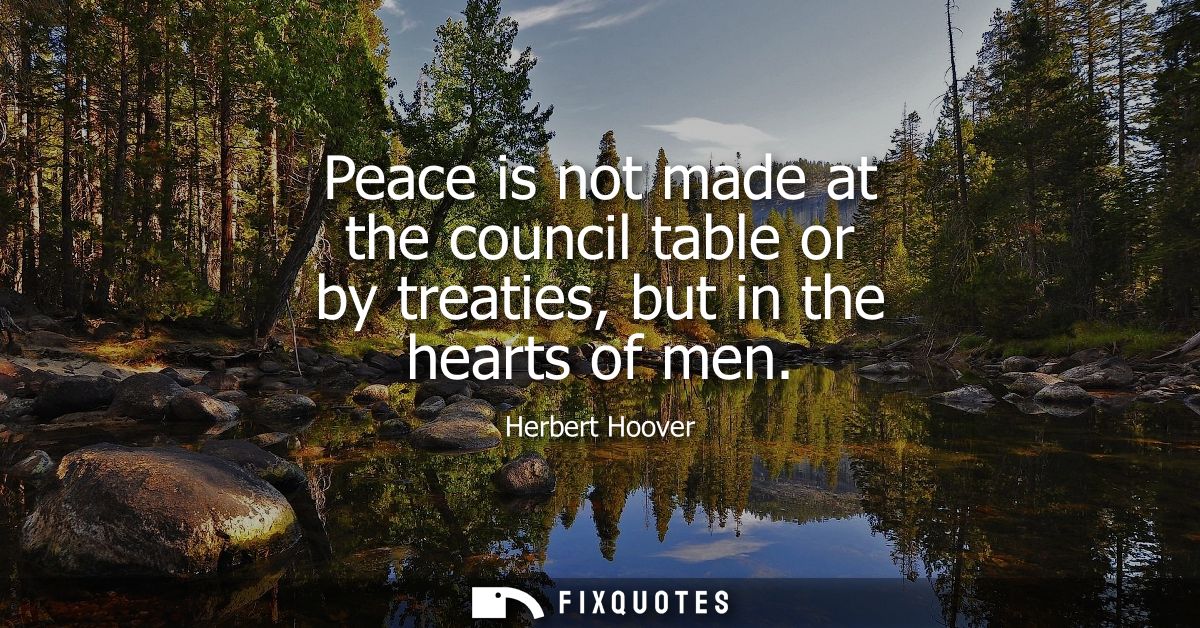
"Peace is not made at the council table or by treaties, but in the hearts of men"
About this Quote
The intent is partly moral and partly defensive. Hoover governed in the long shadow of World War I, when “peace” had been heavily engineered at Versailles and then visibly unraveled into economic nationalism and political extremism. By the time he’s making this claim, the interwar faith in expert negotiation had taken a beating. His subtext: don’t mistake procedure for legitimacy, and don’t outsource responsibility to diplomats. If ordinary people are primed for revenge or panic, leaders will eventually follow, treaty or no treaty.
It’s also a subtle rebuke to the idea that peace is a product you can manufacture with the right conference and the right clause. The line flatters democratic agency (the hearts of men) while issuing a warning about mass emotion as a geopolitical force. Hoover isn’t denying the value of treaties; he’s demoting them to what they really are: brittle scaffolding unless the public appetite for coexistence is already there.
Quote Details
| Topic | Peace |
|---|---|
| Source | Help us find the source |
| Cite |
Citation Formats
APA Style (7th ed.)
Hoover, Herbert. (2026, January 15). Peace is not made at the council table or by treaties, but in the hearts of men. FixQuotes. https://fixquotes.com/quotes/peace-is-not-made-at-the-council-table-or-by-19990/
Chicago Style
Hoover, Herbert. "Peace is not made at the council table or by treaties, but in the hearts of men." FixQuotes. January 15, 2026. https://fixquotes.com/quotes/peace-is-not-made-at-the-council-table-or-by-19990/.
MLA Style (9th ed.)
"Peace is not made at the council table or by treaties, but in the hearts of men." FixQuotes, 15 Jan. 2026, https://fixquotes.com/quotes/peace-is-not-made-at-the-council-table-or-by-19990/. Accessed 19 Mar. 2026.