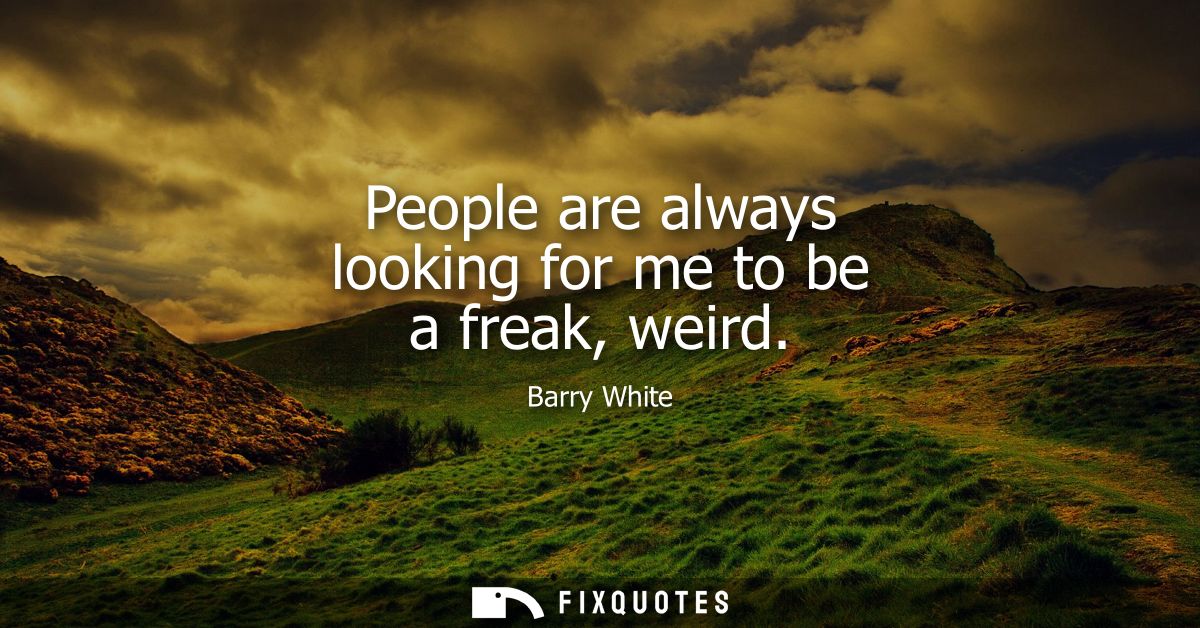
"People are always looking for me to be a freak, weird"
About this Quote
Barry White’s voice sold an image: velvet-deep, slow-burning, unmistakably sensual. That’s why this line lands with a weary bite. When he says people are “always looking for me to be a freak,” he’s pushing back against the way celebrity flattens a person into a consumable kink or caricature. The public doesn’t just want the music; it wants a storyline that explains the music, preferably one that’s lurid enough to feel like backstage access.
“Freak, weird” isn’t random phrasing. It’s the language of spectatorship, the same vibe that turns difference into entertainment and intimacy into evidence. White was a big man with a larger-than-life sound, and in American pop culture that combination often invites a particular kind of scrutiny: jokes about bodies, assumptions about sexuality, and a hunger for “what he must be like” offstage. The subtext is exhaustion at being treated less like an artist and more like a punchline or a fantasy prop.
There’s also a strategic clarity here. White refuses to over-explain. He doesn’t defend himself with details, which would only feed the voyeurism. He names the mechanism instead: people are “looking” for it. That verb matters. It implies the weirdness isn’t discovered; it’s assigned. In an era that loved his romance anthems but often mocked their earnestness, this sentence reads like a quiet boundary. Let the songs be lush and theatrical. The man doesn’t have to be.
“Freak, weird” isn’t random phrasing. It’s the language of spectatorship, the same vibe that turns difference into entertainment and intimacy into evidence. White was a big man with a larger-than-life sound, and in American pop culture that combination often invites a particular kind of scrutiny: jokes about bodies, assumptions about sexuality, and a hunger for “what he must be like” offstage. The subtext is exhaustion at being treated less like an artist and more like a punchline or a fantasy prop.
There’s also a strategic clarity here. White refuses to over-explain. He doesn’t defend himself with details, which would only feed the voyeurism. He names the mechanism instead: people are “looking” for it. That verb matters. It implies the weirdness isn’t discovered; it’s assigned. In an era that loved his romance anthems but often mocked their earnestness, this sentence reads like a quiet boundary. Let the songs be lush and theatrical. The man doesn’t have to be.
Quote Details
| Topic | Music |
|---|---|
| Source | Help us find the source |
| Cite |
Citation Formats
APA Style (7th ed.)
White, Barry. (2026, January 16). People are always looking for me to be a freak, weird. FixQuotes. https://fixquotes.com/quotes/people-are-always-looking-for-me-to-be-a-freak-123188/
Chicago Style
White, Barry. "People are always looking for me to be a freak, weird." FixQuotes. January 16, 2026. https://fixquotes.com/quotes/people-are-always-looking-for-me-to-be-a-freak-123188/.
MLA Style (9th ed.)
"People are always looking for me to be a freak, weird." FixQuotes, 16 Jan. 2026, https://fixquotes.com/quotes/people-are-always-looking-for-me-to-be-a-freak-123188/. Accessed 31 Mar. 2026.
More Quotes by Barry
Add to List