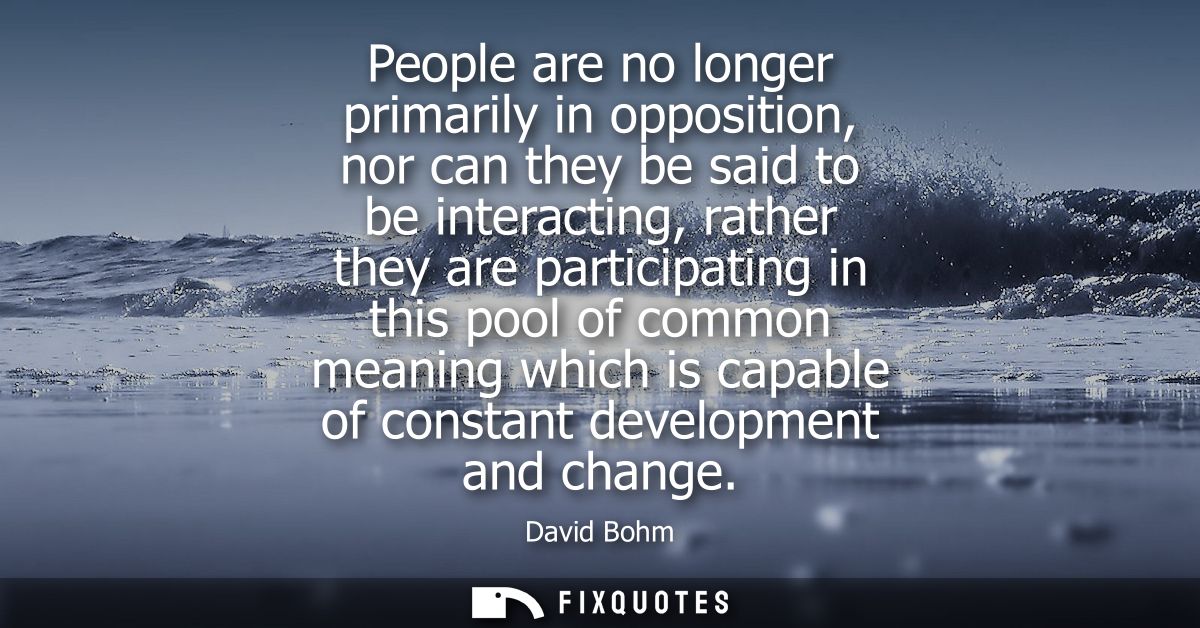
"People are no longer primarily in opposition, nor can they be said to be interacting, rather, they are participating in this pool of common meaning which is capable of constant development and change"
About this Quote
The phrase “pool of common meaning” does a lot of work. It implies that what we think of as private opinion is mostly a local eddy in a larger current made of language, habits, symbols, and assumptions. That’s the subtext: conflict is often not about facts but about incompatible frames, and those frames are socially produced. If meaning is pooled, then it can be polluted (by propaganda, ideology, bad faith) or clarified (by dialogue). Bohm isn’t offering feel-good collectivism; he’s warning that the “common” is unavoidable, and therefore worth tending.
Context matters: Bohm spent decades thinking about wholeness in physics and fragmentation in thought, especially in his work on dialogue. The line reads like a scientist applying systems thinking to culture. “Capable of constant development and change” is the hopeful hinge. Meaning isn’t a fixed code to decode; it’s a living environment. That’s why the quote works: it reframes social life from a debate to be scored into an ecosystem to be cultivated, where the most radical move is to notice the water you’re already swimming in.
Quote Details
| Topic | Deep |
|---|---|
| Source | Help us find the source |
| Cite |
Citation Formats
APA Style (7th ed.)
Bohm, David. (2026, February 18). People are no longer primarily in opposition, nor can they be said to be interacting, rather, they are participating in this pool of common meaning which is capable of constant development and change. FixQuotes. https://fixquotes.com/quotes/people-are-no-longer-primarily-in-opposition-nor-58245/
Chicago Style
Bohm, David. "People are no longer primarily in opposition, nor can they be said to be interacting, rather, they are participating in this pool of common meaning which is capable of constant development and change." FixQuotes. February 18, 2026. https://fixquotes.com/quotes/people-are-no-longer-primarily-in-opposition-nor-58245/.
MLA Style (9th ed.)
"People are no longer primarily in opposition, nor can they be said to be interacting, rather, they are participating in this pool of common meaning which is capable of constant development and change." FixQuotes, 18 Feb. 2026, https://fixquotes.com/quotes/people-are-no-longer-primarily-in-opposition-nor-58245/. Accessed 31 Mar. 2026.