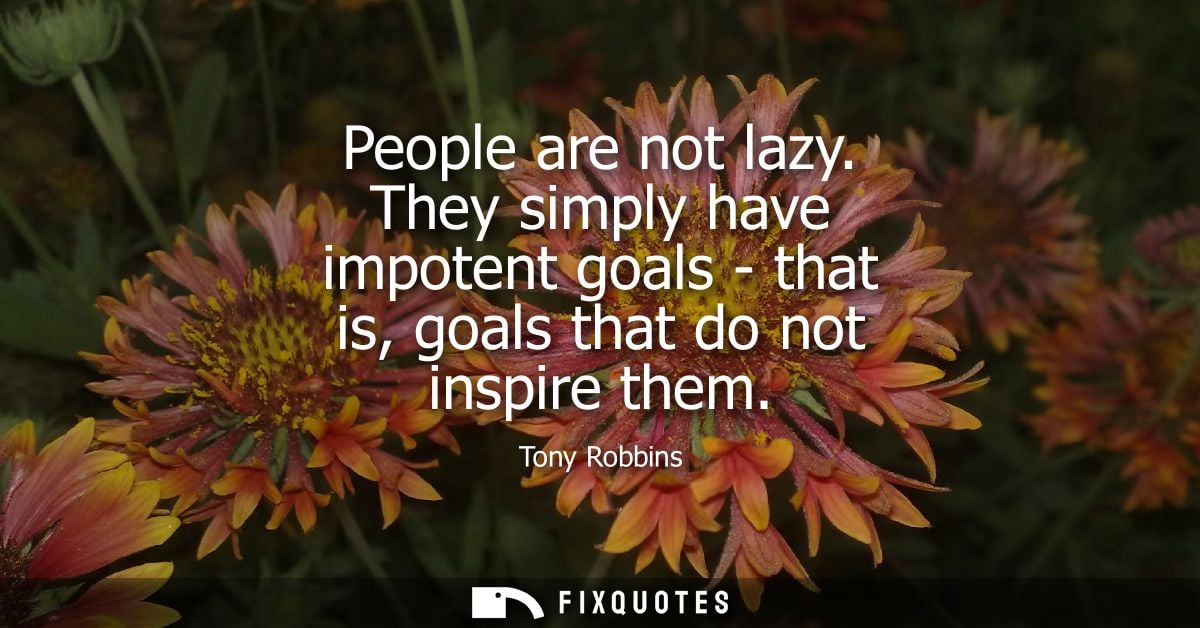
"People are not lazy. They simply have impotent goals - that is, goals that do not inspire them"
About this Quote
The specific intent is practical and strategic: replace vague, externally assigned aims ("I should work out", "I should hustle") with goals that have emotional heat and personal stakes. Robbins has always framed behavior as downstream from identity and feeling, not willpower alone. This quote condenses his broader pitch: motivation is engineered. If the internal reward is weak, the behavior won’t stick, so stop trying to white-knuckle your way through it.
The subtext is classic American self-optimization with a softer edge. It absolves you of "laziness" but keeps responsibility squarely on your shoulders: if you’re stuck, redesign your desires. It also quietly dismisses structural constraints by focusing on inspiration as the missing ingredient, a move that plays well in a culture that prefers actionable psychology over messy economics.
Contextually, it fits the late-20th-century boom in motivational entrepreneurship: therapy language repackaged as performance language, with inspiration as both diagnosis and product.
Quote Details
| Topic | Goal Setting |
|---|---|
| Source | Help us find the source |
| Cite |
Citation Formats
APA Style (7th ed.)
Robbins, Tony. (2026, January 17). People are not lazy. They simply have impotent goals - that is, goals that do not inspire them. FixQuotes. https://fixquotes.com/quotes/people-are-not-lazy-they-simply-have-impotent-28707/
Chicago Style
Robbins, Tony. "People are not lazy. They simply have impotent goals - that is, goals that do not inspire them." FixQuotes. January 17, 2026. https://fixquotes.com/quotes/people-are-not-lazy-they-simply-have-impotent-28707/.
MLA Style (9th ed.)
"People are not lazy. They simply have impotent goals - that is, goals that do not inspire them." FixQuotes, 17 Jan. 2026, https://fixquotes.com/quotes/people-are-not-lazy-they-simply-have-impotent-28707/. Accessed 4 Apr. 2026.