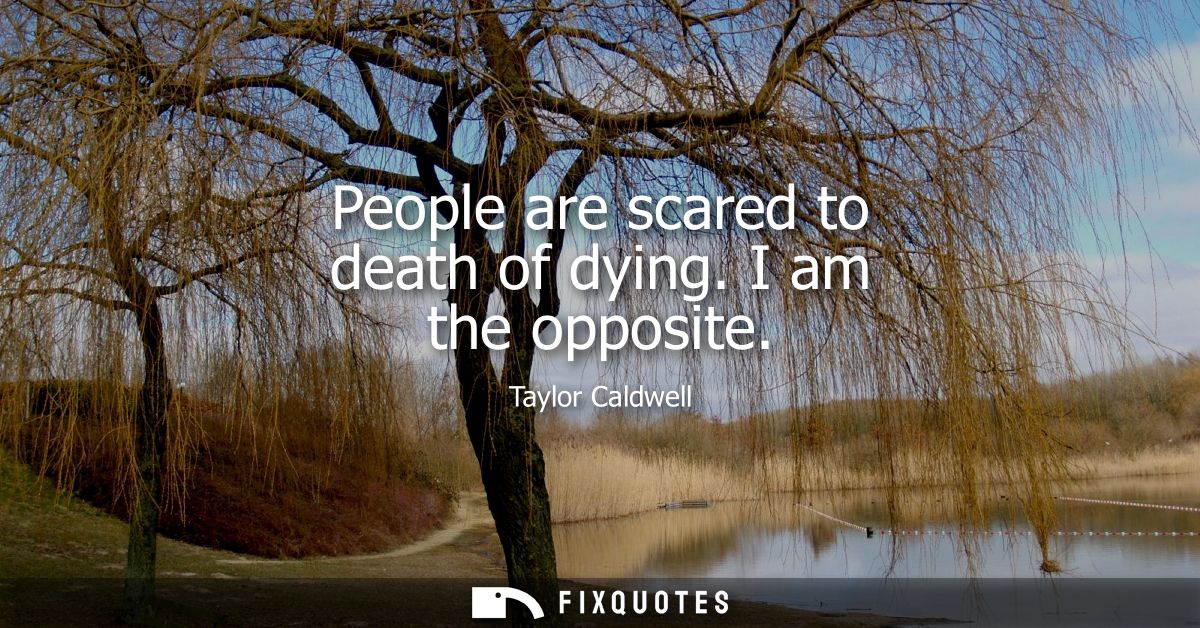
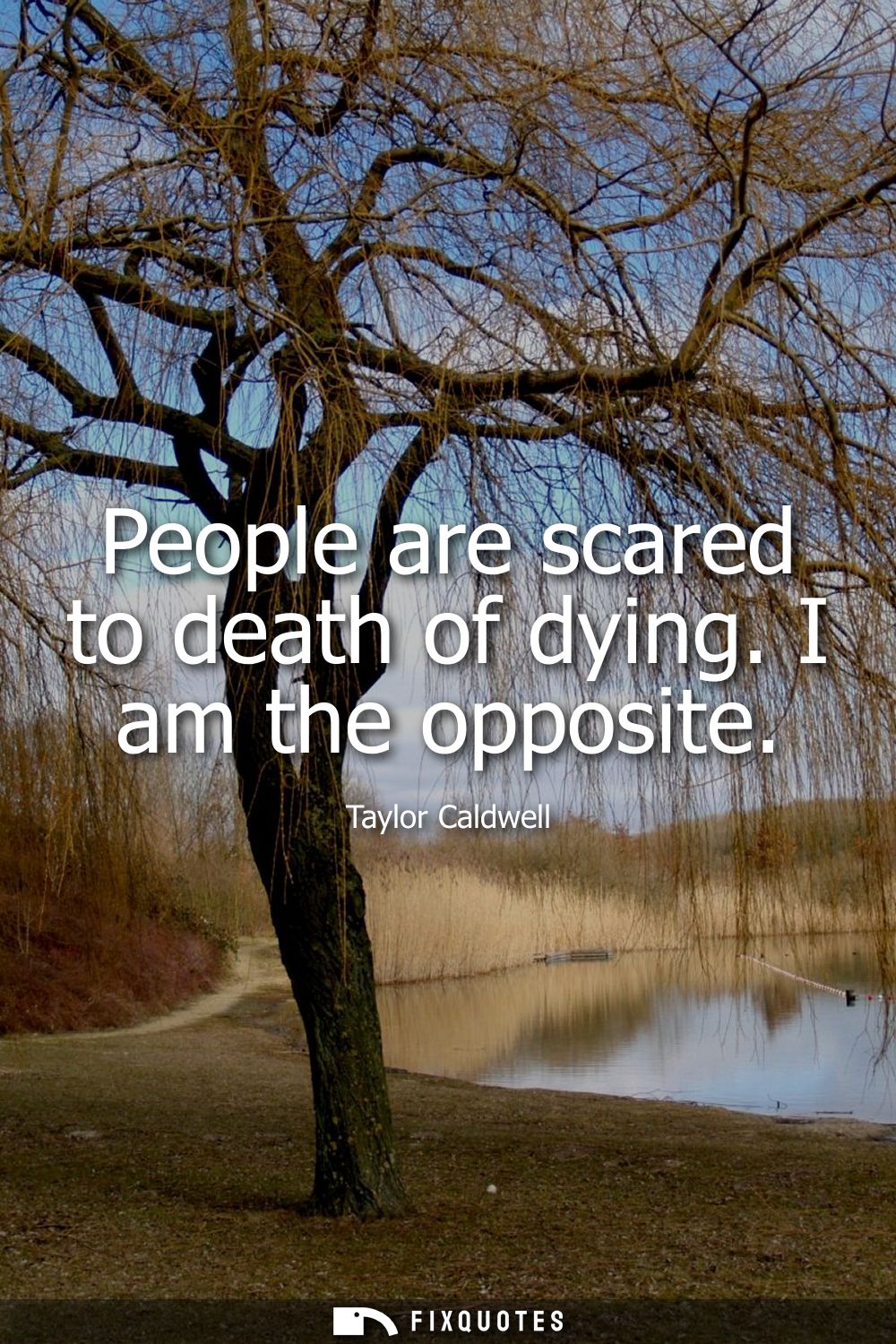
"People are scared to death of dying. I am the opposite"
About this Quote
“People are scared to death of dying. I am the opposite” is a clean little paradox that does two jobs at once: it punctures a common social posture and it stages Caldwell as a deliberate outlier. The first clause isn’t just an observation, it’s a diagnosis of modern behavior. Fear of death becomes the background radiation of daily life - shaping politics, religion, consumerism, even politeness - because it’s the one anxiety you can’t argue out of. Caldwell’s phrasing (“scared to death”) slyly borrows a cliché built on the very thing it claims to describe, letting language betray the obsession.
Then comes the pivot: “I am the opposite.” No explanation, no memoir-ish softening. The bluntness is the point. Caldwell isn’t merely claiming bravery; she’s claiming a different orientation to existence, one that refuses the cultural script where death is treated as the ultimate failure and youth as a moral duty. As a 20th-century popular novelist who wrote sweeping historical and spiritual dramas, she’s also signaling a writer’s intimacy with mortality: fiction trains you to inhabit endings, to watch characters move toward consequences. There’s a professional subtext here: someone who spends her life constructing lives may feel less mystified by their closure.
The line’s power is its audacity. It dares the reader to ask whether fear of death is “natural,” or just well-trained. By presenting fear as the norm and her stance as the reversal, Caldwell invites a more unsettling possibility: maybe the opposite of fearing death isn’t recklessness, but clarity.
Then comes the pivot: “I am the opposite.” No explanation, no memoir-ish softening. The bluntness is the point. Caldwell isn’t merely claiming bravery; she’s claiming a different orientation to existence, one that refuses the cultural script where death is treated as the ultimate failure and youth as a moral duty. As a 20th-century popular novelist who wrote sweeping historical and spiritual dramas, she’s also signaling a writer’s intimacy with mortality: fiction trains you to inhabit endings, to watch characters move toward consequences. There’s a professional subtext here: someone who spends her life constructing lives may feel less mystified by their closure.
The line’s power is its audacity. It dares the reader to ask whether fear of death is “natural,” or just well-trained. By presenting fear as the norm and her stance as the reversal, Caldwell invites a more unsettling possibility: maybe the opposite of fearing death isn’t recklessness, but clarity.
Quote Details
| Topic | Mortality |
|---|---|
| Source | Help us find the source |
| Cite |
Citation Formats
APA Style (7th ed.)
Caldwell, Taylor. (2026, January 16). People are scared to death of dying. I am the opposite. FixQuotes. https://fixquotes.com/quotes/people-are-scared-to-death-of-dying-i-am-the-117341/
Chicago Style
Caldwell, Taylor. "People are scared to death of dying. I am the opposite." FixQuotes. January 16, 2026. https://fixquotes.com/quotes/people-are-scared-to-death-of-dying-i-am-the-117341/.
MLA Style (9th ed.)
"People are scared to death of dying. I am the opposite." FixQuotes, 16 Jan. 2026, https://fixquotes.com/quotes/people-are-scared-to-death-of-dying-i-am-the-117341/. Accessed 3 Apr. 2026.
More Quotes by Taylor
Add to List