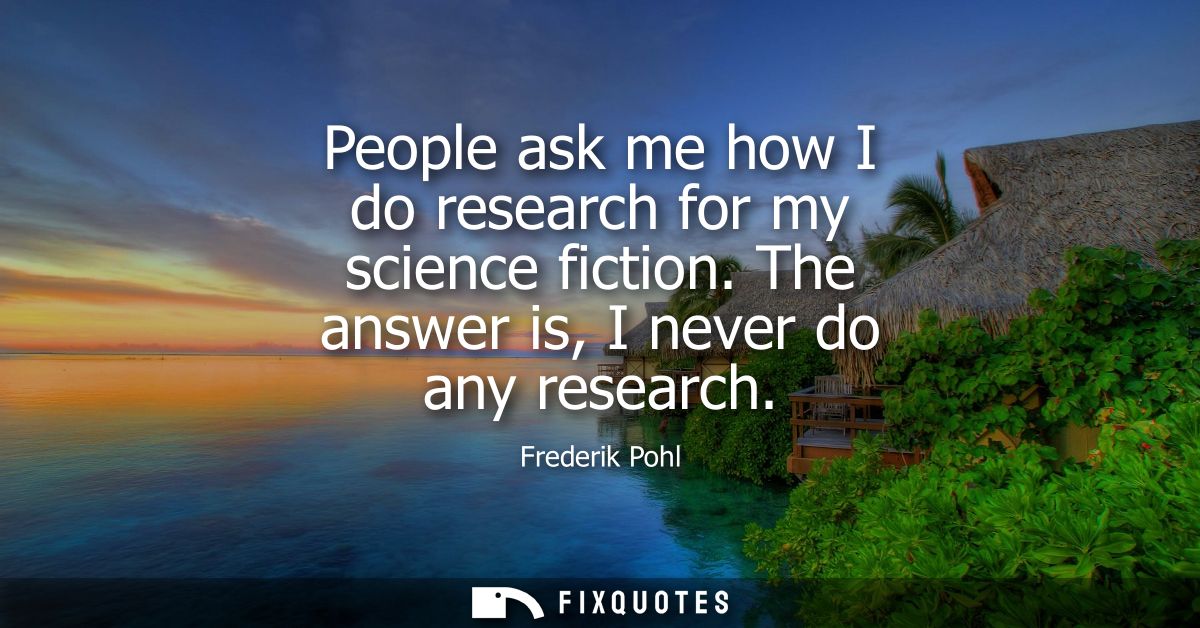
"People ask me how I do research for my science fiction. The answer is, I never do any research"
About this Quote
The intent is to puncture a particular kind of readerly flattery. When people ask about research, they’re often complimenting the author for sounding smart. Pohl refuses the compliment and, in doing so, reasserts where the craft actually lives: in extrapolation, not encyclopedia. The subtext is almost a writer’s manifesto: science fiction isn’t a branch of technical writing, and “accuracy” is not the same as insight. You can research orbital mechanics and still miss the point if you don’t understand how fear, greed, boredom, and bureaucracy behave under pressure.
There’s also a tactical modesty here. By denying research, Pohl sidesteps the expectation of prediction. He’s not claiming to foresee the future; he’s admitting he’s building parables with futuristic props. The cynicism is gentle but real: audiences want the science to certify the fiction, and Pohl is telling them the real engine is imagination disciplined by lived knowledge of people.
Quote Details
| Topic | Writing |
|---|---|
| Source | Help us find the source |
| Cite |
Citation Formats
APA Style (7th ed.)
Pohl, Frederik. (2026, January 17). People ask me how I do research for my science fiction. The answer is, I never do any research. FixQuotes. https://fixquotes.com/quotes/people-ask-me-how-i-do-research-for-my-science-46509/
Chicago Style
Pohl, Frederik. "People ask me how I do research for my science fiction. The answer is, I never do any research." FixQuotes. January 17, 2026. https://fixquotes.com/quotes/people-ask-me-how-i-do-research-for-my-science-46509/.
MLA Style (9th ed.)
"People ask me how I do research for my science fiction. The answer is, I never do any research." FixQuotes, 17 Jan. 2026, https://fixquotes.com/quotes/people-ask-me-how-i-do-research-for-my-science-46509/. Accessed 4 Apr. 2026.