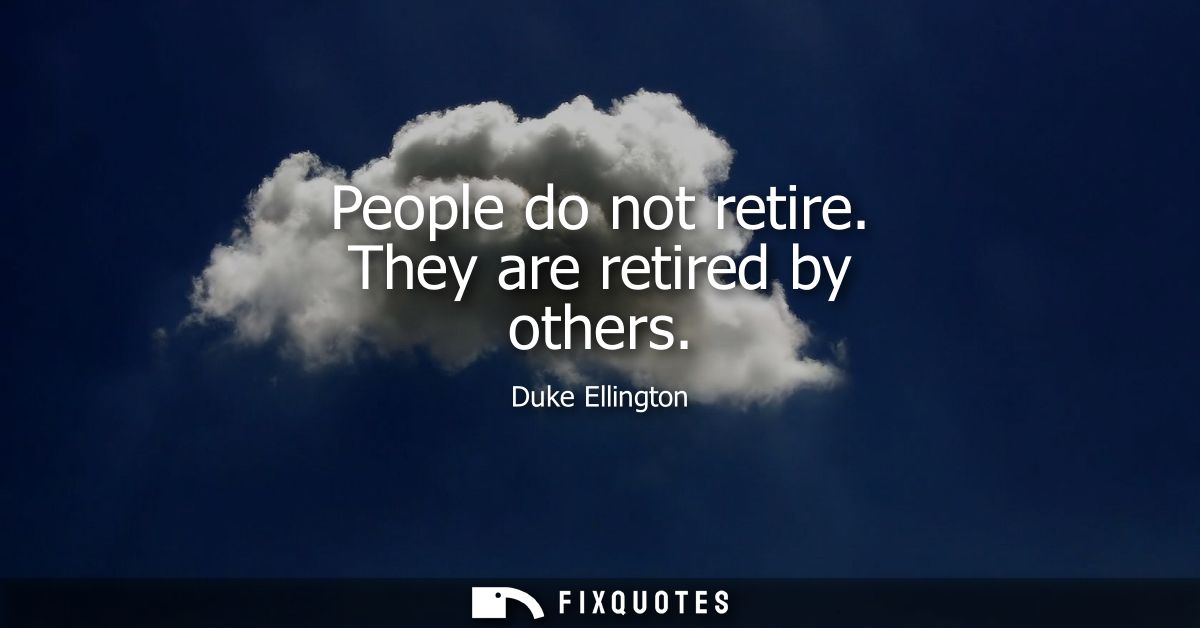
"People do not retire. They are retired by others"
About this Quote
Retirement, in Duke Ellington's framing, isn’t a personal milestone so much as a social eviction notice. The line flips the usual story - that one day you choose rest, clock out gracefully, and fade into leisure - into something colder: institutions decide you’re done, audiences move on, employers rewrite the roster, the culture reassigns your value. The passive construction matters. “They are retired” makes the person an object acted upon, not the author of their own exit.
Coming from a bandleader who lived by touring, negotiating, and constantly reinventing a sound, the quote reads like both warning and self-defense. Ellington worked in an industry where age could be coded as irrelevance, and where Black artists were often celebrated in the abstract while being denied control over their careers in practice. “Retired by others” hints at gatekeeping: managers, labels, venue owners, critics - the whole apparatus that can quietly stop returning your calls. It also gestures at the audience’s power to “retire” you with indifference.
There’s pride tucked inside the cynicism. Ellington implies that real creators don’t naturally stop; they’re stopped. It’s a musician’s version of refusing the sentimental narrative of the victory lap. The subtext is almost combative: if you’re still making work that matters, why should someone else get to declare the ending? In an era obsessed with productivity metrics and “aging out,” Ellington’s line lands as a reminder that retirement is often less about desire than disposability.
Coming from a bandleader who lived by touring, negotiating, and constantly reinventing a sound, the quote reads like both warning and self-defense. Ellington worked in an industry where age could be coded as irrelevance, and where Black artists were often celebrated in the abstract while being denied control over their careers in practice. “Retired by others” hints at gatekeeping: managers, labels, venue owners, critics - the whole apparatus that can quietly stop returning your calls. It also gestures at the audience’s power to “retire” you with indifference.
There’s pride tucked inside the cynicism. Ellington implies that real creators don’t naturally stop; they’re stopped. It’s a musician’s version of refusing the sentimental narrative of the victory lap. The subtext is almost combative: if you’re still making work that matters, why should someone else get to declare the ending? In an era obsessed with productivity metrics and “aging out,” Ellington’s line lands as a reminder that retirement is often less about desire than disposability.
Quote Details
| Topic | Retirement |
|---|---|
| Source | Help us find the source |
| Cite |
Citation Formats
APA Style (7th ed.)
Ellington, Duke. (2026, January 16). People do not retire. They are retired by others. FixQuotes. https://fixquotes.com/quotes/people-do-not-retire-they-are-retired-by-others-100133/
Chicago Style
Ellington, Duke. "People do not retire. They are retired by others." FixQuotes. January 16, 2026. https://fixquotes.com/quotes/people-do-not-retire-they-are-retired-by-others-100133/.
MLA Style (9th ed.)
"People do not retire. They are retired by others." FixQuotes, 16 Jan. 2026, https://fixquotes.com/quotes/people-do-not-retire-they-are-retired-by-others-100133/. Accessed 31 Mar. 2026.
More Quotes by Duke
Add to List