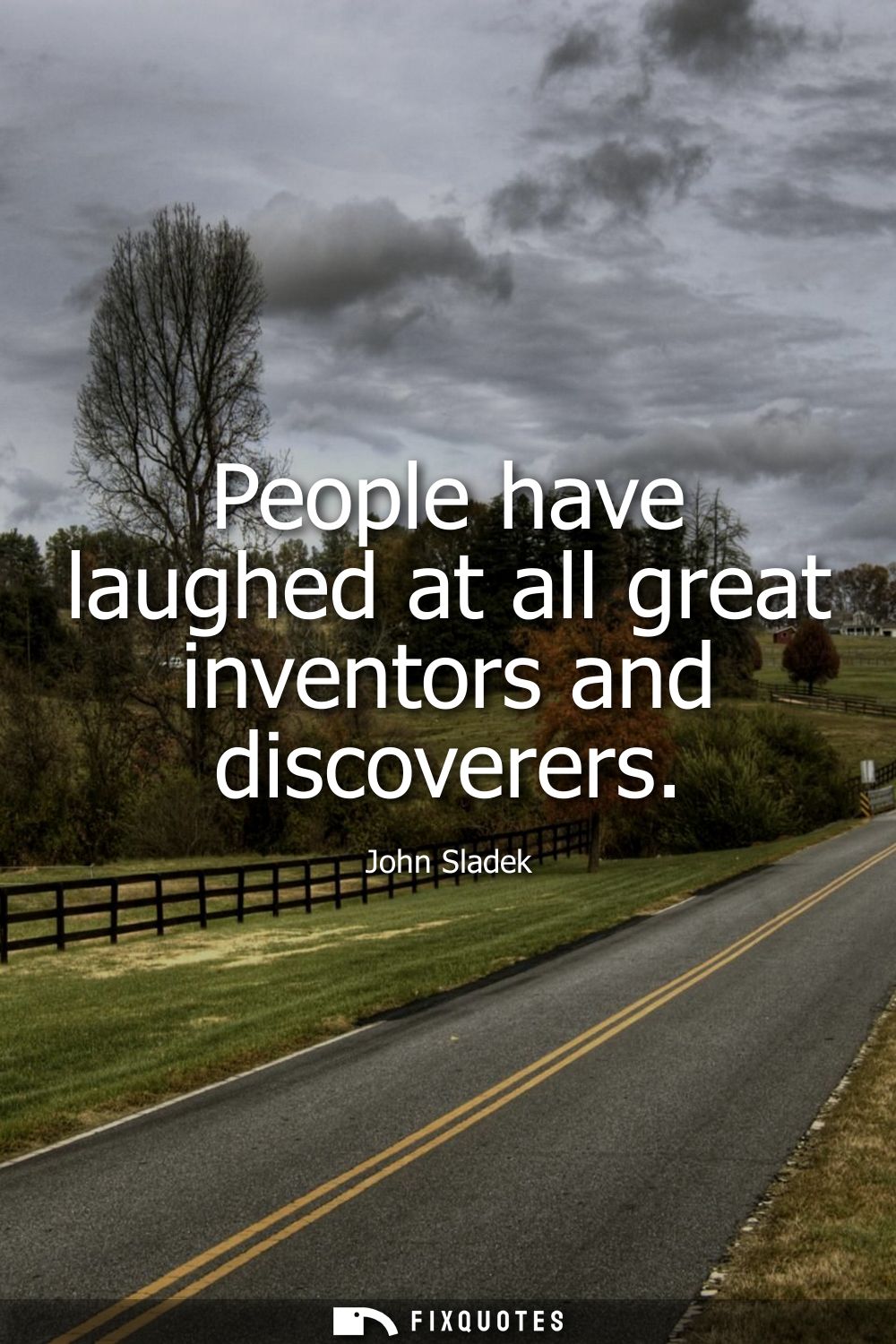
"People have laughed at all great inventors and discoverers"
About this Quote
Progress doesn’t just arrive; it gets heckled on the way in. John Sladek’s line lands with the dry confidence of a writer who knows that ridicule is one of society’s most reliable immune responses to novelty. “People have laughed” isn’t merely observation - it’s indictment. The subject isn’t the inventor at all, but the crowd: a plural, faceless public reflexively protecting the status quo with the cheapest weapon available, contempt.
Sladek’s intent is double-edged. On the surface, it’s consoling: if they’re laughing, you might be onto something. Underneath, it’s a warning about how culture polices its boundaries. Laughter functions as social triage: it marks certain ideas as unserious before they can become dangerous, expensive, or morally demanding. That’s why “all great” is hyperbolic in a strategic way. It’s not a statistical claim; it’s a rhetorical shove, daring you to see mockery as a pattern rather than an exception.
Context matters: Sladek came out of a 20th-century science-fiction tradition that distrusted techno-utopian hero myths while still being fascinated by them. The line reads like it’s aimed at both cranks and geniuses, because the same scorn greets each at first glance. The subtext: don’t mistake persecution for proof, but don’t mistake consensus for intelligence either. In a media environment where dismissal travels faster than understanding, being laughed at becomes less an anomaly than a predictable stage of the innovation lifecycle.
Sladek’s intent is double-edged. On the surface, it’s consoling: if they’re laughing, you might be onto something. Underneath, it’s a warning about how culture polices its boundaries. Laughter functions as social triage: it marks certain ideas as unserious before they can become dangerous, expensive, or morally demanding. That’s why “all great” is hyperbolic in a strategic way. It’s not a statistical claim; it’s a rhetorical shove, daring you to see mockery as a pattern rather than an exception.
Context matters: Sladek came out of a 20th-century science-fiction tradition that distrusted techno-utopian hero myths while still being fascinated by them. The line reads like it’s aimed at both cranks and geniuses, because the same scorn greets each at first glance. The subtext: don’t mistake persecution for proof, but don’t mistake consensus for intelligence either. In a media environment where dismissal travels faster than understanding, being laughed at becomes less an anomaly than a predictable stage of the innovation lifecycle.
Quote Details
| Topic | Perseverance |
|---|---|
| Source | Help us find the source |
| Cite |
Citation Formats
APA Style (7th ed.)
Sladek, John. (2026, January 17). People have laughed at all great inventors and discoverers. FixQuotes. https://fixquotes.com/quotes/people-have-laughed-at-all-great-inventors-and-79856/
Chicago Style
Sladek, John. "People have laughed at all great inventors and discoverers." FixQuotes. January 17, 2026. https://fixquotes.com/quotes/people-have-laughed-at-all-great-inventors-and-79856/.
MLA Style (9th ed.)
"People have laughed at all great inventors and discoverers." FixQuotes, 17 Jan. 2026, https://fixquotes.com/quotes/people-have-laughed-at-all-great-inventors-and-79856/. Accessed 8 Apr. 2026.
More Quotes by John
Add to List