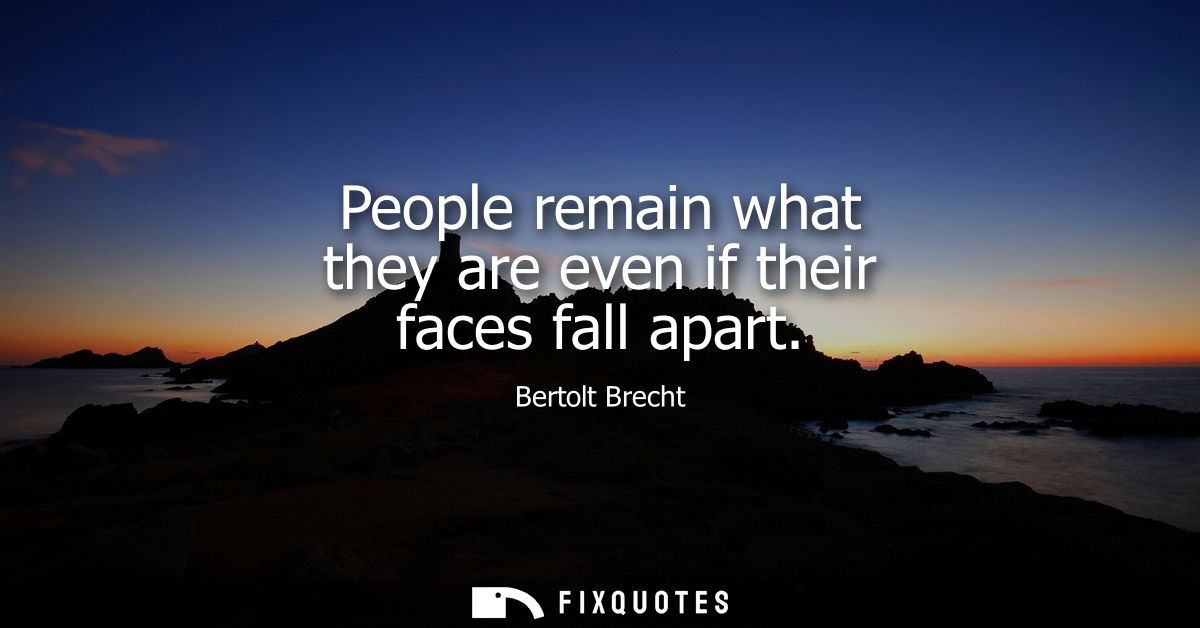
"People remain what they are even if their faces fall apart"
About this Quote
A face falling apart is grotesque on purpose: Brecht wants the reader to feel the body as a mask, and to feel the mask fail. The line lands with the blunt, stage-lit cruelty of his theater, where sentiment is suspect and psychology is less interesting than behavior under pressure. Strip away the comforting idea that identity lives in expression, beauty, or social legibility and you get Brecht's harder claim: character is not cosmetics. It's conduct, allegiance, habit, class position. Even when the surface collapses, the person - and the role they play in the world - persists.
The subtext is political. Brecht wrote in a century that watched faces literally "fall apart": trench warfare, industrial accidents, hunger, bombings, exile. But he's also aiming at a moral disfigurement that doesn't show up in photographs. The bourgeois faith that beneath every person is a private, redeemable self gets punctured; what remains is the social self, forged by material conditions and revealed in crisis. A collaborator doesn't become brave because time has been cruel to their skin. A petty tyrant doesn't get absolved by age.
There's irony in the austerity. Brecht, a poet, could have reached for metaphor that softens the blow. Instead he chooses a near-clinical image that refuses consolation. It's a reminder to judge less by the theater of faces - charisma, civility, the curated front - and more by what people do when the props burn down. In Brecht's world, the mask is never the mystery; the machinery behind it is.
The subtext is political. Brecht wrote in a century that watched faces literally "fall apart": trench warfare, industrial accidents, hunger, bombings, exile. But he's also aiming at a moral disfigurement that doesn't show up in photographs. The bourgeois faith that beneath every person is a private, redeemable self gets punctured; what remains is the social self, forged by material conditions and revealed in crisis. A collaborator doesn't become brave because time has been cruel to their skin. A petty tyrant doesn't get absolved by age.
There's irony in the austerity. Brecht, a poet, could have reached for metaphor that softens the blow. Instead he chooses a near-clinical image that refuses consolation. It's a reminder to judge less by the theater of faces - charisma, civility, the curated front - and more by what people do when the props burn down. In Brecht's world, the mask is never the mystery; the machinery behind it is.
Quote Details
| Topic | Truth |
|---|---|
| Source | Help us find the source |
| Cite |
Citation Formats
APA Style (7th ed.)
Brecht, Bertolt. (2026, January 18). People remain what they are even if their faces fall apart. FixQuotes. https://fixquotes.com/quotes/people-remain-what-they-are-even-if-their-faces-7992/
Chicago Style
Brecht, Bertolt. "People remain what they are even if their faces fall apart." FixQuotes. January 18, 2026. https://fixquotes.com/quotes/people-remain-what-they-are-even-if-their-faces-7992/.
MLA Style (9th ed.)
"People remain what they are even if their faces fall apart." FixQuotes, 18 Jan. 2026, https://fixquotes.com/quotes/people-remain-what-they-are-even-if-their-faces-7992/. Accessed 10 Feb. 2026.
More Quotes by Bertolt
Add to List