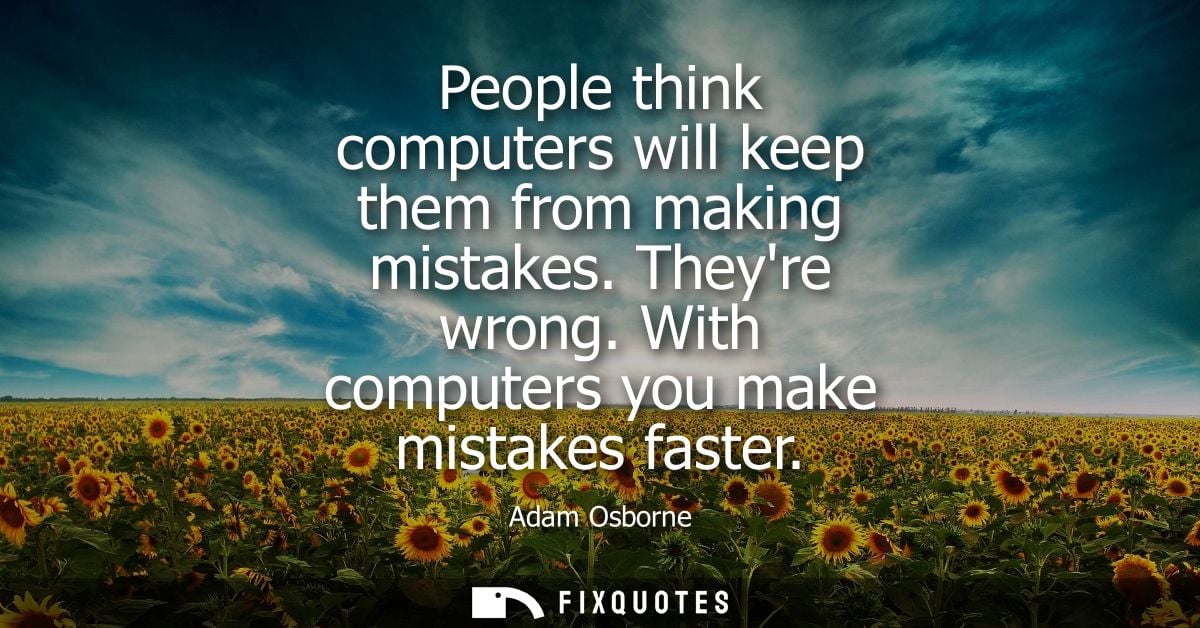
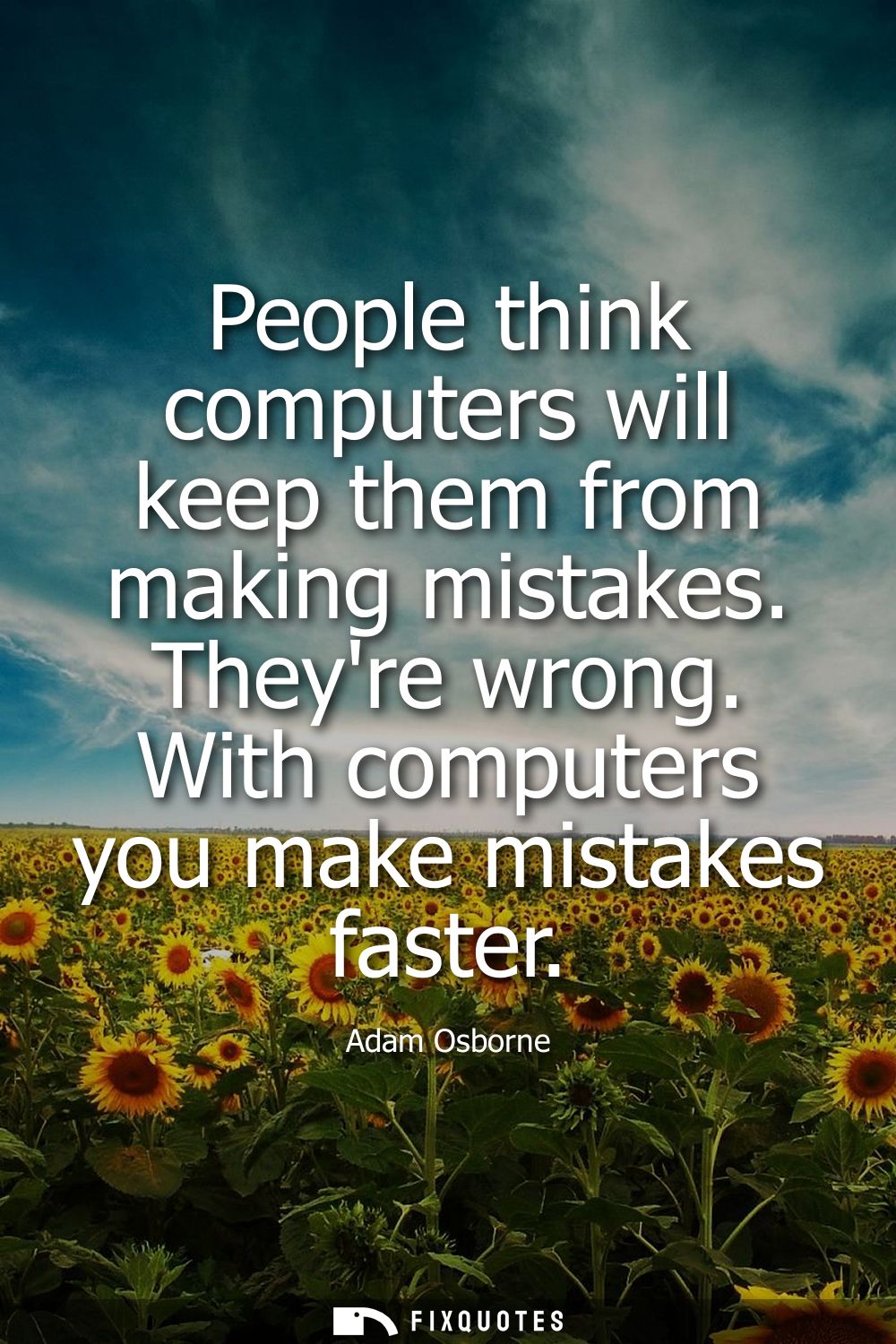
"People think computers will keep them from making mistakes. They're wrong. With computers you make mistakes faster"
About this Quote
The intent isn’t anti-computer so much as anti-complacency. “People think” sets up a familiar delusion: if the machine is precise, the outcome must be correct. Osborne yanks the focus back to inputs, assumptions, and incentives - the messy parts we’d rather outsource. The subtext: most mistakes aren’t arithmetic. They’re conceptual. Bad categories, sloppy requirements, overconfident forecasts, misunderstood users. A computer faithfully executes the wrong idea with stunning efficiency.
Context matters. Osborne came up in the early personal-computing era, when computers were marketed as clean, rational tools that would streamline office life and tame complexity. His quip reads like an early warning about digitizing bureaucracy: when you computerize a flawed process, you don’t fix it, you formalize it. The same dynamic shows up today in spreadsheets that launder dubious numbers into authority, in auto-filled forms that propagate wrong data, in software deployments that ship bugs to millions before lunch.
It’s also a cultural jab at the way “computerized” became shorthand for “trustworthy.” Osborne’s punchline restores the uncomfortable truth: speed is not accuracy, and convenience is not wisdom.
Quote Details
| Topic | Technology |
|---|---|
| Source | Attributed to Adam Osborne; listed on Wikiquote (Adam Osborne) as: 'People think computers will keep them from making mistakes. They're wrong. With computers you make mistakes faster.' |
| Cite |
Citation Formats
APA Style (7th ed.)
Osborne, Adam. (2026, January 15). People think computers will keep them from making mistakes. They're wrong. With computers you make mistakes faster. FixQuotes. https://fixquotes.com/quotes/people-think-computers-will-keep-them-from-making-168761/
Chicago Style
Osborne, Adam. "People think computers will keep them from making mistakes. They're wrong. With computers you make mistakes faster." FixQuotes. January 15, 2026. https://fixquotes.com/quotes/people-think-computers-will-keep-them-from-making-168761/.
MLA Style (9th ed.)
"People think computers will keep them from making mistakes. They're wrong. With computers you make mistakes faster." FixQuotes, 15 Jan. 2026, https://fixquotes.com/quotes/people-think-computers-will-keep-them-from-making-168761/. Accessed 12 Feb. 2026.