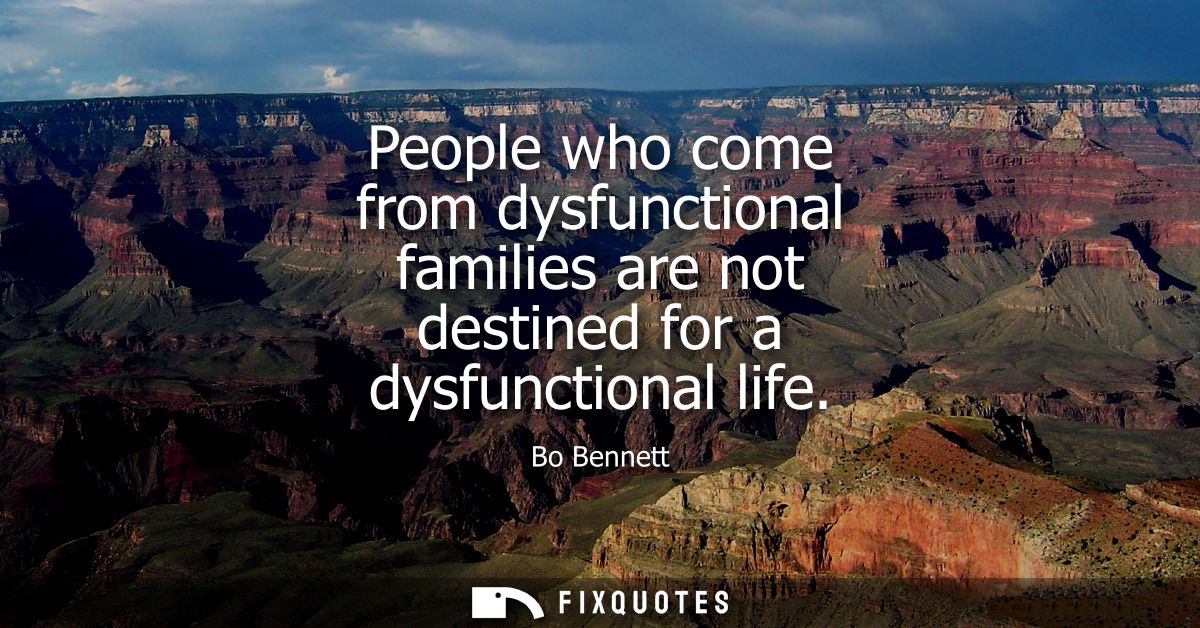
"People who come from dysfunctional families are not destined for a dysfunctional life"
About this Quote
The subtext is a quiet rebellion against a popular cultural script: that damage is destiny, that trauma automatically cashes out as permanent limitation. By saying “not destined,” Bennett rejects the comforting cruelty of inevitability. That word matters. “Destined” implies an external author; Bennett insists you’re still holding the pen, even if you didn’t choose the first chapters. It’s motivational, yes, but also political in a small way: it refuses to let family history become a totalizing explanation that excuses institutions, communities, or the individual from doing the hard work of change.
Contextually, this fits a late-20th/early-21st-century American ethos where therapy language went mainstream at the same time hustle culture did. Bennett threads the needle between empathy and action: acknowledging “dysfunctional families” as real, while warning against turning the label into a lifelong brand. The effectiveness comes from its simplicity and its implied challenge: if you’re not destined, then what are you choosing, building, unlearning, and repeating today?
Quote Details
| Topic | New Beginnings |
|---|---|
| Source | Help us find the source |
| Cite |
Citation Formats
APA Style (7th ed.)
Bennett, Bo. (2026, January 17). People who come from dysfunctional families are not destined for a dysfunctional life. FixQuotes. https://fixquotes.com/quotes/people-who-come-from-dysfunctional-families-are-50197/
Chicago Style
Bennett, Bo. "People who come from dysfunctional families are not destined for a dysfunctional life." FixQuotes. January 17, 2026. https://fixquotes.com/quotes/people-who-come-from-dysfunctional-families-are-50197/.
MLA Style (9th ed.)
"People who come from dysfunctional families are not destined for a dysfunctional life." FixQuotes, 17 Jan. 2026, https://fixquotes.com/quotes/people-who-come-from-dysfunctional-families-are-50197/. Accessed 9 Mar. 2026.