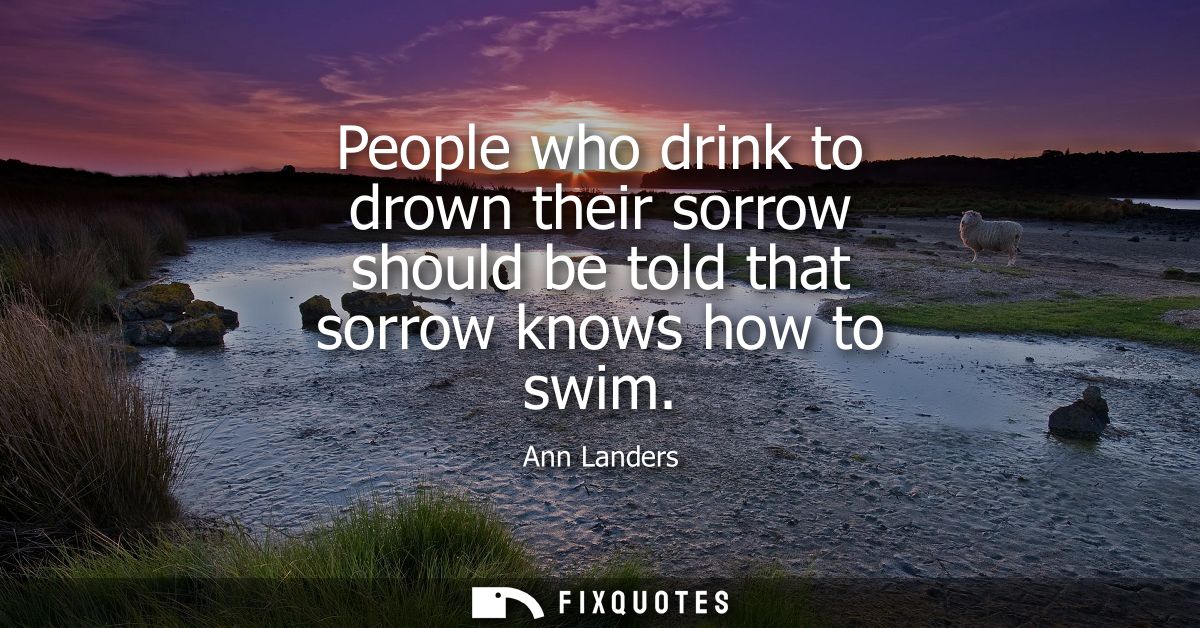
"People who drink to drown their sorrow should be told that sorrow knows how to swim"
About this Quote
The intent is harm reduction before the term existed. Landers isn't policing pleasure; she's targeting the specific bargain people make with alcohol: I'll trade tomorrow for tonight. Her line exposes how lopsided that trade is. Drowning implies control, finality, a clean ending. Swimming implies endurance, adaptation, even a perverse kind of vitality. Sorrow isn't fragile; it's aquatic.
Context matters: Landers built an empire on practical empathy, answering messy, middle-class problems in public. In that setting, a short, memorable aphorism functions like a portable intervention - something a reader can hear in their head at 1 a.m. when the bottle looks like a plan. The subtext is also social: drinking isn't just personal escape, it's an approved ritual for not talking about what's wrong. Landers offers an alternative script: name the sorrow, don't try to out-drink it, because it will outlast the performance.
Quote Details
| Topic | Witty One-Liners |
|---|---|
| Source | Widely attributed to Ann Landers (Eppie Lederer); listed on Wikiquote's 'Ann Landers' page (no definitive primary-source citation given). |
| Cite |
Citation Formats
APA Style (7th ed.)
Landers, Ann. (2026, January 15). People who drink to drown their sorrow should be told that sorrow knows how to swim. FixQuotes. https://fixquotes.com/quotes/people-who-drink-to-drown-their-sorrow-should-be-3880/
Chicago Style
Landers, Ann. "People who drink to drown their sorrow should be told that sorrow knows how to swim." FixQuotes. January 15, 2026. https://fixquotes.com/quotes/people-who-drink-to-drown-their-sorrow-should-be-3880/.
MLA Style (9th ed.)
"People who drink to drown their sorrow should be told that sorrow knows how to swim." FixQuotes, 15 Jan. 2026, https://fixquotes.com/quotes/people-who-drink-to-drown-their-sorrow-should-be-3880/. Accessed 10 Mar. 2026.