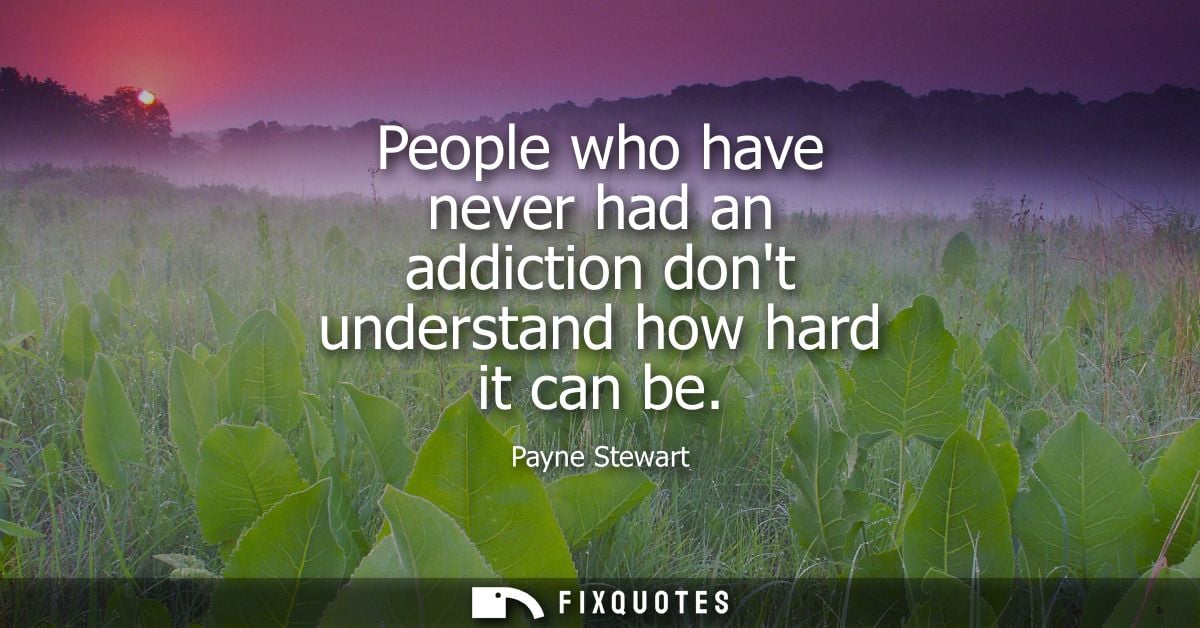
"People who have never had an addiction don't understand how hard it can be"
About this Quote
Stewart’s line lands with the bluntness of a locker-room truth: some experiences can’t be “gotten” through observation, only through living inside their gravity. Coming from an athlete, it’s also a quiet rebuke to the sports world’s favorite mythologies - discipline as cure-all, willpower as personality trait, redemption as a clean third-act montage. He’s not asking for applause; he’s drawing a boundary around what empathy can and can’t fake.
The intent is partly defensive and partly invitational. Defensive, because addiction is routinely mistaken for a character flaw, especially in cultures obsessed with performance. Invitational, because he’s naming the invisible labor: the constant negotiation with triggers, shame, and the body’s insistence on repetition. “How hard it can be” is careful phrasing - not melodrama, not self-pity, just an insistence that the difficulty is structural, not occasional.
The subtext is about the limits of judgment. People without addiction often offer tidy advice (“just stop,” “stay busy,” “think positive”) because they imagine the problem as a choice made once, not a compulsion fought daily. Stewart’s sentence exposes that misread in a single move: it shifts the focus from moral failure to lived constraint.
Context matters. Late-90s celebrity culture and professional sports weren’t built for vulnerability; they were built for hero narratives and damage control. An athlete speaking this plainly punctures the PR-friendly script and replaces it with something rarer: a demand for understanding that doesn’t depend on being inspirational.
The intent is partly defensive and partly invitational. Defensive, because addiction is routinely mistaken for a character flaw, especially in cultures obsessed with performance. Invitational, because he’s naming the invisible labor: the constant negotiation with triggers, shame, and the body’s insistence on repetition. “How hard it can be” is careful phrasing - not melodrama, not self-pity, just an insistence that the difficulty is structural, not occasional.
The subtext is about the limits of judgment. People without addiction often offer tidy advice (“just stop,” “stay busy,” “think positive”) because they imagine the problem as a choice made once, not a compulsion fought daily. Stewart’s sentence exposes that misread in a single move: it shifts the focus from moral failure to lived constraint.
Context matters. Late-90s celebrity culture and professional sports weren’t built for vulnerability; they were built for hero narratives and damage control. An athlete speaking this plainly punctures the PR-friendly script and replaces it with something rarer: a demand for understanding that doesn’t depend on being inspirational.
Quote Details
| Topic | Mental Health |
|---|---|
| Source | Help us find the source |
More Quotes by Payne
Add to List