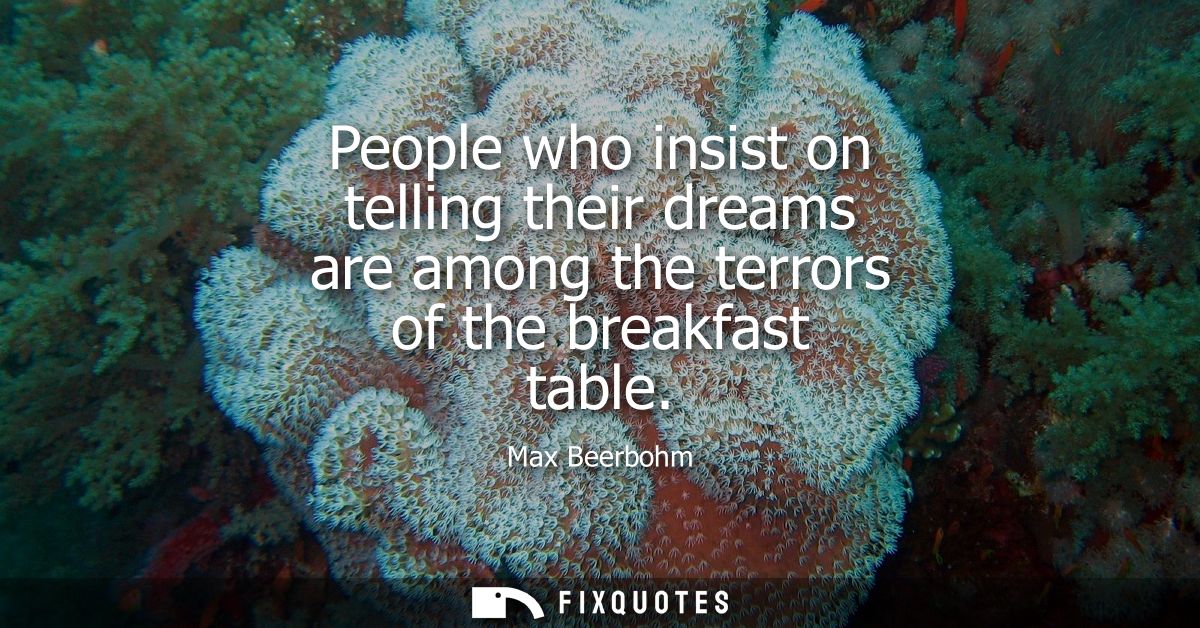
"People who insist on telling their dreams are among the terrors of the breakfast table"
About this Quote
Nothing kills morning civility faster than someone turning toast and coffee into a one-person theater piece. Beerbohm’s line lands because it frames a petty irritation as a genuine menace: “terrors” is mock-grandiose, the kind of exaggeration that flatters the listener’s annoyance while pretending the stakes are high. That’s the joke and the social critique. The breakfast table is a tiny institution of modern life, governed by unspoken rules: keep it light, keep it brief, don’t demand emotional labor before caffeine.
“Insist” does the heavy lifting. Beerbohm isn’t mocking dreaming; he’s skewering the compulsion to perform it. Dream-telling is an intimacy grab disguised as conversation. The speaker asks for attention, interpretation, even admiration for the mind’s private cinema, but offers little in return because dreams are famously non-transferable: vivid to the dreamer, shapeless to everyone else. The subtext is about consent and boundaries in social space. You can’t opt out without seeming rude, so you’re trapped in a narrative with no plot and no exit.
The context is Beerbohm’s Edwardian sensibility: a culture obsessed with manners and allergic to earnest self-disclosure. As a satirist with an actor’s ear for timing, he turns everyday boredom into a sharp little moral: conversation is a shared performance, not a hostage situation. The line still works now, in an age of oversharing, because it nails a familiar dynamic: the person who can’t stop talking about themselves, using “I had the weirdest dream” as a socially acceptable opening monologue.
“Insist” does the heavy lifting. Beerbohm isn’t mocking dreaming; he’s skewering the compulsion to perform it. Dream-telling is an intimacy grab disguised as conversation. The speaker asks for attention, interpretation, even admiration for the mind’s private cinema, but offers little in return because dreams are famously non-transferable: vivid to the dreamer, shapeless to everyone else. The subtext is about consent and boundaries in social space. You can’t opt out without seeming rude, so you’re trapped in a narrative with no plot and no exit.
The context is Beerbohm’s Edwardian sensibility: a culture obsessed with manners and allergic to earnest self-disclosure. As a satirist with an actor’s ear for timing, he turns everyday boredom into a sharp little moral: conversation is a shared performance, not a hostage situation. The line still works now, in an age of oversharing, because it nails a familiar dynamic: the person who can’t stop talking about themselves, using “I had the weirdest dream” as a socially acceptable opening monologue.
Quote Details
| Topic | Witty One-Liners |
|---|---|
| Source | Help us find the source |
More Quotes by Max
Add to List