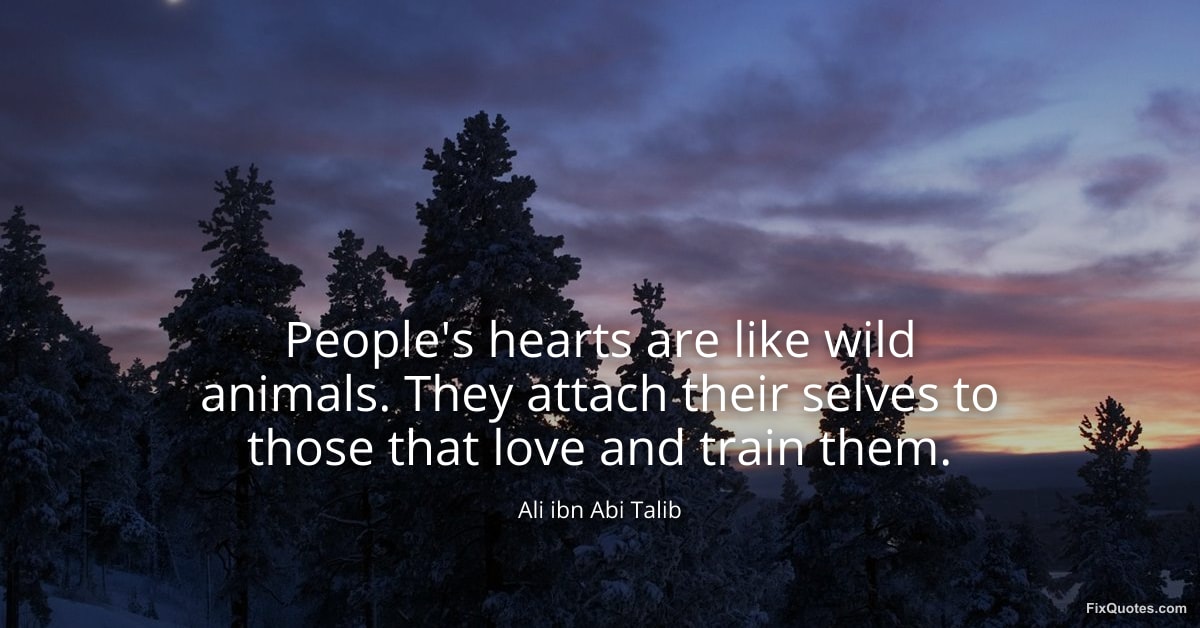
"People's hearts are like wild animals. They attach their selves to those that love and train them"
About this Quote
He compares the human heart to a wild animal not to romanticize feeling, but to put it under a sober moral light: affection is powerful, unpredictable, and responsive to treatment. In Ali ibn Abi Talib's framing, love is not just a sentiment you "have"; it's a practice that shapes allegiance. The heart "attaches" the way a creature bonds with the hand that feeds it. That imagery carries a bracing implication: loyalty is cultivated, not owed, and neglect has consequences.
The verb pairing is the quote's quiet provocation. "Love" and "train" sit side by side, refusing the modern fantasy that care is purely spontaneous and therefore morally pure. Training suggests discipline, patience, repetition, boundaries. The subtext is both pastoral and political: if you want devotion - from a spouse, a child, a friend, a community - you don't command it, you earn it through consistent care and ethical guidance. And if you instead rule through fear, caprice, or vanity, don't be surprised when hearts bolt.
Context matters. Ali speaks from an early Islamic world where leadership was not merely administrative; it was spiritual stewardship, with real stakes in communal cohesion and justice. Read that way, the line doubles as advice to rulers and religious guides: the legitimacy of authority rests on compassion joined to moral formation. It's also a warning against manipulation. To "train" a heart can be nurture, or it can be domestication. Ali's image leaves the listener with responsibility: if hearts are wild, how you handle them reveals who you are.
The verb pairing is the quote's quiet provocation. "Love" and "train" sit side by side, refusing the modern fantasy that care is purely spontaneous and therefore morally pure. Training suggests discipline, patience, repetition, boundaries. The subtext is both pastoral and political: if you want devotion - from a spouse, a child, a friend, a community - you don't command it, you earn it through consistent care and ethical guidance. And if you instead rule through fear, caprice, or vanity, don't be surprised when hearts bolt.
Context matters. Ali speaks from an early Islamic world where leadership was not merely administrative; it was spiritual stewardship, with real stakes in communal cohesion and justice. Read that way, the line doubles as advice to rulers and religious guides: the legitimacy of authority rests on compassion joined to moral formation. It's also a warning against manipulation. To "train" a heart can be nurture, or it can be domestication. Ali's image leaves the listener with responsibility: if hearts are wild, how you handle them reveals who you are.
Quote Details
| Topic | Love |
|---|
More Quotes by Ali
Add to List