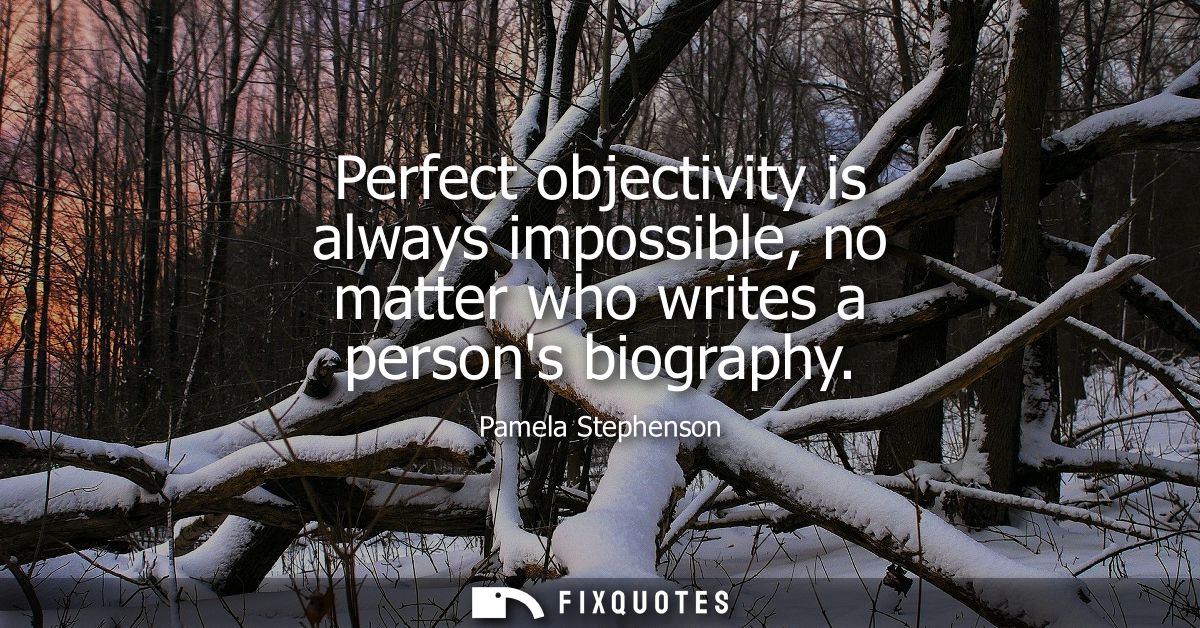
"Perfect objectivity is always impossible, no matter who writes a person's biography"
About this Quote
The intent lands as both warning and permission. Warning, because readers love biographies as verdicts: the “real” person, finally exposed. Permission, because it frees us from pretending we’re consuming court transcripts. Stephenson’s phrasing is careful: “always impossible” isn’t cynical for its own sake; it’s a practical admission that memory is messy, sources are partial, and narrative demands coherence that actual living rarely provides. Even the most conscientious writer has to translate contradiction into a through-line, and that translation is interpretation.
The subtext is cultural, too: in an era of celebrity mythmaking and brand management, biography is less a neutral record than a battleground over legacy. Coming from a performer, the point sharpens. Actors know that “truth” onstage is manufactured through craft. Stephenson is nudging us to read biographies the same way: not as pure fact, but as authored reality, with all the power - and risk - that comes with authorship.
Quote Details
| Topic | Truth |
|---|---|
| Source | Help us find the source |
| Cite |
Citation Formats
APA Style (7th ed.)
Stephenson, Pamela. (2026, January 16). Perfect objectivity is always impossible, no matter who writes a person's biography. FixQuotes. https://fixquotes.com/quotes/perfect-objectivity-is-always-impossible-no-115039/
Chicago Style
Stephenson, Pamela. "Perfect objectivity is always impossible, no matter who writes a person's biography." FixQuotes. January 16, 2026. https://fixquotes.com/quotes/perfect-objectivity-is-always-impossible-no-115039/.
MLA Style (9th ed.)
"Perfect objectivity is always impossible, no matter who writes a person's biography." FixQuotes, 16 Jan. 2026, https://fixquotes.com/quotes/perfect-objectivity-is-always-impossible-no-115039/. Accessed 5 Mar. 2026.