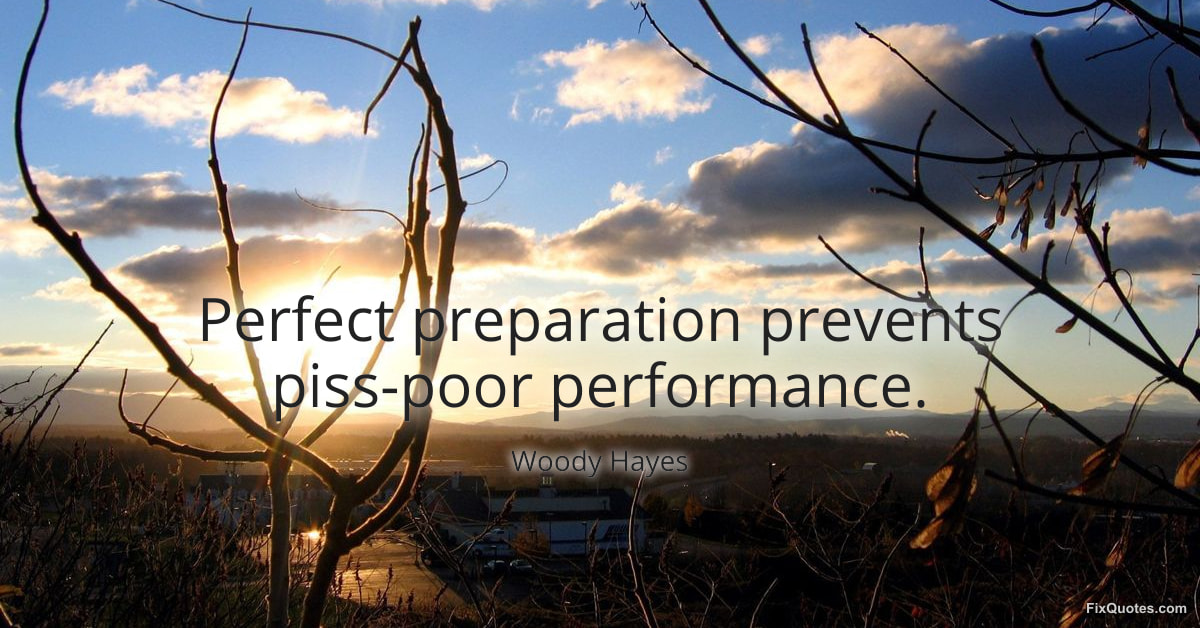
"Perfect preparation prevents piss-poor performance"
About this Quote
Hayes’s line lands like a locker-room door slam: blunt, rhythmic, and impossible to politely ignore. “Perfect preparation” is deliberately excessive. Nobody prepares perfectly, and Hayes knew it. The hyperbole isn’t a mistake; it’s a pressure tactic. By raising the standard to “perfect,” he narrows the athlete’s mental wiggle room. If your plan is anything less than total, you’ve already granted yourself permission to fail.
The alliteration is the engine. Those hard p’s turn the phrase into a chant, a mnemonic you can carry onto a practice field or into a film session. The profanity isn’t decorative either. “Piss-poor” makes the consequence feel bodily and humiliating, not abstract. It’s not “suboptimal performance,” it’s embarrassment - the kind you can’t explain away in the postgame presser.
Context matters: Hayes coached in an era and environment where discipline was treated as destiny, and where “mental toughness” often meant pre-loading the week with repetition until Sunday or Saturday felt inevitable. The intent is less about inspiration than control. Preparation becomes moral behavior; performance becomes its public verdict. If you lose, the subtext goes, it’s not bad luck or a talented opponent - it’s negligence.
That’s the ruthless clarity of coaching culture at its most persuasive and most unforgiving: it sells mastery by making unpreparedness feel not merely risky, but shameful.
The alliteration is the engine. Those hard p’s turn the phrase into a chant, a mnemonic you can carry onto a practice field or into a film session. The profanity isn’t decorative either. “Piss-poor” makes the consequence feel bodily and humiliating, not abstract. It’s not “suboptimal performance,” it’s embarrassment - the kind you can’t explain away in the postgame presser.
Context matters: Hayes coached in an era and environment where discipline was treated as destiny, and where “mental toughness” often meant pre-loading the week with repetition until Sunday or Saturday felt inevitable. The intent is less about inspiration than control. Preparation becomes moral behavior; performance becomes its public verdict. If you lose, the subtext goes, it’s not bad luck or a talented opponent - it’s negligence.
That’s the ruthless clarity of coaching culture at its most persuasive and most unforgiving: it sells mastery by making unpreparedness feel not merely risky, but shameful.
Quote Details
| Topic | Work Ethic |
|---|---|
| Source | Help us find the source |
| Cite |
Citation Formats
APA Style (7th ed.)
Hayes, Woody. (2026, January 15). Perfect preparation prevents piss-poor performance. FixQuotes. https://fixquotes.com/quotes/perfect-preparation-prevents-piss-poor-performance-173601/
Chicago Style
Hayes, Woody. "Perfect preparation prevents piss-poor performance." FixQuotes. January 15, 2026. https://fixquotes.com/quotes/perfect-preparation-prevents-piss-poor-performance-173601/.
MLA Style (9th ed.)
"Perfect preparation prevents piss-poor performance." FixQuotes, 15 Jan. 2026, https://fixquotes.com/quotes/perfect-preparation-prevents-piss-poor-performance-173601/. Accessed 12 Feb. 2026.
More Quotes by Woody
Add to List