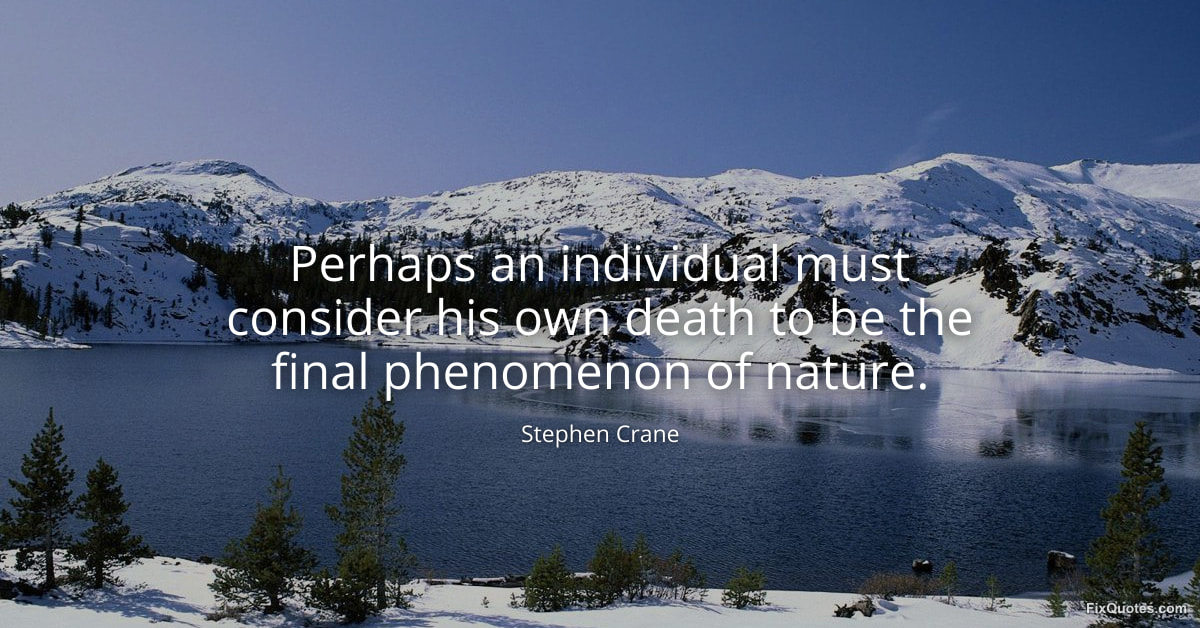
"Perhaps an individual must consider his own death to be the final phenomenon of nature"
About this Quote
That clinical chill is classic Crane. Writing at the tail end of the 19th century, he’s steeped in literary naturalism, where human beings are not heroic centers of the universe but small organisms pushed around by environment, chance, and bodily limits. The subtext is a rebuke to comforting narratives: religion as guaranteed afterlife, Victorian sentimentality, even the ego’s assumption that the world is arranged for our personal arc. Nature doesn’t narrate; it happens.
The sentence also has a needle of psychological insight. “Must consider” implies a discipline, almost an ethical requirement: the mature mind has to look at death head-on because it clarifies everything else. If your own extinction is the last fact you can’t bargain with, then much of what you tell yourself about control, legacy, even morality gets pressured into honesty. Crane’s intent isn’t nihilism for its own sake; it’s a hard reset on human self-importance, delivered in the cool tone of someone who suspects that the universe will not be attending your funeral.
Quote Details
| Topic | Mortality |
|---|---|
| Source | Help us find the source |
| Cite |
Citation Formats
APA Style (7th ed.)
Crane, Stephen. (2026, January 15). Perhaps an individual must consider his own death to be the final phenomenon of nature. FixQuotes. https://fixquotes.com/quotes/perhaps-an-individual-must-consider-his-own-death-173374/
Chicago Style
Crane, Stephen. "Perhaps an individual must consider his own death to be the final phenomenon of nature." FixQuotes. January 15, 2026. https://fixquotes.com/quotes/perhaps-an-individual-must-consider-his-own-death-173374/.
MLA Style (9th ed.)
"Perhaps an individual must consider his own death to be the final phenomenon of nature." FixQuotes, 15 Jan. 2026, https://fixquotes.com/quotes/perhaps-an-individual-must-consider-his-own-death-173374/. Accessed 25 Mar. 2026.