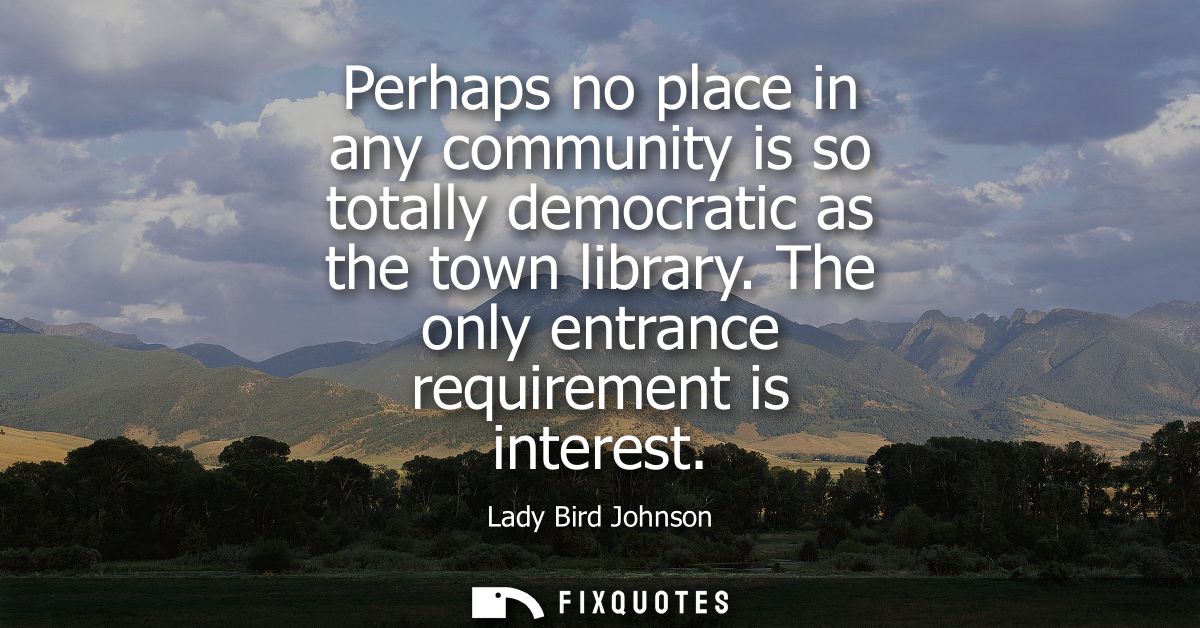
"Perhaps no place in any community is so totally democratic as the town library. The only entrance requirement is interest"
About this Quote
The genius of Lady Bird Johnson's line is how it smuggles a political argument into the gentle furniture of civic life. Call the town library "totally democratic" and you are quietly redefining democracy itself: not as voting, not as rallies, not as ideology, but as access. No ID checks, no dress code, no wealth threshold, no insider language. Just the radical proposition that curiosity is enough.
The phrase "entrance requirement" carries the subtext. Libraries usually feel like soft spaces, but Johnson frames them like institutions with gates, then flips the script: the gatekeeper is not class or credential, it's "interest". That word is doing heavy lifting. Interest is personal, self-directed, unruly. It can't be inherited the way status is, and it doesn't require permission. In a country that often confuses equality with sameness, she argues for an equality of opportunity to learn, to roam, to change your mind.
Context matters: as First Lady in the 1960s, Johnson was associated with the Great Society ethos and a broad push for public investment, including education and community programs. This quote functions as a defense of the public commons at a time when America's "democracy" was being contested in the streets and in law. The library becomes a moral counterexample to exclusion: it is one of the few places where a kid, an immigrant, a retiree, and a job seeker can occupy the same room without having to justify their presence.
It's also aspirational. Libraries aren't automatically democratic; they are made that way through funding, welcoming policies, and a culture that treats knowledge as a right, not a luxury. Johnson's sentence is a civic dare: if interest is the only requirement, then the community has no excuse not to keep the doors open.
The phrase "entrance requirement" carries the subtext. Libraries usually feel like soft spaces, but Johnson frames them like institutions with gates, then flips the script: the gatekeeper is not class or credential, it's "interest". That word is doing heavy lifting. Interest is personal, self-directed, unruly. It can't be inherited the way status is, and it doesn't require permission. In a country that often confuses equality with sameness, she argues for an equality of opportunity to learn, to roam, to change your mind.
Context matters: as First Lady in the 1960s, Johnson was associated with the Great Society ethos and a broad push for public investment, including education and community programs. This quote functions as a defense of the public commons at a time when America's "democracy" was being contested in the streets and in law. The library becomes a moral counterexample to exclusion: it is one of the few places where a kid, an immigrant, a retiree, and a job seeker can occupy the same room without having to justify their presence.
It's also aspirational. Libraries aren't automatically democratic; they are made that way through funding, welcoming policies, and a culture that treats knowledge as a right, not a luxury. Johnson's sentence is a civic dare: if interest is the only requirement, then the community has no excuse not to keep the doors open.
Quote Details
| Topic | Knowledge |
|---|
More Quotes by Lady
Add to List