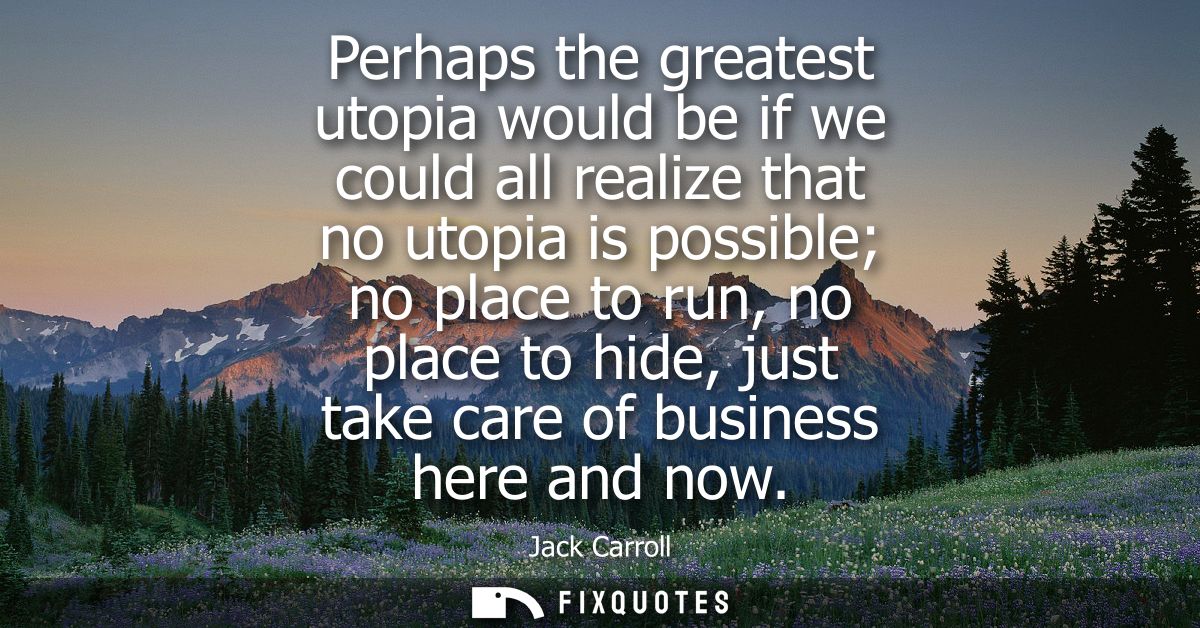
"Perhaps the greatest utopia would be if we could all realize that no utopia is possible; no place to run, no place to hide, just take care of business here and now"
About this Quote
The subtext is a critique of escapism in its modern forms: not just literal flight, but ideological retreat into purity politics, nostalgia, or “one weird fix” solutions. “No place to run, no place to hide” sounds like a pop lyric, but here it functions as a hardline civic ethic: you don’t get to outsource responsibility to the next election, the next administration, the next technological breakthrough. It’s also a quiet rebuke to voters who demand miracles while resisting trade-offs.
Contextually, this kind of rhetoric tends to surface in periods of institutional fatigue - when faith in sweeping projects has been burned by war, recession, scandal, or stalled reform. Carroll’s intent is to reframe realism as a higher form of hope: not the hope that everything can be fixed, but the hope that enough can be handled. “Take care of business here and now” lands like managerial pragmatism, but it’s also a cultural stance: the only future worth having is the one built without the narcotic of perfection.
Quote Details
| Topic | Live in the Moment |
|---|---|
| Source | Help us find the source |
| Cite |
Citation Formats
APA Style (7th ed.)
Carroll, Jack. (2026, January 15). Perhaps the greatest utopia would be if we could all realize that no utopia is possible; no place to run, no place to hide, just take care of business here and now. FixQuotes. https://fixquotes.com/quotes/perhaps-the-greatest-utopia-would-be-if-we-could-130264/
Chicago Style
Carroll, Jack. "Perhaps the greatest utopia would be if we could all realize that no utopia is possible; no place to run, no place to hide, just take care of business here and now." FixQuotes. January 15, 2026. https://fixquotes.com/quotes/perhaps-the-greatest-utopia-would-be-if-we-could-130264/.
MLA Style (9th ed.)
"Perhaps the greatest utopia would be if we could all realize that no utopia is possible; no place to run, no place to hide, just take care of business here and now." FixQuotes, 15 Jan. 2026, https://fixquotes.com/quotes/perhaps-the-greatest-utopia-would-be-if-we-could-130264/. Accessed 28 Mar. 2026.