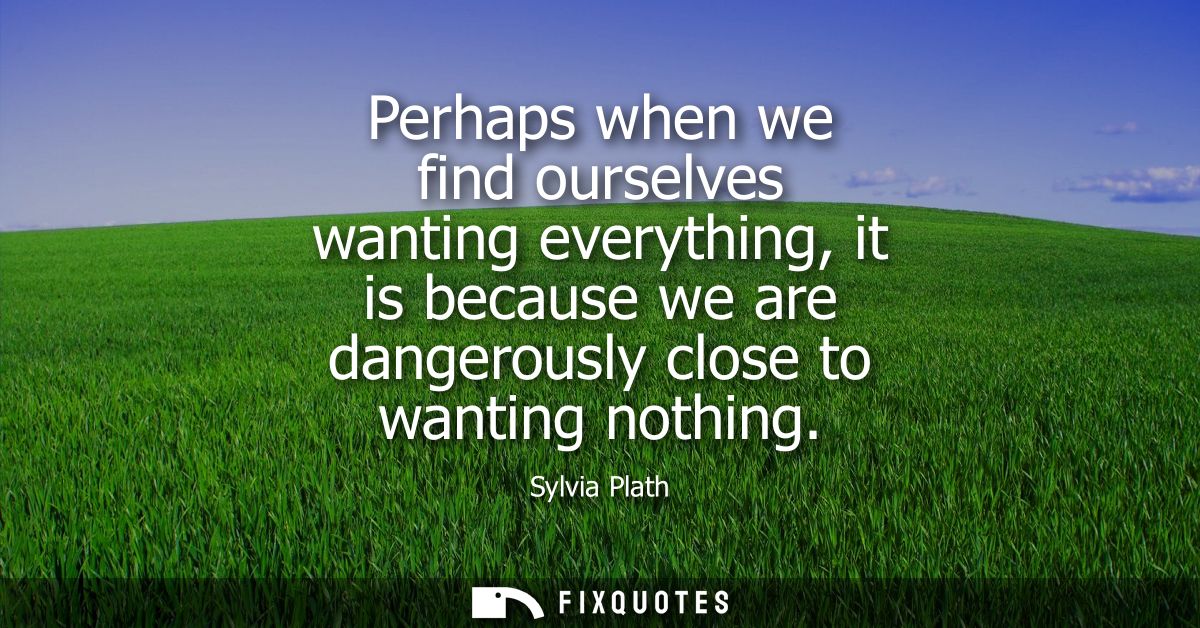
"Perhaps when we find ourselves wanting everything, it is because we are dangerously close to wanting nothing"
About this Quote
The line turns greed into a symptom, not a sin: wanting everything isn’t ambition at full volume, it’s appetite with a hole in it. Plath’s “perhaps” is doing quiet, lethal work. It softens the claim into something conversational, even reasonable, while smuggling in a diagnosis: the mind that demands totality is already flirting with emptiness. “Dangerously close” frames desire as vertigo, a psychological edge where longing stops being about objects and becomes about annihilating the self’s ability to feel satisfied at all.
The subtext is a fear of inner vacancy dressed up as hunger. Wanting “everything” sounds expansive, but it’s also nonspecific. It’s the language of someone who can’t name a single thing that would actually help, so the wish inflates until it becomes abstract. That’s why the punch lands on “nothing.” Plath collapses the apparent opposite into its twin, implying that excess desire and numbness are adjacent states, separated by a thin membrane of meaning.
In Plath’s context - mid-century domestic constraint, rising consumer fantasy, and her own documented oscillations between ferocious striving and depressive void - the sentence reads like a warning flare. It captures the moment when longing stops being a route out of life’s limits and becomes a refusal to live inside any limit at all. The intent isn’t to scold craving; it’s to expose how craving can be a camouflage for despair.
The subtext is a fear of inner vacancy dressed up as hunger. Wanting “everything” sounds expansive, but it’s also nonspecific. It’s the language of someone who can’t name a single thing that would actually help, so the wish inflates until it becomes abstract. That’s why the punch lands on “nothing.” Plath collapses the apparent opposite into its twin, implying that excess desire and numbness are adjacent states, separated by a thin membrane of meaning.
In Plath’s context - mid-century domestic constraint, rising consumer fantasy, and her own documented oscillations between ferocious striving and depressive void - the sentence reads like a warning flare. It captures the moment when longing stops being a route out of life’s limits and becomes a refusal to live inside any limit at all. The intent isn’t to scold craving; it’s to expose how craving can be a camouflage for despair.
Quote Details
| Topic | Meaning of Life |
|---|
More Quotes by Sylvia
Add to List