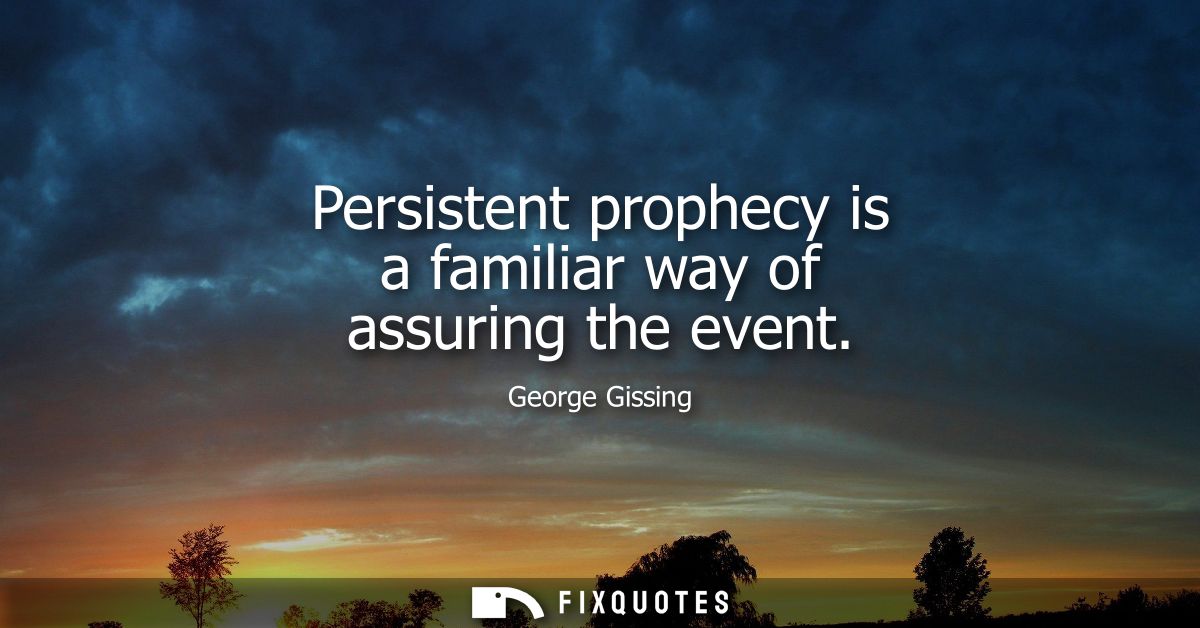
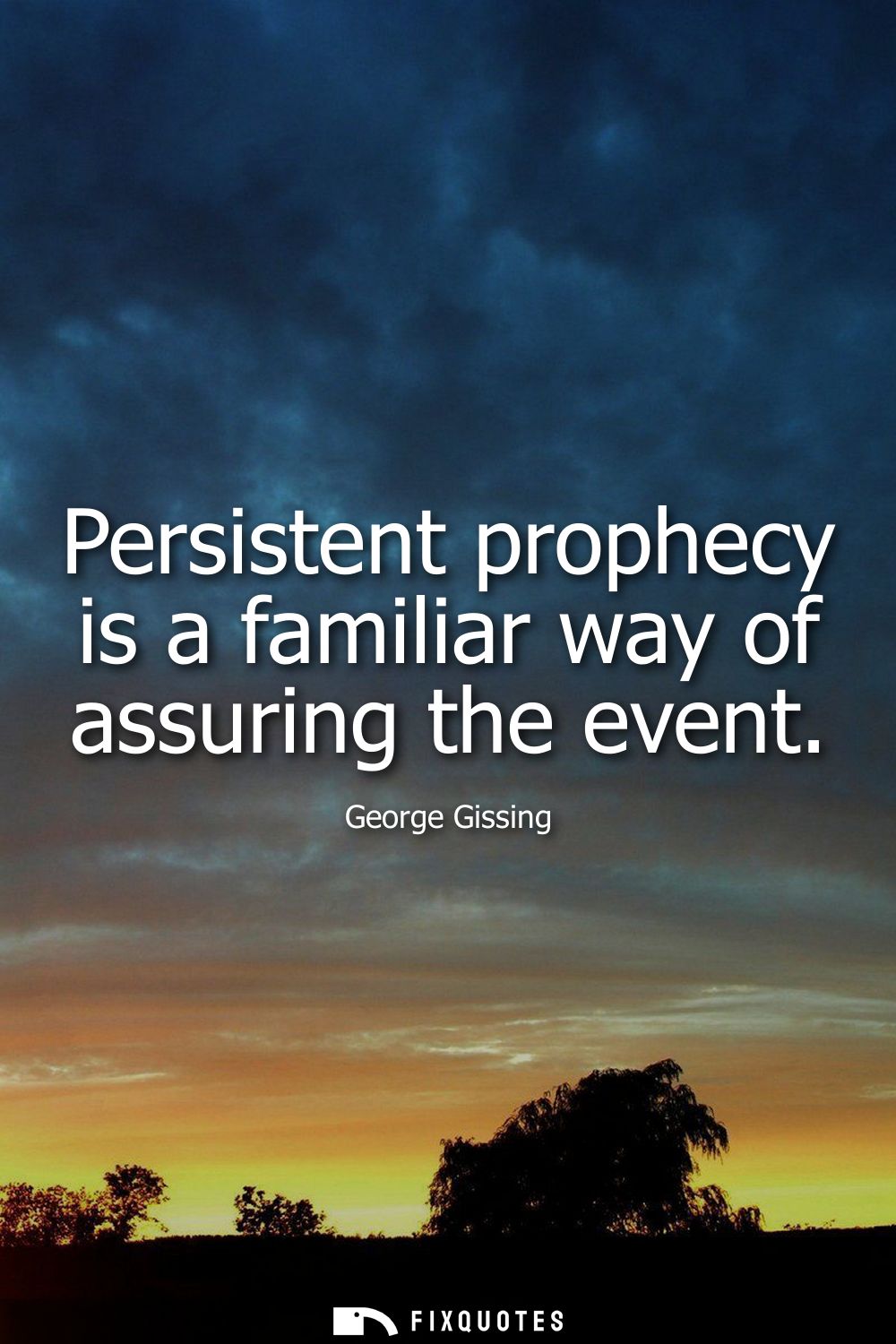
"Persistent prophecy is a familiar way of assuring the event"
About this Quote
“Persistent prophecy” sounds mystical, but Gissing is really talking about social physics: say a thing will happen often enough, with enough conviction, and you start laying the tracks for it. The line cuts against the Victorian taste for moral certainty by treating prediction not as foresight but as pressure. Prophecy here is less oracle than instrument - a way to steer other people’s expectations, justify decisions, and make outcomes feel inevitable even when they’re engineered.
The subtext is quietly cynical. Gissing isn’t praising vision; he’s warning about how narratives colonize reality. Repetition creates credibility, credibility creates compliance. When a family insists a son is “destined” to fail, or a class insists the poor are “bound” to remain poor, the prediction becomes a script everyone performs. It’s a compact diagnosis of the self-fulfilling prophecy, years before the term gets popularized: belief hardens into behavior, behavior hardens into fact.
As a late-19th-century novelist attuned to money, status, and humiliation, Gissing knew how “assurance” works in polite society: not through proof, but through relentless assertion. Victorian Britain ran on reputations, and reputations were essentially communal prophecies - repeated until they passed for truth. The quote’s bite is in that word “familiar”: this isn’t rare manipulation; it’s a common habit. Gissing implies that people don’t just predict the future. They manufacture it, then pretend they merely saw it coming.
The subtext is quietly cynical. Gissing isn’t praising vision; he’s warning about how narratives colonize reality. Repetition creates credibility, credibility creates compliance. When a family insists a son is “destined” to fail, or a class insists the poor are “bound” to remain poor, the prediction becomes a script everyone performs. It’s a compact diagnosis of the self-fulfilling prophecy, years before the term gets popularized: belief hardens into behavior, behavior hardens into fact.
As a late-19th-century novelist attuned to money, status, and humiliation, Gissing knew how “assurance” works in polite society: not through proof, but through relentless assertion. Victorian Britain ran on reputations, and reputations were essentially communal prophecies - repeated until they passed for truth. The quote’s bite is in that word “familiar”: this isn’t rare manipulation; it’s a common habit. Gissing implies that people don’t just predict the future. They manufacture it, then pretend they merely saw it coming.
Quote Details
| Topic | Free Will & Fate |
|---|---|
| Source | Help us find the source |
| Cite |
Citation Formats
APA Style (7th ed.)
Gissing, George. (2026, January 15). Persistent prophecy is a familiar way of assuring the event. FixQuotes. https://fixquotes.com/quotes/persistent-prophecy-is-a-familiar-way-of-assuring-164708/
Chicago Style
Gissing, George. "Persistent prophecy is a familiar way of assuring the event." FixQuotes. January 15, 2026. https://fixquotes.com/quotes/persistent-prophecy-is-a-familiar-way-of-assuring-164708/.
MLA Style (9th ed.)
"Persistent prophecy is a familiar way of assuring the event." FixQuotes, 15 Jan. 2026, https://fixquotes.com/quotes/persistent-prophecy-is-a-familiar-way-of-assuring-164708/. Accessed 28 Mar. 2026.
More Quotes by George
Add to List