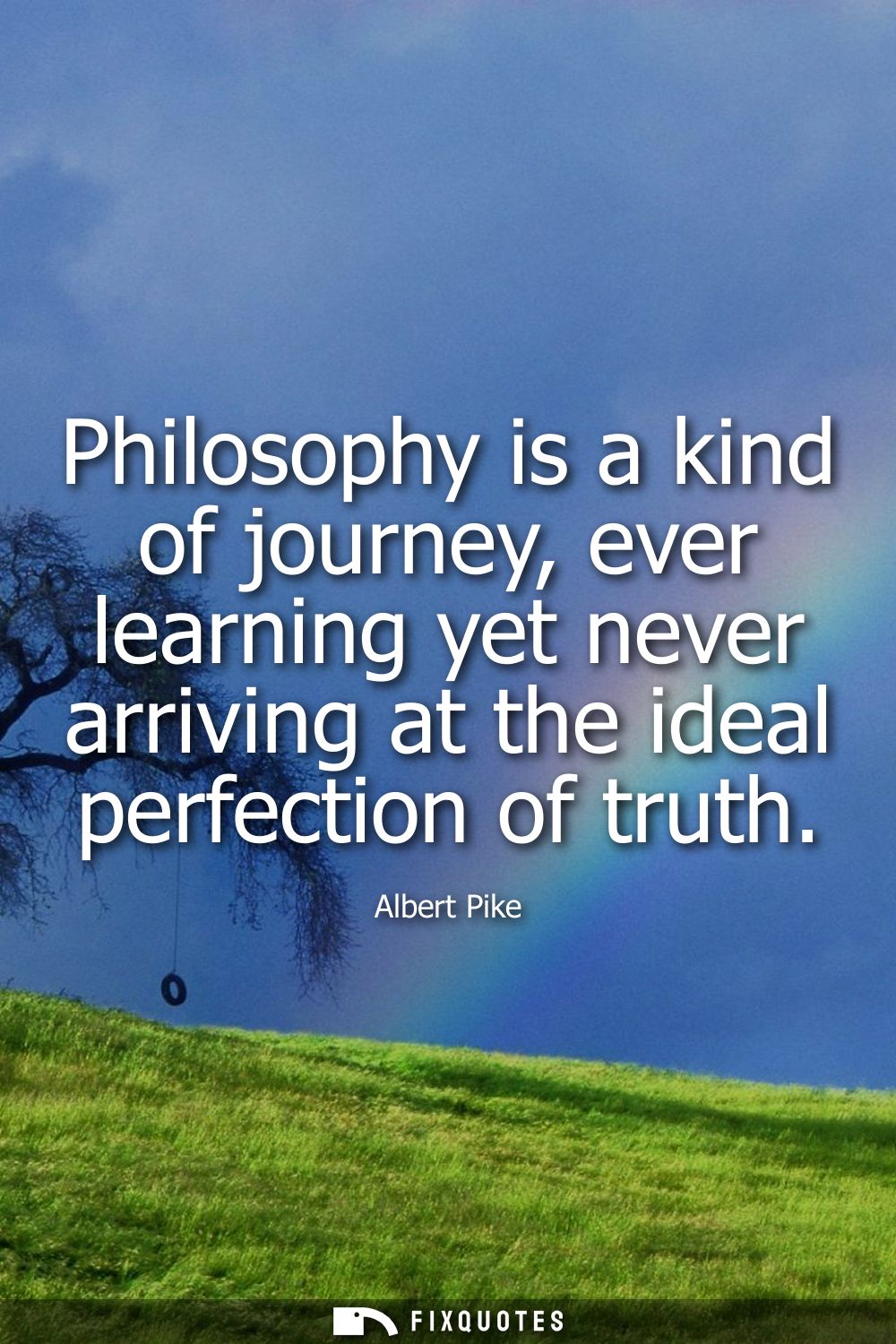
"Philosophy is a kind of journey, ever learning yet never arriving at the ideal perfection of truth"
About this Quote
The phrasing also works as a kind of institutional self-defense. Pike was a lawyer, trained to treat truth as something argued, tested, and provisionally established, not received as revelation. In law, you don’t get "ideal perfection"; you get judgments, precedents, and appeals. That professional sensibility leaks into the sentence: "learning" is the work, "arriving" is the fantasy.
Subtextually, the quote gives ambition a leash. It invites rigor without promising certainty, which is a useful posture in a century where science, religion, and politics competed to crown themselves final authorities. Pike’s line flatters the seeker but warns the zealot: if you claim perfection, you’ve stopped traveling. The real badge of seriousness, he implies, is continuing to move.
Quote Details
| Topic | Truth |
|---|---|
| Source | Help us find the source |
| Cite | Cite this Quote |
Citation Formats
APA Style (7th ed.)
Pike, Albert. (n.d.). Philosophy is a kind of journey, ever learning yet never arriving at the ideal perfection of truth. FixQuotes. https://fixquotes.com/quotes/philosophy-is-a-kind-of-journey-ever-learning-yet-149428/
Chicago Style
Pike, Albert. "Philosophy is a kind of journey, ever learning yet never arriving at the ideal perfection of truth." FixQuotes. Accessed February 2, 2026. https://fixquotes.com/quotes/philosophy-is-a-kind-of-journey-ever-learning-yet-149428/.
MLA Style (9th ed.)
"Philosophy is a kind of journey, ever learning yet never arriving at the ideal perfection of truth." FixQuotes, https://fixquotes.com/quotes/philosophy-is-a-kind-of-journey-ever-learning-yet-149428/. Accessed 2 Feb. 2026.