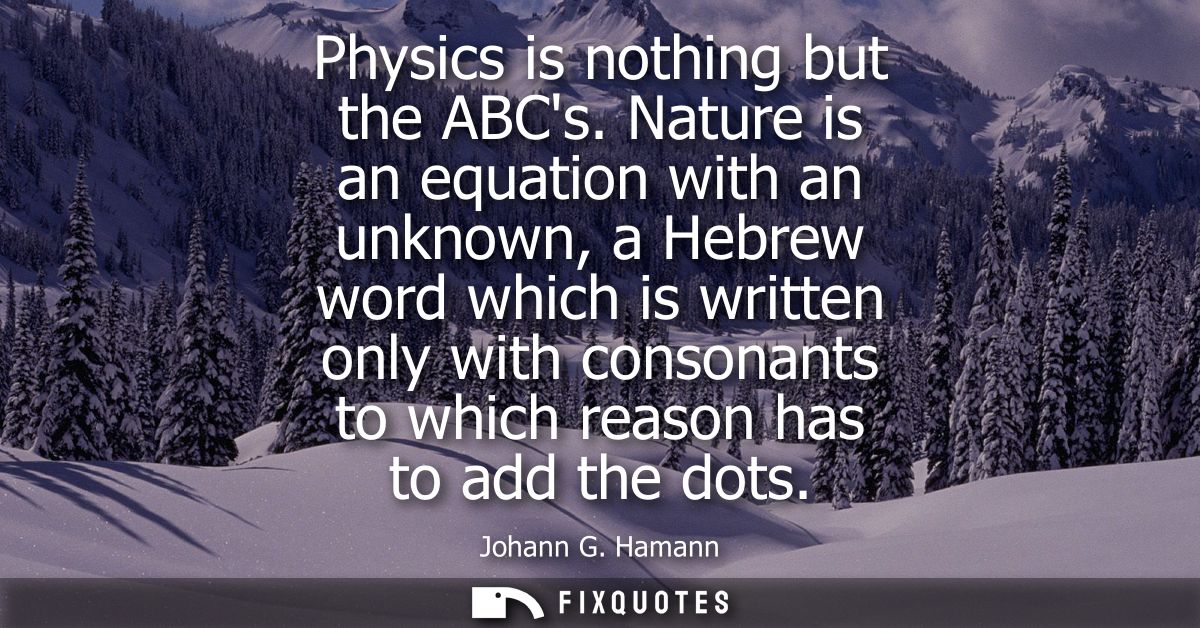
"Physics is nothing but the ABCs. Nature is an equation with an unknown, a Hebrew word which is written only with consonants to which reason has to add the dots"
About this Quote
The second image sharpens the critique. Nature as “an equation with an unknown” grants science its proper dignity: inquiry is real, but its objects are never fully closed, never finally solved. Then he switches alphabets and the temperature changes. A “Hebrew word... written only with consonants” evokes a script that demands interpretation; you don’t simply read it, you supply what’s missing. “Reason has to add the dots” sounds, at first, like praise for rational completion - but it’s also an indictment. The vowels aren’t in the text; they’re projections, conventions, guesses. Rationality doesn’t merely decode nature; it edits it.
Context matters: Hamann was a contemporary irritant to Kant, suspicious of grand systems and allergic to the Enlightenment’s clean separation of reason from language, history, and faith. By invoking Hebrew - a language tied to revelation, tradition, and exegesis - he suggests that the world is less a transparent machine than a stubborn text, thick with ambiguity. Physics can teach you the alphabet of phenomena, but it can’t guarantee you’re pronouncing reality correctly.
Quote Details
| Topic | Reason & Logic |
|---|---|
| Source | Help us find the source |
| Cite |
Citation Formats
APA Style (7th ed.)
Hamann, Johann G. (2026, February 16). Physics is nothing but the ABCs. Nature is an equation with an unknown, a Hebrew word which is written only with consonants to which reason has to add the dots. FixQuotes. https://fixquotes.com/quotes/physics-is-nothing-but-the-abcs-nature-is-an-164001/
Chicago Style
Hamann, Johann G. "Physics is nothing but the ABCs. Nature is an equation with an unknown, a Hebrew word which is written only with consonants to which reason has to add the dots." FixQuotes. February 16, 2026. https://fixquotes.com/quotes/physics-is-nothing-but-the-abcs-nature-is-an-164001/.
MLA Style (9th ed.)
"Physics is nothing but the ABCs. Nature is an equation with an unknown, a Hebrew word which is written only with consonants to which reason has to add the dots." FixQuotes, 16 Feb. 2026, https://fixquotes.com/quotes/physics-is-nothing-but-the-abcs-nature-is-an-164001/. Accessed 4 Apr. 2026.