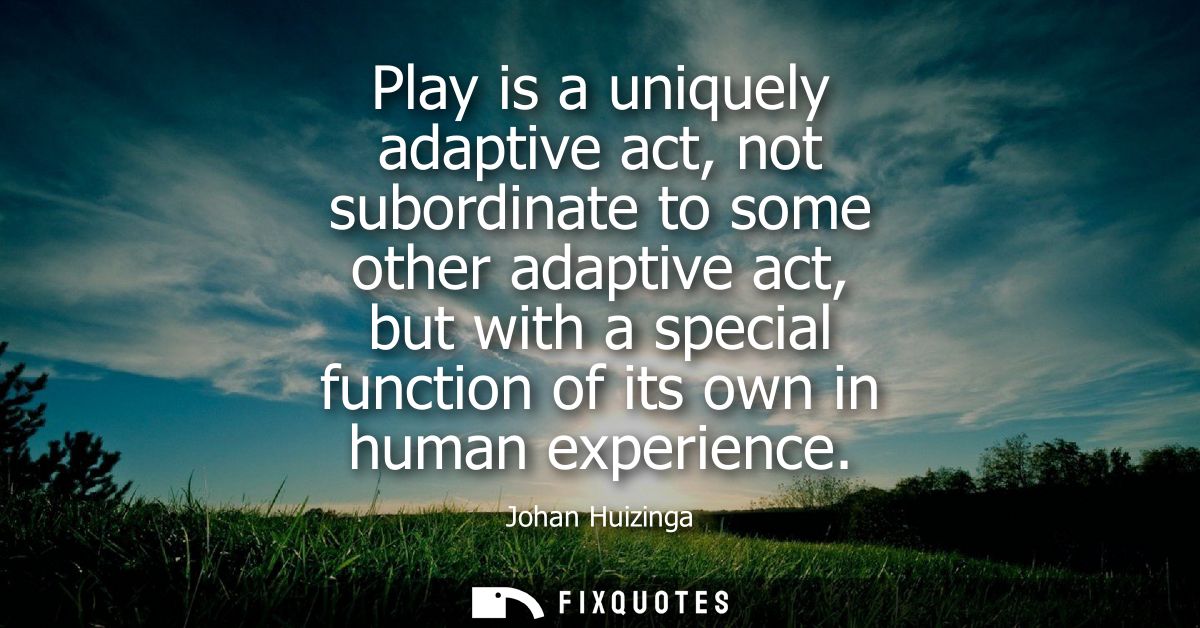
"Play is a uniquely adaptive act, not subordinate to some other adaptive act, but with a special function of its own in human experience"
About this Quote
The phrasing does quiet rhetorical work. “Not subordinate” is a refusal of hierarchy: play doesn’t need to justify itself as training for war, rehearsal for labor, or a safety valve for stress. It has “a special function of its own,” meaning it creates a distinctive kind of order: rules voluntarily accepted, boundaries drawn, stakes that feel real even when they’re invented. That’s the subtext: humans don’t just adapt by optimizing; we adapt by making worlds.
As a historian, Huizinga is also smuggling in a critique of the era’s favorite story about progress. If culture is built only from utility, then art, ritual, sport, law, even politics become mere camouflage for power and economics. Huizinga argues the opposite: many of our most consequential institutions are play-structures that hardened into seriousness. The line lands because it reframes play as the birthplace of meaning, not an escape from it.
Quote Details
| Topic | Deep |
|---|---|
| Source | Help us find the source |
| Cite | Cite this Quote |
Citation Formats
APA Style (7th ed.)
Huizinga, Johan. (n.d.). Play is a uniquely adaptive act, not subordinate to some other adaptive act, but with a special function of its own in human experience. FixQuotes. https://fixquotes.com/quotes/play-is-a-uniquely-adaptive-act-not-subordinate-57486/
Chicago Style
Huizinga, Johan. "Play is a uniquely adaptive act, not subordinate to some other adaptive act, but with a special function of its own in human experience." FixQuotes. Accessed February 2, 2026. https://fixquotes.com/quotes/play-is-a-uniquely-adaptive-act-not-subordinate-57486/.
MLA Style (9th ed.)
"Play is a uniquely adaptive act, not subordinate to some other adaptive act, but with a special function of its own in human experience." FixQuotes, https://fixquotes.com/quotes/play-is-a-uniquely-adaptive-act-not-subordinate-57486/. Accessed 2 Feb. 2026.