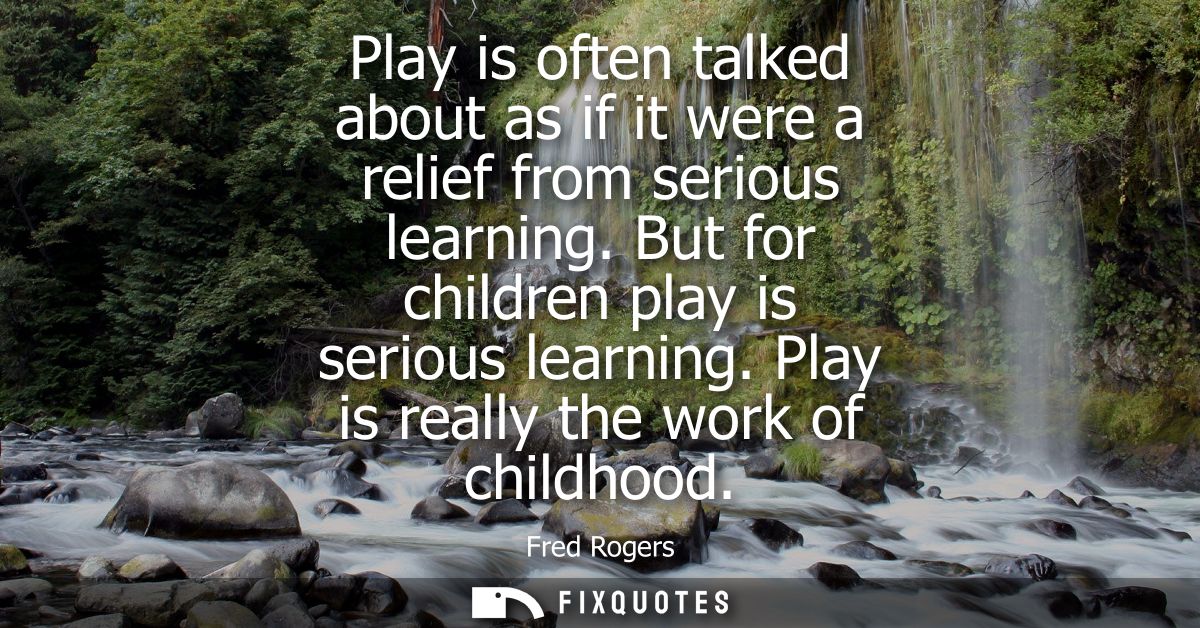
"Play is often talked about as if it were a relief from serious learning. But for children play is serious learning. Play is really the work of childhood"
About this Quote
The line works because it reassigns status. "Serious" is usually reserved for adult-coded behaviors: sitting still, producing measurable outputs, speaking in correct answers. Rogers insists that children don't learn primarily by absorbing information; they learn by rehearsing life. In play, kids run experiments in power, fairness, fear, attachment, and identity. They try on roles, negotiate rules, fail safely, and practice emotional regulation. That's not escape from learning; it's a laboratory for it.
"Play is really the work of childhood" is classic Rogers: gentle phrasing, blunt implication. If play is work, then interrupting it isn't just stealing fun; it's sabotaging development. The subtext is a cultural critique of productivity worship - the adult anxiety that every moment must be optimized - and of institutions that demand kids perform adulthood early.
Context matters: Rogers built an empire on slowing down, listening, and taking children's feelings seriously in a media landscape that often talked at them. This quote is part defense of childhood itself, and part argument for a different kind of education: one that treats imagination and emotional practice as core curriculum, not decorative extras.
Quote Details
| Topic | Learning |
|---|---|
| Source | Later attribution: The Psychoanalysis of Career Choice, Job Performance, and... (Paul Marcus, 2017) modern compilationISBN: 9781315452517 · ID: j_DzDQAAQBAJ
Evidence:
... Fred Rogers perceptively observed , “ Play is often talked about as if it were a relief from serious learning . But for children play is serious learning . Play is really the work of childhood " ( www.fcs.txstate.edu ) . Classically ... |
| Cite |
Citation Formats
APA Style (7th ed.)
Rogers, Fred. (2026, February 8). Play is often talked about as if it were a relief from serious learning. But for children play is serious learning. Play is really the work of childhood. FixQuotes. https://fixquotes.com/quotes/play-is-often-talked-about-as-if-it-were-a-relief-115167/
Chicago Style
Rogers, Fred. "Play is often talked about as if it were a relief from serious learning. But for children play is serious learning. Play is really the work of childhood." FixQuotes. February 8, 2026. https://fixquotes.com/quotes/play-is-often-talked-about-as-if-it-were-a-relief-115167/.
MLA Style (9th ed.)
"Play is often talked about as if it were a relief from serious learning. But for children play is serious learning. Play is really the work of childhood." FixQuotes, 8 Feb. 2026, https://fixquotes.com/quotes/play-is-often-talked-about-as-if-it-were-a-relief-115167/. Accessed 31 Mar. 2026.