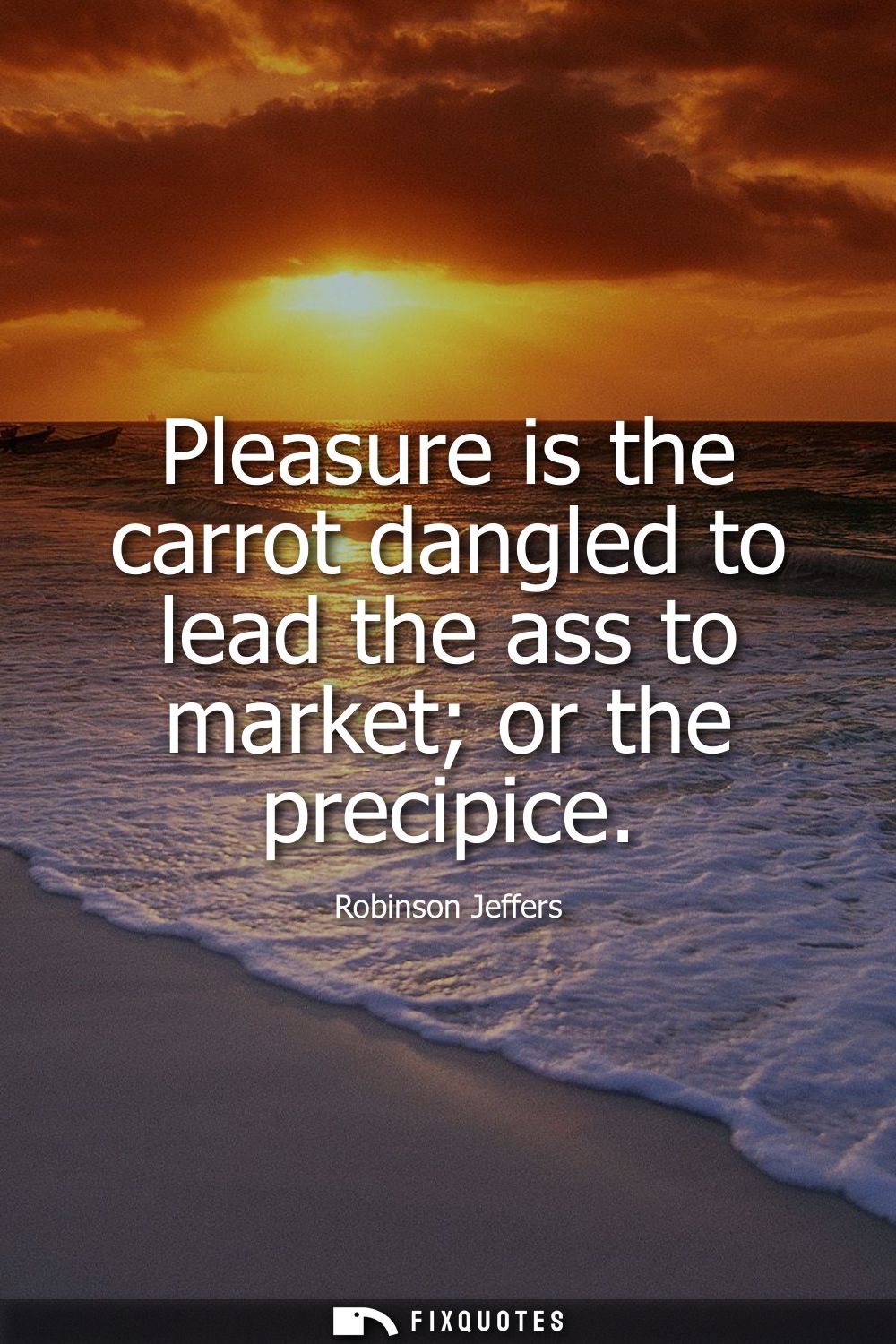
"Pleasure is the carrot dangled to lead the ass to market; or the precipice"
About this Quote
The twist is the last clause: “to market; or the precipice.” Market suggests civilization’s respectable endpoint: commerce, productivity, the social contract. You follow the carrot and you end up where everyone else ends up, traded and tallied. The “precipice” makes the same mechanism catastrophic. The difference isn’t in the bait; it’s in the path and who’s holding the stick. Jeffers is warning that pleasure is morally neutral and politically pliable: it can shepherd us into orderly participation or over the edge of personal and ecological ruin.
Context matters. Jeffers wrote in an era watching industrial modernity harden into mass society and mechanized war, and his poetry often leans toward “Inhumanism,” a cold-eyed re-scaling of human desire against the larger, indifferent world. This aphorism compresses that worldview: our sweetest impulses can be the most efficient lever for control, and the self congratulates itself for moving while it’s being moved.
Quote Details
| Topic | Wisdom |
|---|---|
| Source | Help us find the source |
| Cite |
Citation Formats
APA Style (7th ed.)
Jeffers, Robinson. (2026, January 16). Pleasure is the carrot dangled to lead the ass to market; or the precipice. FixQuotes. https://fixquotes.com/quotes/pleasure-is-the-carrot-dangled-to-lead-the-ass-to-123530/
Chicago Style
Jeffers, Robinson. "Pleasure is the carrot dangled to lead the ass to market; or the precipice." FixQuotes. January 16, 2026. https://fixquotes.com/quotes/pleasure-is-the-carrot-dangled-to-lead-the-ass-to-123530/.
MLA Style (9th ed.)
"Pleasure is the carrot dangled to lead the ass to market; or the precipice." FixQuotes, 16 Jan. 2026, https://fixquotes.com/quotes/pleasure-is-the-carrot-dangled-to-lead-the-ass-to-123530/. Accessed 7 Apr. 2026.