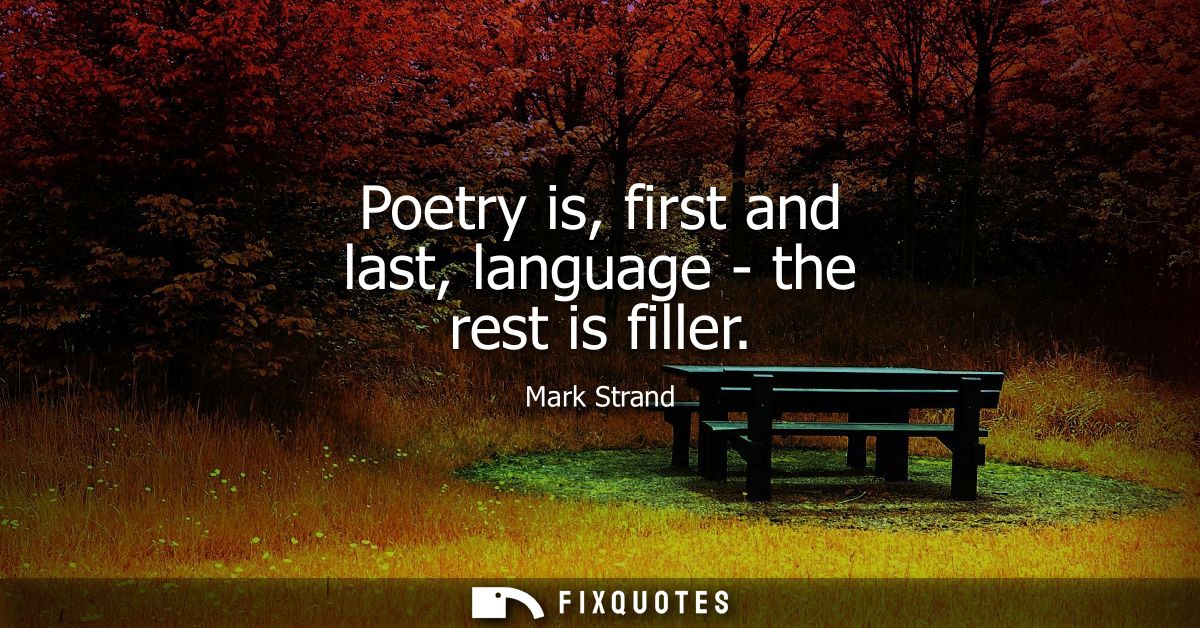
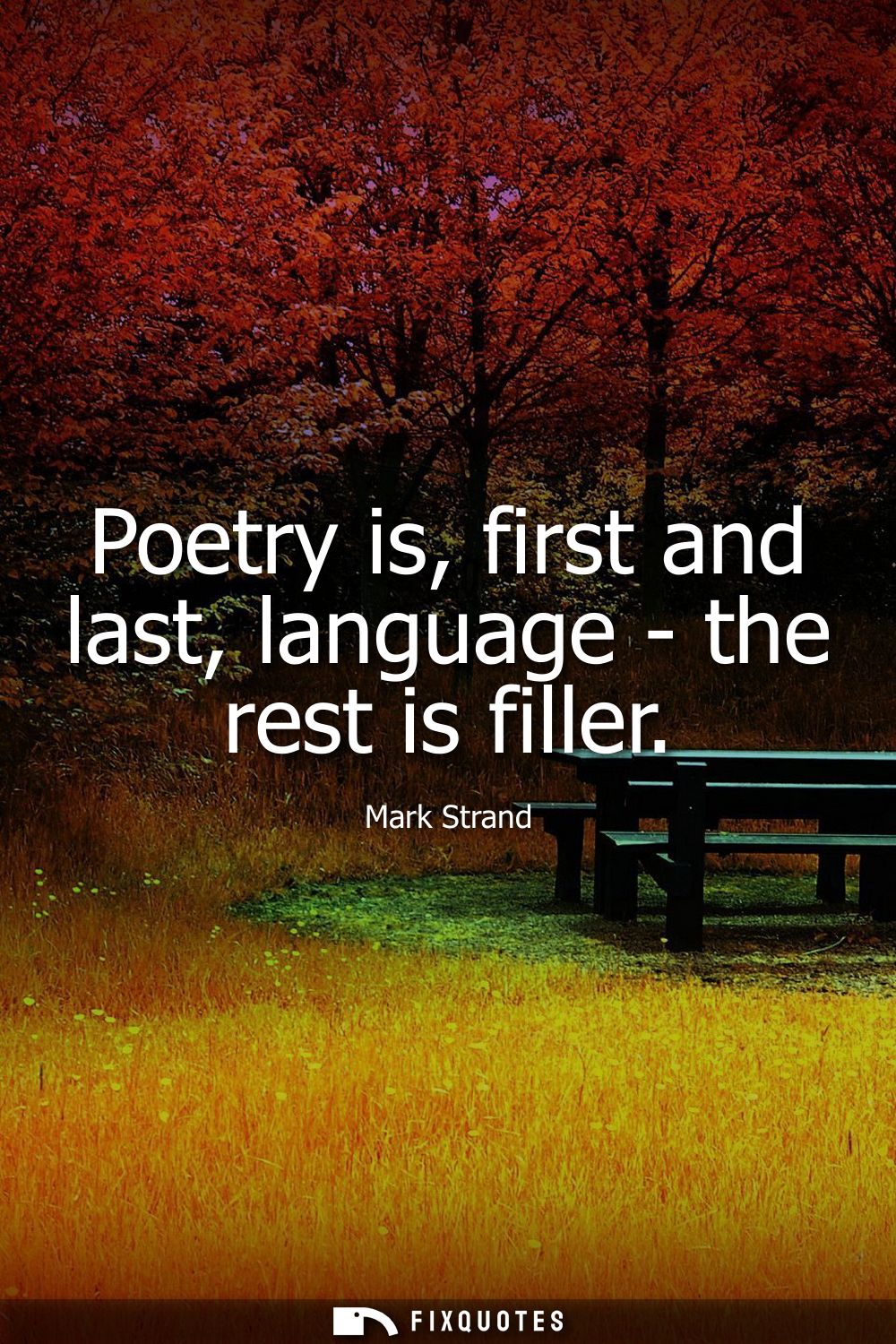
"Poetry is, first and last, language - the rest is filler"
About this Quote
Strand’s line lands like a pocketknife: small, sharp, and designed to puncture the romantic fog that still hangs around “poetry” as a special spiritual substance. By insisting poetry is “first and last, language,” he’s stripping the art down to its only non-negotiable material. Not inspiration, not trauma, not sincerity, not even “message” - words, arranged under pressure. The dash does the heavy lifting: it turns the sentence into a verdict, separating the craft from the cultural noise that accretes around it.
“The rest is filler” is the provocation, and it’s deliberately rude. Strand isn’t denying that poems can carry philosophy, politics, autobiography, or transcendence; he’s demoting those elements to byproducts, not foundations. Subtext: if your poem’s power depends on backstory, explanation, or the reader’s charitable interest in your feelings, it isn’t doing its job as a poem. He’s also taking a swipe at a workshop-era tendency to treat poetry as premium content attached to an anecdote - the poem as a caption to experience.
Context matters: Strand’s work is famously lucid, eerie, and exact, invested in how plain diction can open onto the uncanny. So this isn’t a formalist slogan for its own sake; it’s a defense of attention. Language is where the intelligence lives, where ambiguity earns its keep, where rhythm and syntax make meaning feel inevitable. Everything else is marketing.
“The rest is filler” is the provocation, and it’s deliberately rude. Strand isn’t denying that poems can carry philosophy, politics, autobiography, or transcendence; he’s demoting those elements to byproducts, not foundations. Subtext: if your poem’s power depends on backstory, explanation, or the reader’s charitable interest in your feelings, it isn’t doing its job as a poem. He’s also taking a swipe at a workshop-era tendency to treat poetry as premium content attached to an anecdote - the poem as a caption to experience.
Context matters: Strand’s work is famously lucid, eerie, and exact, invested in how plain diction can open onto the uncanny. So this isn’t a formalist slogan for its own sake; it’s a defense of attention. Language is where the intelligence lives, where ambiguity earns its keep, where rhythm and syntax make meaning feel inevitable. Everything else is marketing.
Quote Details
| Topic | Poetry |
|---|---|
| Source | Help us find the source |
| Cite |
Citation Formats
APA Style (7th ed.)
Strand, Mark. (2026, January 15). Poetry is, first and last, language - the rest is filler. FixQuotes. https://fixquotes.com/quotes/poetry-is-first-and-last-language-the-rest-is-164224/
Chicago Style
Strand, Mark. "Poetry is, first and last, language - the rest is filler." FixQuotes. January 15, 2026. https://fixquotes.com/quotes/poetry-is-first-and-last-language-the-rest-is-164224/.
MLA Style (9th ed.)
"Poetry is, first and last, language - the rest is filler." FixQuotes, 15 Jan. 2026, https://fixquotes.com/quotes/poetry-is-first-and-last-language-the-rest-is-164224/. Accessed 19 Feb. 2026.
More Quotes by Mark
Add to List