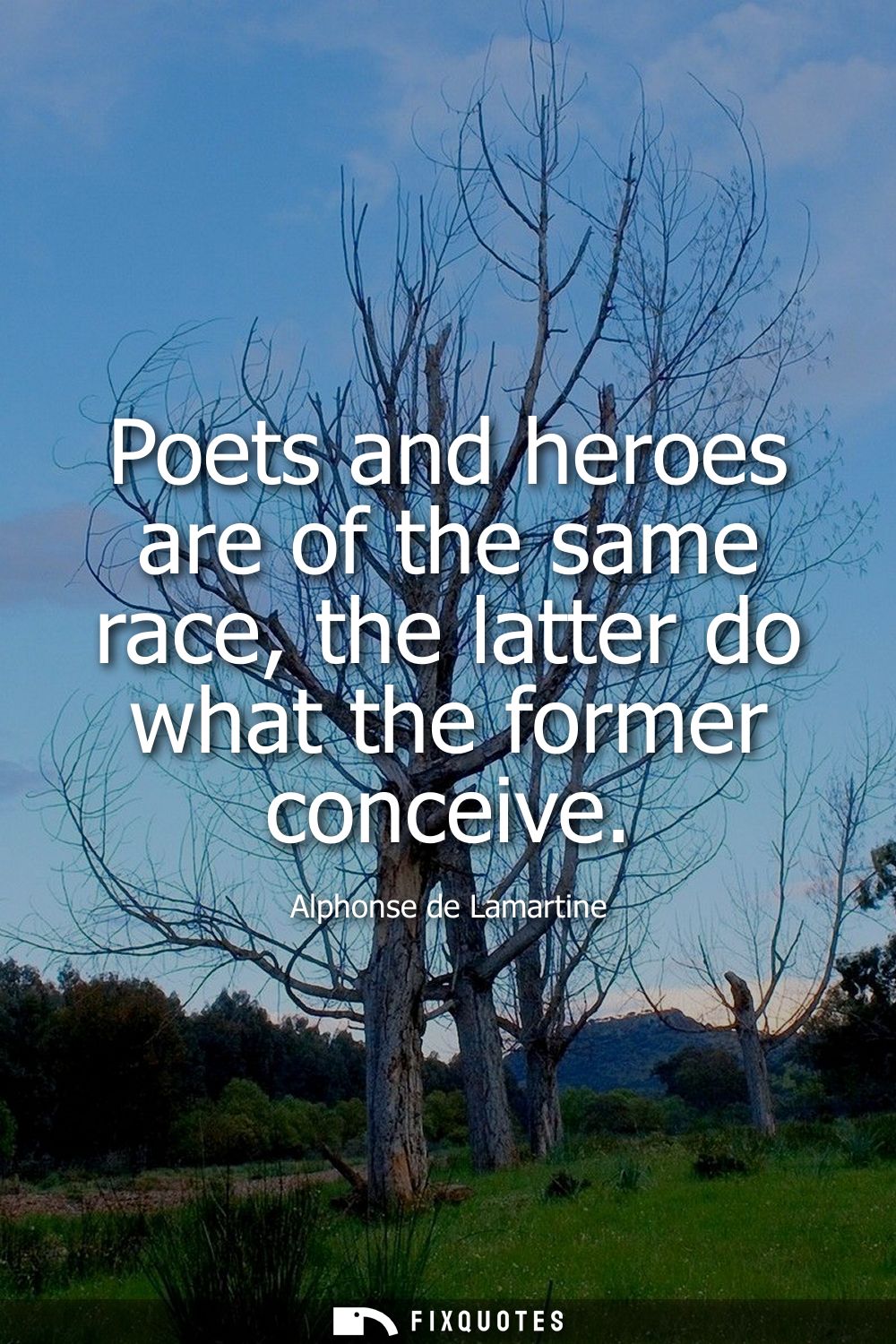
"Poets and heroes are of the same race, the latter do what the former conceive"
About this Quote
The line works because it quietly demotes brute force. The hero’s deed is framed as an execution of a prior idea, like a script finally staged. That’s a radical power move for a poet to make: it claims that the deepest engine of political and moral change is conceptual - vision, narrative, metaphor, the ability to name what doesn’t yet exist. Heroes, in this telling, are the visible tip of an invisible authorial process.
Context sharpens the stakes. Lamartine wasn’t only a Romantic poet; he was a statesman of the 1848 French Revolution, briefly at the center of government. He had seen crowds move on slogans, symbols, and songs - and had tried to steer them with speech. The subtext is self-justifying and cautionary at once: if poets “conceive” the future, they also bear responsibility for what their visions unleash. Ideas don’t stay on the page; someone eventually picks them up and acts.
Quote Details
| Topic | Wisdom |
|---|---|
| Source | Help us find the source |
| Cite |
Citation Formats
APA Style (7th ed.)
Lamartine, Alphonse de. (2026, January 17). Poets and heroes are of the same race, the latter do what the former conceive. FixQuotes. https://fixquotes.com/quotes/poets-and-heroes-are-of-the-same-race-the-latter-71632/
Chicago Style
Lamartine, Alphonse de. "Poets and heroes are of the same race, the latter do what the former conceive." FixQuotes. January 17, 2026. https://fixquotes.com/quotes/poets-and-heroes-are-of-the-same-race-the-latter-71632/.
MLA Style (9th ed.)
"Poets and heroes are of the same race, the latter do what the former conceive." FixQuotes, 17 Jan. 2026, https://fixquotes.com/quotes/poets-and-heroes-are-of-the-same-race-the-latter-71632/. Accessed 6 Apr. 2026.