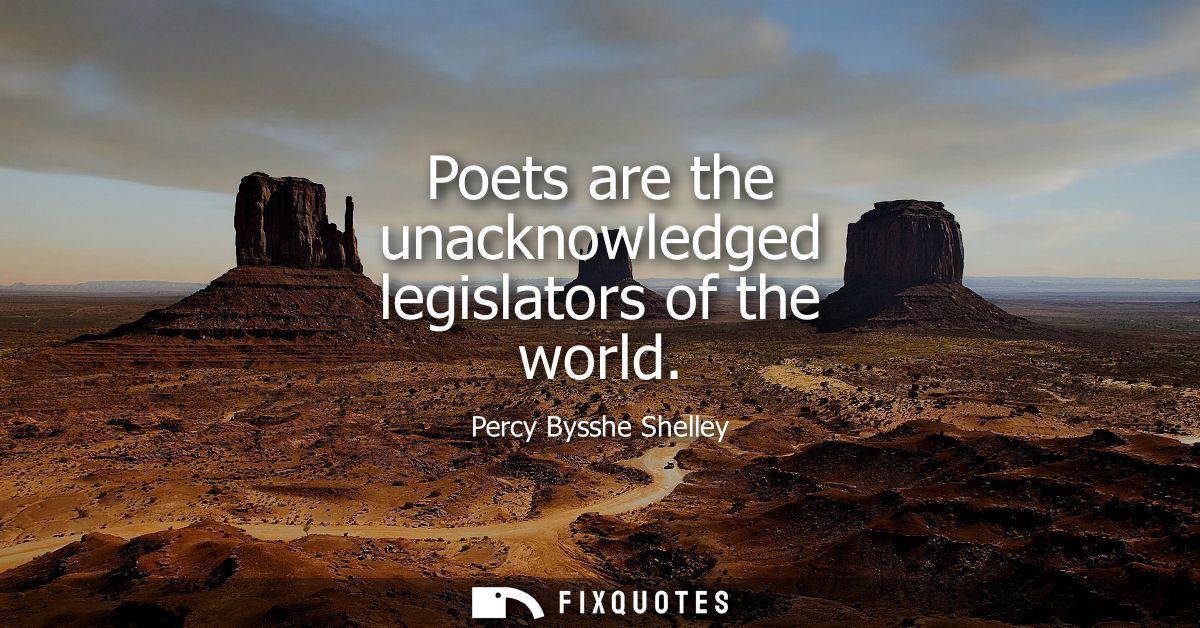
"Poets are the unacknowledged legislators of the world"
About this Quote
Shelley’s line is a power move disguised as a compliment to the arts: if lawmakers write statutes, poets write the feelings and assumptions that make statutes possible. Calling poets “unacknowledged legislators” smuggles cultural influence into the language of political authority, insisting that imagination is not decoration but infrastructure. The real audacity is the word “unacknowledged.” Shelley isn’t just praising poets; he’s indicting a society that refuses to admit what it’s actually governed by: stories, metaphors, and moral vocabularies that seep in long before a bill hits the floor.
The intent lands in the context of Romanticism’s revolt against cold rationalism and the tightening machinery of early industrial modernity. Shelley, a political radical with a deep suspicion of entrenched power, is arguing for a different kind of legitimacy: not the legitimacy of coercion, but of persuasion. Poetry, in his framing, doesn’t command; it colonizes the inner life. It teaches people what to desire, what to mourn, what to find shameful, what counts as “natural.” That’s legislation at the level where laws get their emotional compliance.
Subtextually, the quote also functions as self-authorization. In an era when poets were easy to patronize as dreamy or impractical, Shelley claims a seat at the table by declaring the table itself a product of imagination. It’s a Romantic flex, but it’s also a warning: the most consequential politics often arrives without a gavel, delivered instead in the phrases a culture can’t stop repeating.
The intent lands in the context of Romanticism’s revolt against cold rationalism and the tightening machinery of early industrial modernity. Shelley, a political radical with a deep suspicion of entrenched power, is arguing for a different kind of legitimacy: not the legitimacy of coercion, but of persuasion. Poetry, in his framing, doesn’t command; it colonizes the inner life. It teaches people what to desire, what to mourn, what to find shameful, what counts as “natural.” That’s legislation at the level where laws get their emotional compliance.
Subtextually, the quote also functions as self-authorization. In an era when poets were easy to patronize as dreamy or impractical, Shelley claims a seat at the table by declaring the table itself a product of imagination. It’s a Romantic flex, but it’s also a warning: the most consequential politics often arrives without a gavel, delivered instead in the phrases a culture can’t stop repeating.
Quote Details
| Topic | Poetry |
|---|---|
| Source | Help us find the source |
| Cite |
Citation Formats
APA Style (7th ed.)
Shelley, Percy Bysshe. (2026, January 16). Poets are the unacknowledged legislators of the world. FixQuotes. https://fixquotes.com/quotes/poets-are-the-unacknowledged-legislators-of-the-126169/
Chicago Style
Shelley, Percy Bysshe. "Poets are the unacknowledged legislators of the world." FixQuotes. January 16, 2026. https://fixquotes.com/quotes/poets-are-the-unacknowledged-legislators-of-the-126169/.
MLA Style (9th ed.)
"Poets are the unacknowledged legislators of the world." FixQuotes, 16 Jan. 2026, https://fixquotes.com/quotes/poets-are-the-unacknowledged-legislators-of-the-126169/. Accessed 4 Apr. 2026.
More Quotes by Percy
Add to List