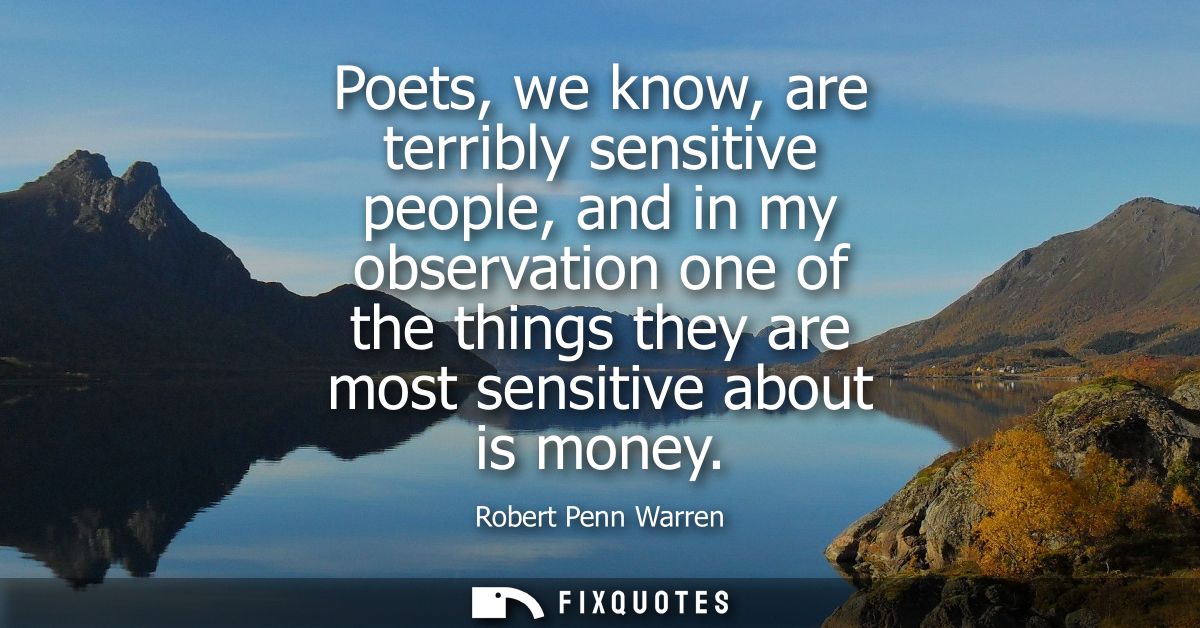
"Poets, we know, are terribly sensitive people, and in my observation one of the things they are most sensitive about is money"
About this Quote
The subtext is about status. Money is the vulgar measure that the market insists on using, and the poet’s sensitivity to it can read as embarrassment (needing it), resentment (being denied it), or moral anxiety (fearing that wanting it makes the art impure). Warren, writing from the more commercially legible position of a novelist, lets himself be the realist in the room: creativity doesn’t cancel economics; it just makes the negotiation more psychologically loaded. Art is supposed to float above commerce, yet every grant application, reading fee, and “exposure” gig drags it back down.
Contextually, this fits a 20th-century American literary world where poetry’s cultural prestige outpaced its paycheck. Warren’s wit is a pressure test: if your identity is built on sensitivity, the surest way to find the nerve is to touch the wallet.
Quote Details
| Topic | Poetry |
|---|---|
| Source | Help us find the source |
| Cite |
Citation Formats
APA Style (7th ed.)
Warren, Robert Penn. (2026, January 16). Poets, we know, are terribly sensitive people, and in my observation one of the things they are most sensitive about is money. FixQuotes. https://fixquotes.com/quotes/poets-we-know-are-terribly-sensitive-people-and-135289/
Chicago Style
Warren, Robert Penn. "Poets, we know, are terribly sensitive people, and in my observation one of the things they are most sensitive about is money." FixQuotes. January 16, 2026. https://fixquotes.com/quotes/poets-we-know-are-terribly-sensitive-people-and-135289/.
MLA Style (9th ed.)
"Poets, we know, are terribly sensitive people, and in my observation one of the things they are most sensitive about is money." FixQuotes, 16 Jan. 2026, https://fixquotes.com/quotes/poets-we-know-are-terribly-sensitive-people-and-135289/. Accessed 28 Mar. 2026.