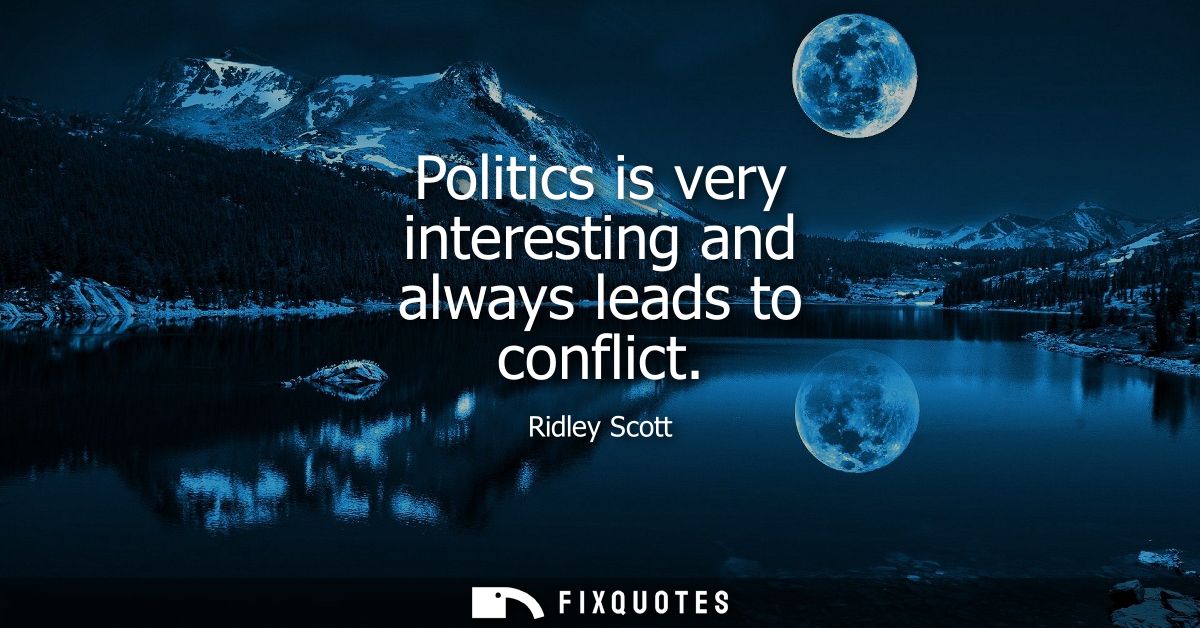
"Politics is very interesting and always leads to conflict"
About this Quote
Politics is the kind of “interesting” that leaves blood on the lens. When Ridley Scott drops that word, it lands less like a civics-club compliment and more like a director’s shrug toward the combustible engine that drives almost every big story: competing agendas in a closed room that eventually spill into the street. Scott has spent a career staging that spill. In Gladiator, a succession crisis becomes mass spectacle; in Black Hawk Down, geopolitical abstraction turns into minute-by-minute chaos; in Kingdom of Heaven and Napoleon, ideology and ego dress themselves up as destiny.
The line’s intent is bluntly practical. Politics, for Scott, isn’t a debate society; it’s a narrative machine. It generates stakes, factions, betrayals, and the crucial thing cinema needs: consequences. “Always leads to conflict” reads like craft advice disguised as a worldview. If you want drama, track power. If you want action, watch what happens when power gets threatened.
The subtext is darker: conflict isn’t a failure of politics but its default setting. That’s a skeptical, almost newsroom-grade realism, but it’s also a filmmaker’s comfort with mess. Scott doesn’t idealize consensus; he’s drawn to systems under stress, where “policy” becomes the story people tell themselves while bodies move across maps.
Context matters, too. Scott comes out of postwar Britain and makes blockbusters in an era when politics is increasingly entertainment-coded. His quote quietly admits the feedback loop: politics produces conflict, conflict produces compelling images, and compelling images can, in turn, shape how audiences imagine politics.
The line’s intent is bluntly practical. Politics, for Scott, isn’t a debate society; it’s a narrative machine. It generates stakes, factions, betrayals, and the crucial thing cinema needs: consequences. “Always leads to conflict” reads like craft advice disguised as a worldview. If you want drama, track power. If you want action, watch what happens when power gets threatened.
The subtext is darker: conflict isn’t a failure of politics but its default setting. That’s a skeptical, almost newsroom-grade realism, but it’s also a filmmaker’s comfort with mess. Scott doesn’t idealize consensus; he’s drawn to systems under stress, where “policy” becomes the story people tell themselves while bodies move across maps.
Context matters, too. Scott comes out of postwar Britain and makes blockbusters in an era when politics is increasingly entertainment-coded. His quote quietly admits the feedback loop: politics produces conflict, conflict produces compelling images, and compelling images can, in turn, shape how audiences imagine politics.
Quote Details
| Topic | War |
|---|---|
| Source | Help us find the source |
| Cite |
Citation Formats
APA Style (7th ed.)
Scott, Ridley. (2026, January 17). Politics is very interesting and always leads to conflict. FixQuotes. https://fixquotes.com/quotes/politics-is-very-interesting-and-always-leads-to-24660/
Chicago Style
Scott, Ridley. "Politics is very interesting and always leads to conflict." FixQuotes. January 17, 2026. https://fixquotes.com/quotes/politics-is-very-interesting-and-always-leads-to-24660/.
MLA Style (9th ed.)
"Politics is very interesting and always leads to conflict." FixQuotes, 17 Jan. 2026, https://fixquotes.com/quotes/politics-is-very-interesting-and-always-leads-to-24660/. Accessed 13 Feb. 2026.
More Quotes by Ridley
Add to List