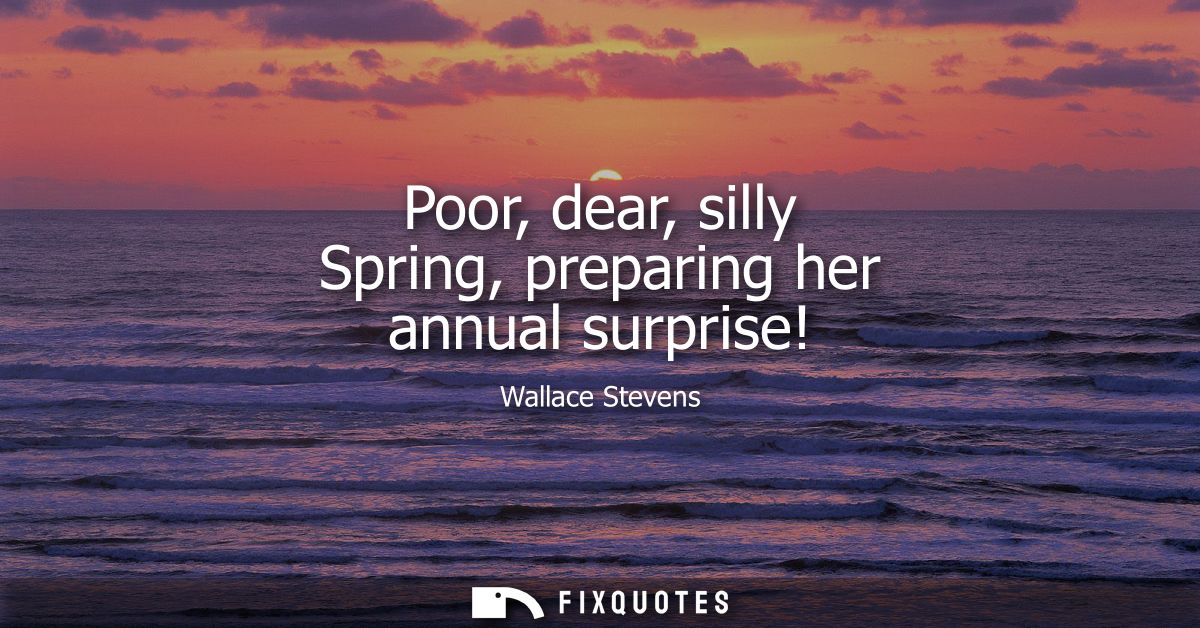
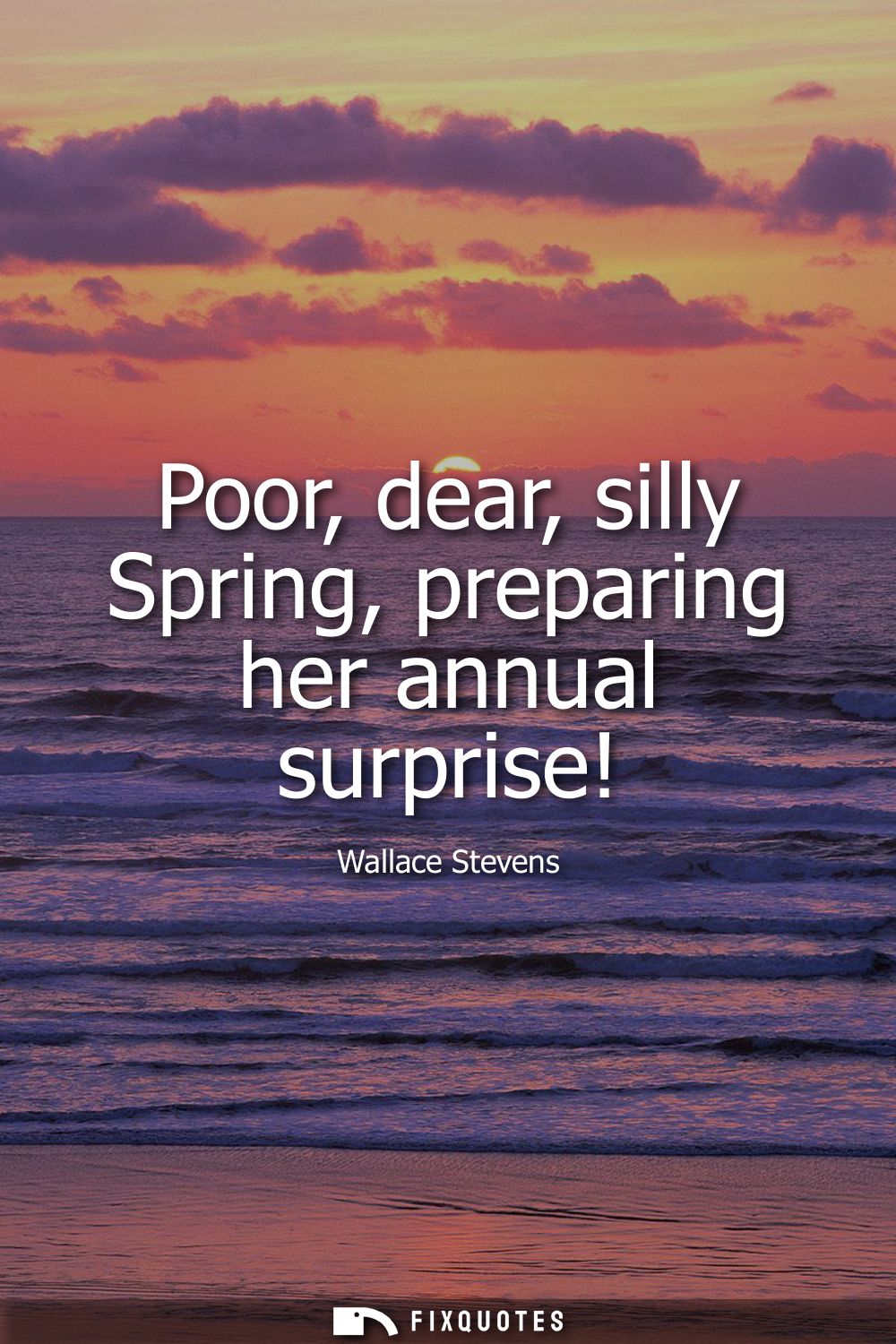
"Poor, dear, silly Spring, preparing her annual surprise!"
About this Quote
Stevens turns Spring into a well-meaning fool, and in four quick adjectives he punctures one of the oldest cultural scripts we have: that seasonal renewal is automatically profound. “Poor, dear, silly” lands like a fond, slightly impatient sigh. It’s not outright contempt; it’s the tone you use for someone you like who keeps falling for the same trick. Then comes the clincher: “annual surprise.” Spring’s “surprise” is precisely that it isn’t one. The novelty is scheduled, the miracle on a calendar.
That’s classic Stevens: a poet obsessed with how the mind manufactures freshness, how we keep consenting to be dazzled by repetition. Personifying Spring as “her” isn’t just quaint; it sets up a relationship of affection and condescension between speaker and season, as if nature is trying to stage a little production for us each year and we’re complicit in pretending not to know the plot. The line reads as a critique of sentimentality, but also as an admission of need. We want the reset. We want the performance.
Context matters: Stevens writes in a modernist key, wary of inherited consolations after a century that made “rebirth” feel less like a guarantee than a fantasy. Against that backdrop, Spring becomes a cultural habit of hope, not a metaphysical promise. The intent isn’t to cancel wonder; it’s to show wonder’s mechanics. If Spring is “silly,” it’s because it keeps offering the same gift, and we keep accepting it like it’s new - which is, quietly, the most human thing in the line.
That’s classic Stevens: a poet obsessed with how the mind manufactures freshness, how we keep consenting to be dazzled by repetition. Personifying Spring as “her” isn’t just quaint; it sets up a relationship of affection and condescension between speaker and season, as if nature is trying to stage a little production for us each year and we’re complicit in pretending not to know the plot. The line reads as a critique of sentimentality, but also as an admission of need. We want the reset. We want the performance.
Context matters: Stevens writes in a modernist key, wary of inherited consolations after a century that made “rebirth” feel less like a guarantee than a fantasy. Against that backdrop, Spring becomes a cultural habit of hope, not a metaphysical promise. The intent isn’t to cancel wonder; it’s to show wonder’s mechanics. If Spring is “silly,” it’s because it keeps offering the same gift, and we keep accepting it like it’s new - which is, quietly, the most human thing in the line.
Quote Details
| Topic | Spring |
|---|---|
| Source | Help us find the source |
| Cite |
Citation Formats
APA Style (7th ed.)
Stevens, Wallace. (2026, January 16). Poor, dear, silly Spring, preparing her annual surprise! FixQuotes. https://fixquotes.com/quotes/poor-dear-silly-spring-preparing-her-annual-90845/
Chicago Style
Stevens, Wallace. "Poor, dear, silly Spring, preparing her annual surprise!" FixQuotes. January 16, 2026. https://fixquotes.com/quotes/poor-dear-silly-spring-preparing-her-annual-90845/.
MLA Style (9th ed.)
"Poor, dear, silly Spring, preparing her annual surprise!" FixQuotes, 16 Jan. 2026, https://fixquotes.com/quotes/poor-dear-silly-spring-preparing-her-annual-90845/. Accessed 27 Mar. 2026.
More Quotes by Wallace
Add to List