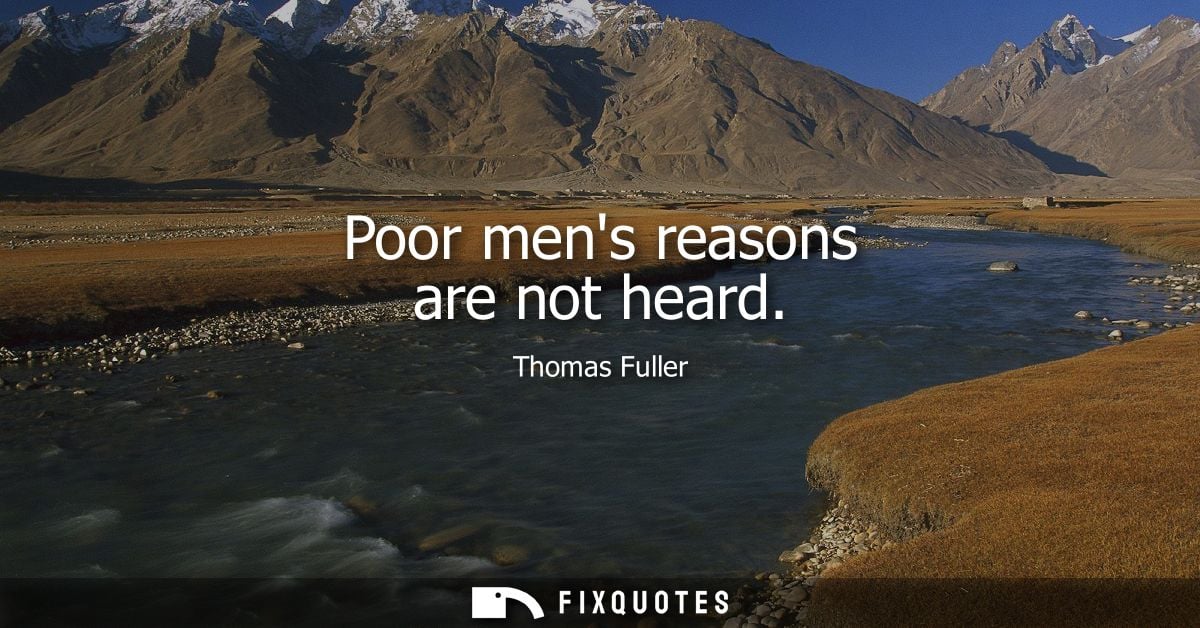
"Poor men's reasons are not heard"
About this Quote
A whole social order is compressed into eight words: if you are poor, your logic doesn’t fail so much as it fails to register. Fuller’s line works because it refuses the comforting myth that public life is a meritocracy of arguments. “Reasons” implies the poor may be right, coherent, even morally urgent. The tragedy is procedural, not intellectual: they are “not heard.” Passive voice does the quiet damage here, pointing to a system that muffles without needing a single identifiable villain.
Fuller, a seventeenth-century English clergyman, writes from a world where status was not an accidental byproduct of wealth but its ordained twin. His profession matters: clergy were meant to be society’s moral ear, the intermediaries between suffering and power. So the aphorism carries an uncomfortable double edge. It can read as pastoral realism, an acknowledgment of how parishioners are dismissed in courts, churches, and councils. It can also read as a warning to elites who congratulate themselves on their “reasonableness” while only recognizing reason when it arrives in a gentleman’s accent.
The subtext is that silence is not neutral. Being “not heard” isn’t just about volume; it’s about credibility. Poverty becomes a kind of epistemic stain: your testimony is treated as grievance, your explanation as excuse, your demand as noise. Fuller’s economy makes the indictment sharper; it sounds like a proverb you’d overhear at a market, which is fitting, because it’s about who gets to count as a speaker in the first place.
Fuller, a seventeenth-century English clergyman, writes from a world where status was not an accidental byproduct of wealth but its ordained twin. His profession matters: clergy were meant to be society’s moral ear, the intermediaries between suffering and power. So the aphorism carries an uncomfortable double edge. It can read as pastoral realism, an acknowledgment of how parishioners are dismissed in courts, churches, and councils. It can also read as a warning to elites who congratulate themselves on their “reasonableness” while only recognizing reason when it arrives in a gentleman’s accent.
The subtext is that silence is not neutral. Being “not heard” isn’t just about volume; it’s about credibility. Poverty becomes a kind of epistemic stain: your testimony is treated as grievance, your explanation as excuse, your demand as noise. Fuller’s economy makes the indictment sharper; it sounds like a proverb you’d overhear at a market, which is fitting, because it’s about who gets to count as a speaker in the first place.
Quote Details
| Topic | Justice |
|---|---|
| Source | Help us find the source |
| Cite |
Citation Formats
APA Style (7th ed.)
Fuller, Thomas. (2026, January 18). Poor men's reasons are not heard. FixQuotes. https://fixquotes.com/quotes/poor-mens-reasons-are-not-heard-10331/
Chicago Style
Fuller, Thomas. "Poor men's reasons are not heard." FixQuotes. January 18, 2026. https://fixquotes.com/quotes/poor-mens-reasons-are-not-heard-10331/.
MLA Style (9th ed.)
"Poor men's reasons are not heard." FixQuotes, 18 Jan. 2026, https://fixquotes.com/quotes/poor-mens-reasons-are-not-heard-10331/. Accessed 5 Apr. 2026.
More Quotes by Thomas
Add to List