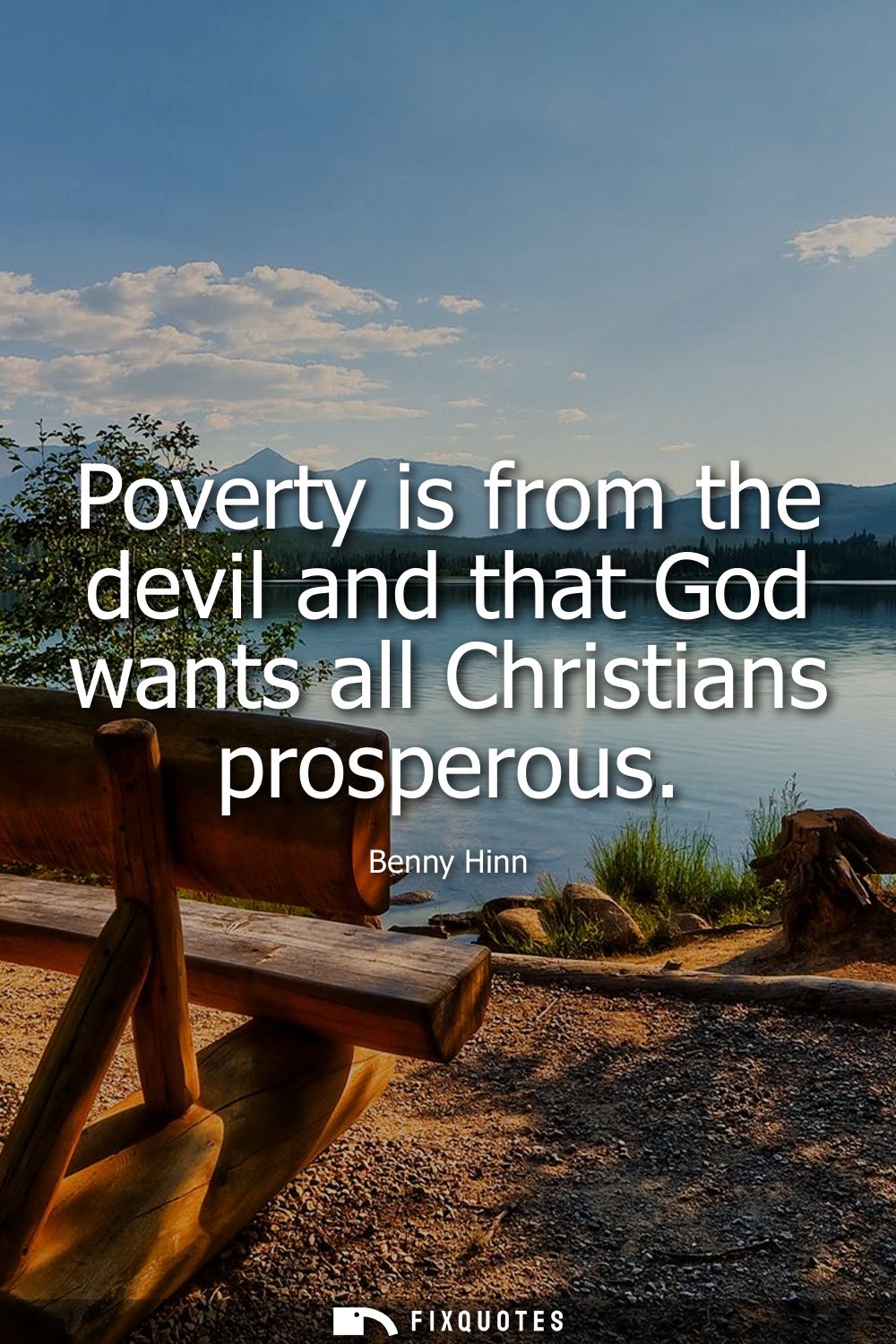
"Poverty is from the devil, and that God wants all Christians prosperous"
About this Quote
Poverty gets reframed here not as misfortune or structural failure, but as spiritual contamination: “from the devil.” It’s a rhetorical shortcut that does two things at once. First, it turns a complex social reality into a cosmic villain you can rebuke. Second, it quietly relocates responsibility from systems to souls. If poverty is demonic, then prosperity isn’t just desirable; it’s evidence of moral alignment. You’re not merely broke, you’re under attack.
Benny Hinn’s line also works as a sales pitch dressed as reassurance. “God wants all Christians prosperous” sounds egalitarian, even comforting, but the subtext is conditional: prosperity becomes the expected outcome of correct belief, correct confession, correct giving. In prosperity-gospel culture, money functions like a sacrament - visible proof of invisible favor. That makes wealth legible as righteousness and, more dangerously, makes poverty legible as failure: failure to have faith, to sow the seed, to claim the promise.
The context matters. Hinn rose within late-20th-century televangelism, when mass media turned charisma into an economy. Broadcast religion thrives on clear stakes, simple causality, and testimonials. This quote supplies all three: an enemy (the devil), a promise (prosperity), and an implied method (align with the ministry’s teaching). It’s spiritually energizing and culturally on-brand in a consumer society: salvation framed not as endurance or solidarity, but as upgrade. The power of the line is its audacity - and its cruelty, because it can bless the already comfortable while shaming the people it claims to liberate.
Benny Hinn’s line also works as a sales pitch dressed as reassurance. “God wants all Christians prosperous” sounds egalitarian, even comforting, but the subtext is conditional: prosperity becomes the expected outcome of correct belief, correct confession, correct giving. In prosperity-gospel culture, money functions like a sacrament - visible proof of invisible favor. That makes wealth legible as righteousness and, more dangerously, makes poverty legible as failure: failure to have faith, to sow the seed, to claim the promise.
The context matters. Hinn rose within late-20th-century televangelism, when mass media turned charisma into an economy. Broadcast religion thrives on clear stakes, simple causality, and testimonials. This quote supplies all three: an enemy (the devil), a promise (prosperity), and an implied method (align with the ministry’s teaching). It’s spiritually energizing and culturally on-brand in a consumer society: salvation framed not as endurance or solidarity, but as upgrade. The power of the line is its audacity - and its cruelty, because it can bless the already comfortable while shaming the people it claims to liberate.
Quote Details
| Topic | God |
|---|---|
| Source | Later attribution: The Civic Gospel (William M. Reynolds, Julie A. Webber, 2009) modern compilationISBN: 9789087904838 · ID: 23ofEAAAQBAJ
Evidence:
... Benny Hinn says “Poverty is from the devil and that God wants all Christians prosperous” (Benny Hinn, TBN, 11/6/90). In “The Battle for God: A History of Fundamentalism (2001) Karen Armstrong discusses the history fundamentalism in the ... |
| Cite |
Citation Formats
APA Style (7th ed.)
Hinn, Benny. (2026, March 9). Poverty is from the devil, and that God wants all Christians prosperous. FixQuotes. https://fixquotes.com/quotes/poverty-is-from-the-devil-and-that-god-wants-all-154389/
Chicago Style
Hinn, Benny. "Poverty is from the devil, and that God wants all Christians prosperous." FixQuotes. March 9, 2026. https://fixquotes.com/quotes/poverty-is-from-the-devil-and-that-god-wants-all-154389/.
MLA Style (9th ed.)
"Poverty is from the devil, and that God wants all Christians prosperous." FixQuotes, 9 Mar. 2026, https://fixquotes.com/quotes/poverty-is-from-the-devil-and-that-god-wants-all-154389/. Accessed 3 Apr. 2026.
More Quotes by Benny
Add to List