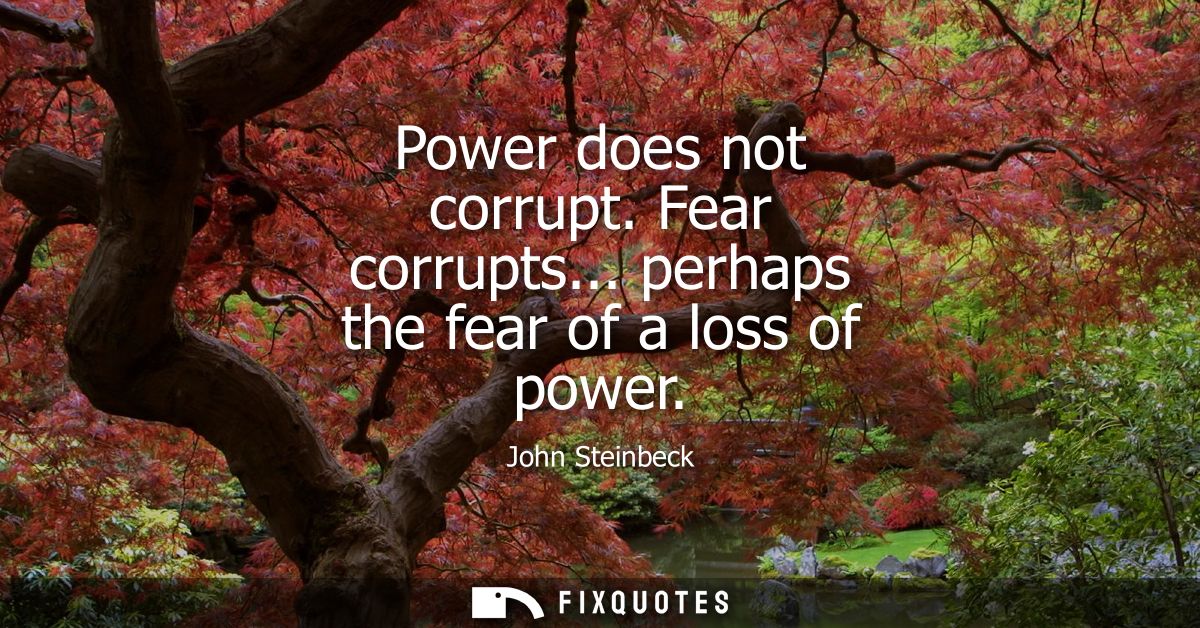
"Power does not corrupt. Fear corrupts... Perhaps the fear of a loss of power"
About this Quote
The ellipsis is the tell. It’s not a neat aphorism; it’s a pause where the mind runs the tape forward. Fear corrupts... of what? Steinbeck supplies the answer with a grim shrug: “perhaps the fear of a loss of power.” “Perhaps” softens the claim while sharpening its credibility, as if he’s watched enough bosses, landlords, politicians, sheriffs, and patriarchs to know the pattern but doesn’t need to grandstand. The subtext is psychological and political: the most dangerous actor isn’t the confident ruler, it’s the insecure one. When power feels threatened, people start preemptively punishing, hoarding, lying, and rewriting the rules. They call it security; it reads like panic.
Contextually, this sits comfortably in Steinbeck’s America: Depression-era scarcity, labor conflict, institutional violence, and the small, everyday tyrannies that hold systems together. His novels are full of characters who don’t become monstrous because they’re strong, but because they’re scared - of losing land, status, respectability, control. The line works because it makes corruption sound less like temptation and more like self-defense gone rancid: fear turning the moral world into a zero-sum ledger.
Quote Details
| Topic | Leadership |
|---|---|
| Source | Help us find the source |
| Cite |
Citation Formats
APA Style (7th ed.)
Steinbeck, John. (2026, February 19). Power does not corrupt. Fear corrupts... Perhaps the fear of a loss of power. FixQuotes. https://fixquotes.com/quotes/power-does-not-corrupt-fear-corrupts-perhaps-the-28821/
Chicago Style
Steinbeck, John. "Power does not corrupt. Fear corrupts... Perhaps the fear of a loss of power." FixQuotes. February 19, 2026. https://fixquotes.com/quotes/power-does-not-corrupt-fear-corrupts-perhaps-the-28821/.
MLA Style (9th ed.)
"Power does not corrupt. Fear corrupts... Perhaps the fear of a loss of power." FixQuotes, 19 Feb. 2026, https://fixquotes.com/quotes/power-does-not-corrupt-fear-corrupts-perhaps-the-28821/. Accessed 29 Mar. 2026.