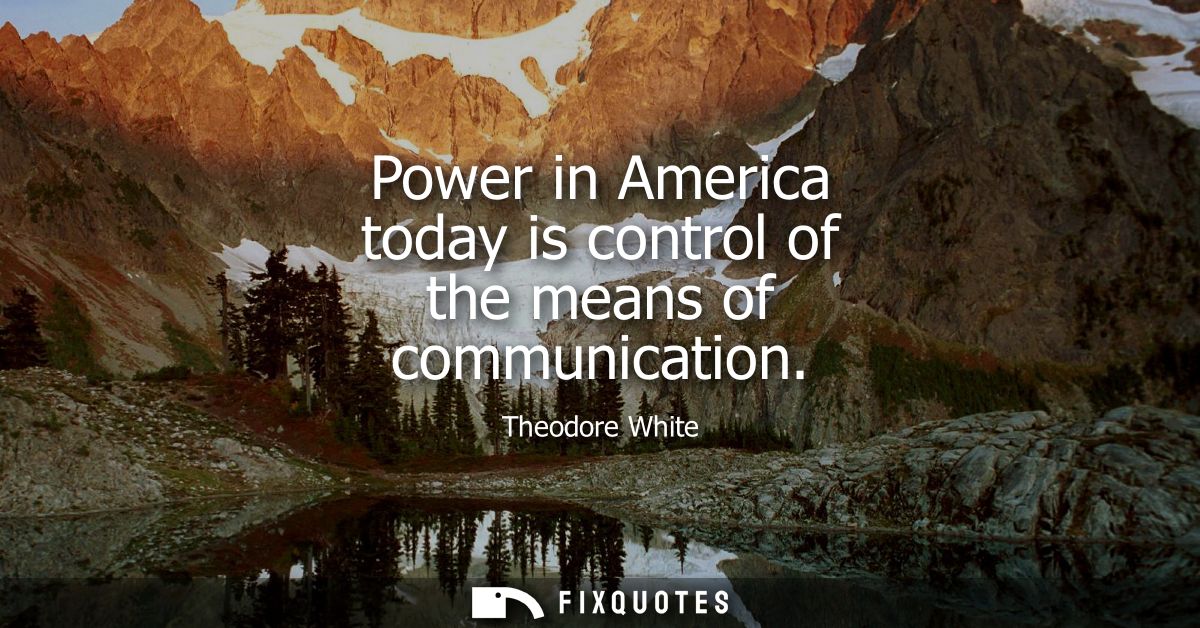
"Power in America today is control of the means of communication"
About this Quote
In White's hands, "power" stops being a matter of who holds office and becomes a question of who controls the story. The line is blunt on purpose: it strips American democracy down to an infrastructure problem. Not ballots, not laws, not even money as such, but the channels that decide what counts as reality long enough to be acted on.
White was a journalist steeped in the television age and the postwar rise of professionalized politics, when campaigns began to look less like civic arguments and more like managed spectacles. "Means of communication" sounds Marx-ish, and that's part of the sting: he borrows the cadence of material power to argue that media isn't a neutral mirror, it's the factory where legitimacy gets manufactured. Control here doesn't have to mean censorship in the old authoritarian sense. It can be access, gatekeeping, agenda-setting, the quiet ability to frame the options before the public even knows a choice is being made.
The subtext is also a warning to White's own tribe. Journalists like to cast themselves as watchdogs, but White suggests they sit closer to the fuse box. Whoever owns the distribution, whoever can amplify or mute, can define which scandals stick, which wars feel necessary, which candidates seem "electable", which movements appear fringe or inevitable.
It's a line that keeps updating itself: from three broadcast networks to cable to platforms. The names change, the leverage point doesn't.
White was a journalist steeped in the television age and the postwar rise of professionalized politics, when campaigns began to look less like civic arguments and more like managed spectacles. "Means of communication" sounds Marx-ish, and that's part of the sting: he borrows the cadence of material power to argue that media isn't a neutral mirror, it's the factory where legitimacy gets manufactured. Control here doesn't have to mean censorship in the old authoritarian sense. It can be access, gatekeeping, agenda-setting, the quiet ability to frame the options before the public even knows a choice is being made.
The subtext is also a warning to White's own tribe. Journalists like to cast themselves as watchdogs, but White suggests they sit closer to the fuse box. Whoever owns the distribution, whoever can amplify or mute, can define which scandals stick, which wars feel necessary, which candidates seem "electable", which movements appear fringe or inevitable.
It's a line that keeps updating itself: from three broadcast networks to cable to platforms. The names change, the leverage point doesn't.
Quote Details
| Topic | Human Rights |
|---|---|
| Source | Help us find the source |
| Cite |
Citation Formats
APA Style (7th ed.)
White, Theodore. (2026, January 16). Power in America today is control of the means of communication. FixQuotes. https://fixquotes.com/quotes/power-in-america-today-is-control-of-the-means-of-105404/
Chicago Style
White, Theodore. "Power in America today is control of the means of communication." FixQuotes. January 16, 2026. https://fixquotes.com/quotes/power-in-america-today-is-control-of-the-means-of-105404/.
MLA Style (9th ed.)
"Power in America today is control of the means of communication." FixQuotes, 16 Jan. 2026, https://fixquotes.com/quotes/power-in-america-today-is-control-of-the-means-of-105404/. Accessed 8 Apr. 2026.
More Quotes by Theodore
Add to List