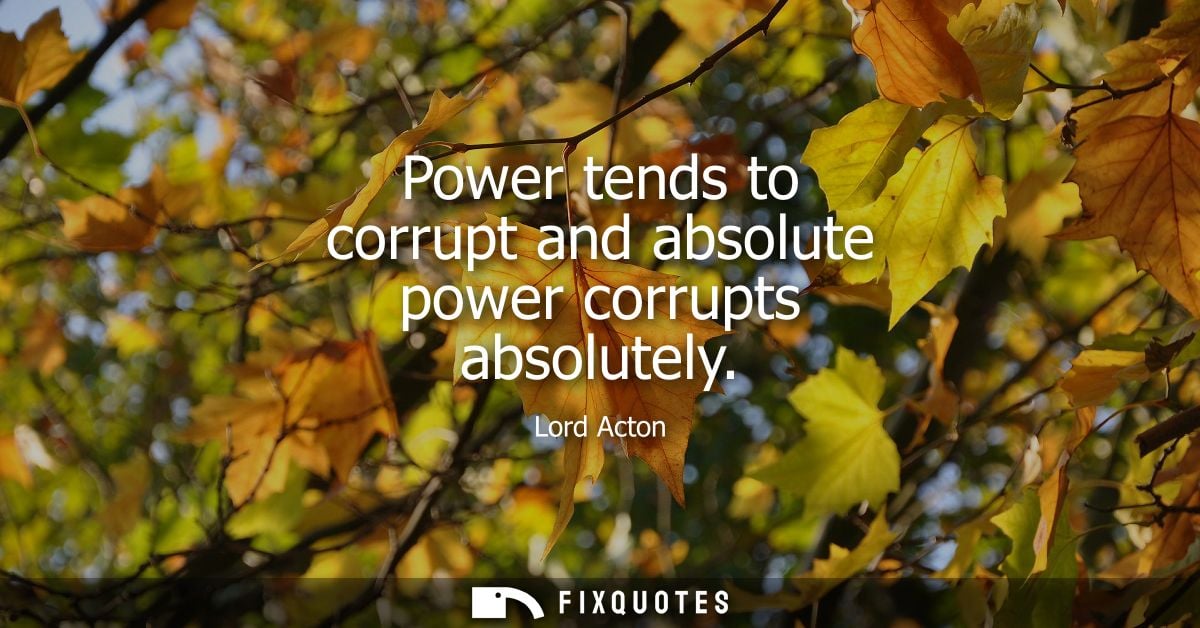
"Power tends to corrupt, and absolute power corrupts absolutely"
About this Quote
Acton’s line lands because it refuses the comforting fantasy that corruption is a personality defect. It’s an ecosystem. The verb “tends” is doing quiet, devastating work: he’s not claiming every powerful person is a villain, he’s arguing that power changes the odds. Put someone in a position where consequences don’t reach them, where flattery replaces feedback, where institutions bend to their preferences, and you’ve built a moral slip-and-slide. Corruption becomes less a dramatic fall than a gradual recalibration of what feels permissible.
Then he tightens the screw with “absolute,” a word that drips with institutional critique. Absolute power isn’t just a tyrant with bad intentions; it’s a system without friction: no rivals, no oversight, no independent press, no credible threat of removal. In that environment, even decent motives can curdle into self-justification. People start confusing their interests with the public’s, their survival with the nation’s stability, their ego with destiny.
Context sharpens the warning. Acton, a Catholic liberal historian, wrote the sentiment in an 1887 letter amid debates over the moral status of rulers and the tendency of institutions (including churches and empires) to excuse atrocities committed “for the greater good.” He was pushing back on hero-worship history: the idea that “great men” get graded on a curve. The subtext is blunt: don’t outsource ethics to charisma or legacy. If you want cleaner leaders, design dirt-resistant systems.
Then he tightens the screw with “absolute,” a word that drips with institutional critique. Absolute power isn’t just a tyrant with bad intentions; it’s a system without friction: no rivals, no oversight, no independent press, no credible threat of removal. In that environment, even decent motives can curdle into self-justification. People start confusing their interests with the public’s, their survival with the nation’s stability, their ego with destiny.
Context sharpens the warning. Acton, a Catholic liberal historian, wrote the sentiment in an 1887 letter amid debates over the moral status of rulers and the tendency of institutions (including churches and empires) to excuse atrocities committed “for the greater good.” He was pushing back on hero-worship history: the idea that “great men” get graded on a curve. The subtext is blunt: don’t outsource ethics to charisma or legacy. If you want cleaner leaders, design dirt-resistant systems.
Quote Details
| Topic | Ethics & Morality |
|---|---|
| Source | Verified source: Acton-Creighton Correspondence (Lord Acton, 1887)
Evidence: Historic responsibility has to make up for the want of legal responsibility. Power tends to corrupt and absolute power corrupts absolutely. (Letter I (Cannes, April 5, 1887), PDF p. 8). This is the earliest PRIMARY-source form: Lord Acton wrote it in a private letter to Mandell Creighton dated Cannes, April 5, 1887 (Letter I). The commonly circulated version often inserts a comma after “corrupt” and sometimes omits the preceding sentence; Acton’s wording in this letter is exactly as quoted above. The quote was not originally a speech or interview; it originates in correspondence. Other candidates (1) The Power of God and the Gods of Power (Daniel L. Migliore, 2008) compilation95.0% ... Lord Acton: “Power tends to corrupt, and absolute power corrupts absolutely.” There is much truth in this stateme... |
| Cite |
Citation Formats
APA Style (7th ed.)
Acton, Lord. (2026, March 2). Power tends to corrupt, and absolute power corrupts absolutely. FixQuotes. https://fixquotes.com/quotes/power-tends-to-corrupt-and-absolute-power-4342/
Chicago Style
Acton, Lord. "Power tends to corrupt, and absolute power corrupts absolutely." FixQuotes. March 2, 2026. https://fixquotes.com/quotes/power-tends-to-corrupt-and-absolute-power-4342/.
MLA Style (9th ed.)
"Power tends to corrupt, and absolute power corrupts absolutely." FixQuotes, 2 Mar. 2026, https://fixquotes.com/quotes/power-tends-to-corrupt-and-absolute-power-4342/. Accessed 26 Mar. 2026.
More Quotes by Lord
Add to List