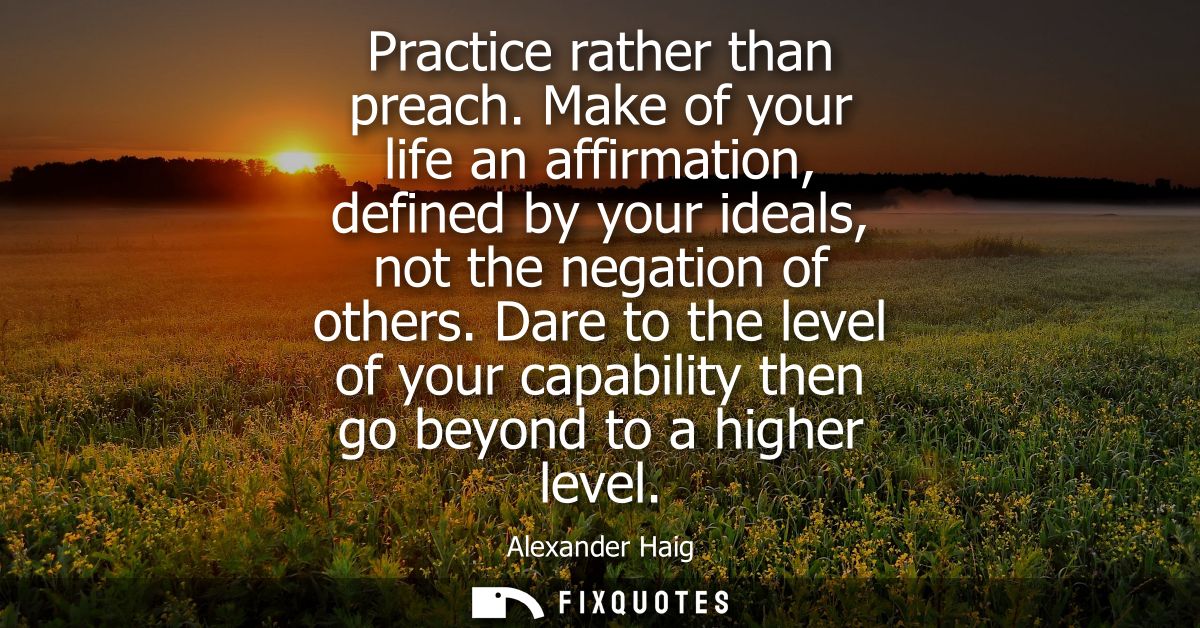
"Practice rather than preach. Make of your life an affirmation, defined by your ideals, not the negation of others. Dare to the level of your capability, then go beyond to a higher level"
About this Quote
The sharper move is his pivot from “negation of others” to “affirmation.” That’s a warning against the easiest kind of political identity: defining yourself by who you despise. Haig is pushing a discipline of self-definition that’s intrinsically conservative in method, even when the ideals are not. Build something. Stand for something. Don’t outsource your character to your enemies.
Then comes the ambition: “Dare to the level of your capability then go beyond.” In the Cold War-era bureaucratic universe Haig inhabited, audacity is framed as duty, not self-expression. He’s describing a ladder of responsibility: first meet the standard your role demands, then exceed it because the situation may require more than the job description admits. The subtext is managerial and martial at once: competence isn’t the finish line; it’s the entry fee. The quote works because it welds ethics to performance, turning “ideals” into a measurable practice rather than a decorative vocabulary.
Quote Details
| Topic | Motivational |
|---|---|
| Source | Help us find the source |
| Cite |
Citation Formats
APA Style (7th ed.)
Haig, Alexander. (2026, February 18). Practice rather than preach. Make of your life an affirmation, defined by your ideals, not the negation of others. Dare to the level of your capability, then go beyond to a higher level. FixQuotes. https://fixquotes.com/quotes/practice-rather-than-preach-make-of-your-life-an-61655/
Chicago Style
Haig, Alexander. "Practice rather than preach. Make of your life an affirmation, defined by your ideals, not the negation of others. Dare to the level of your capability, then go beyond to a higher level." FixQuotes. February 18, 2026. https://fixquotes.com/quotes/practice-rather-than-preach-make-of-your-life-an-61655/.
MLA Style (9th ed.)
"Practice rather than preach. Make of your life an affirmation, defined by your ideals, not the negation of others. Dare to the level of your capability, then go beyond to a higher level." FixQuotes, 18 Feb. 2026, https://fixquotes.com/quotes/practice-rather-than-preach-make-of-your-life-an-61655/. Accessed 6 Apr. 2026.