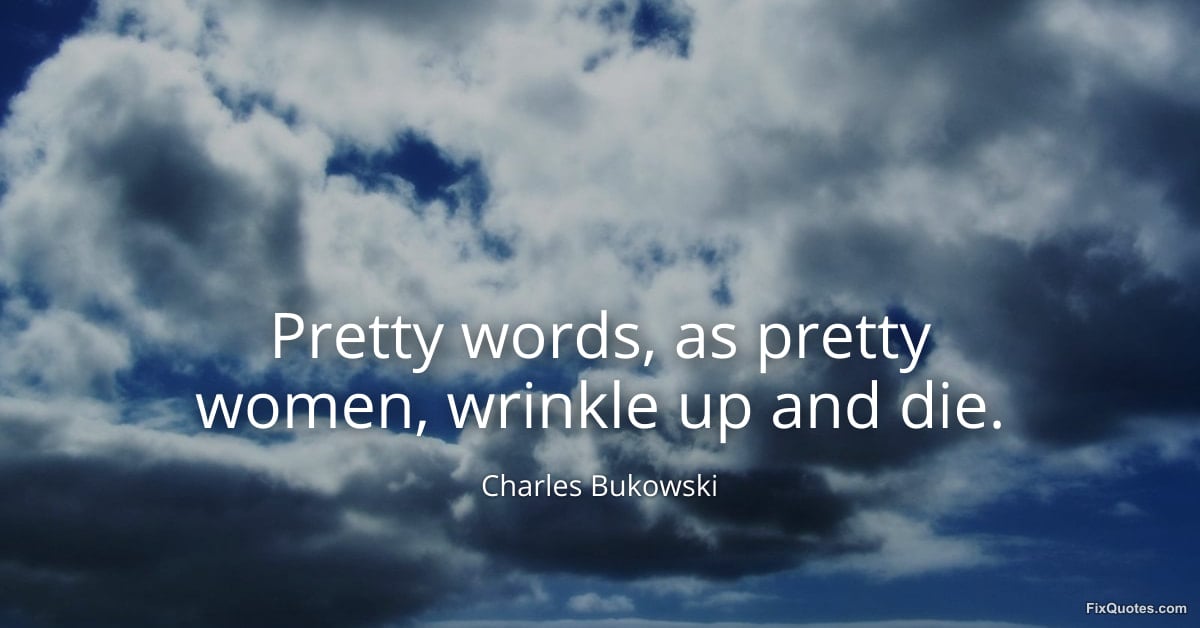
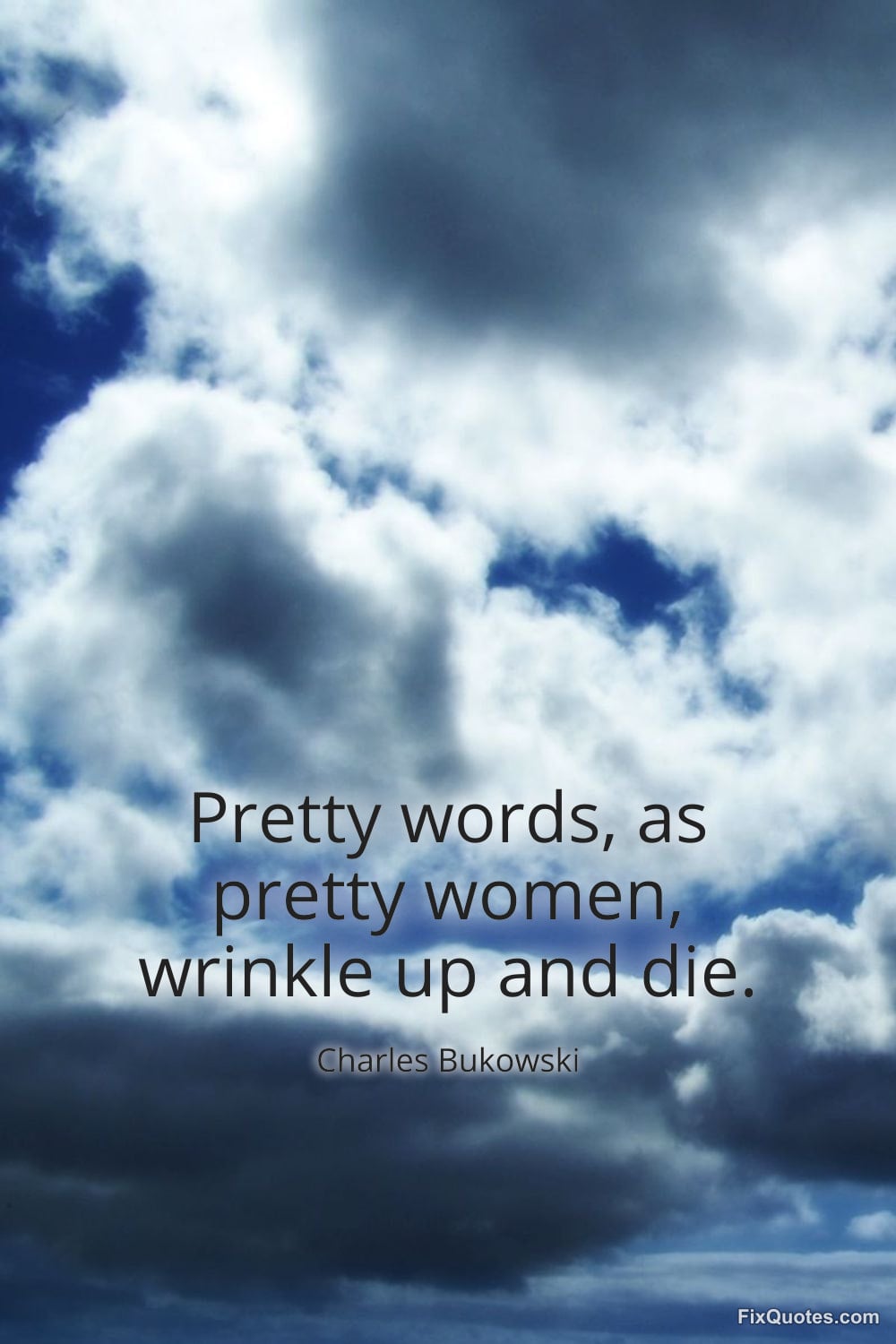
"Pretty words, as pretty women, wrinkle up and die"
About this Quote
Bukowski takes a knife to the kind of beauty that wants to be admired more than it wants to be true. The line lands because it’s blunt, almost ugly in its construction: “pretty words” set beside “pretty women”, then both dragged to the same ending - time, decay, the body. He’s not politely critiquing poetic ornament; he’s staging an execution of it.
The intent is anti-romantic, but not purely misogynistic provocation (though the comparison knowingly courts that charge). Bukowski is attacking a cultural reflex: the worship of surfaces, the way we treat art and women as consumables whose value is tied to freshness. By yoking language to the female body, he exposes how quickly “pretty” becomes a trap. A flattering line and a flattering face both get rented for attention, then discarded when they stop performing youth and polish.
The subtext is anxiety as much as contempt. “Wrinkle up and die” is a memento mori disguised as a sneer. If beauty doesn’t last, then anyone who builds their identity - or their art - on beauty is building on rot. Bukowski’s preferred counter-aesthetic is endurance: the rough sentence, the unvarnished confession, the bar-stool truth that doesn’t rely on glow.
Context matters: mid-to-late 20th century American letters, where his “dirty realism” posture pushes against workshop sheen and literary gentility. He’s carving out a brand of authenticity that sounds like refusal, but also like fear of being fooled by elegance again.
The intent is anti-romantic, but not purely misogynistic provocation (though the comparison knowingly courts that charge). Bukowski is attacking a cultural reflex: the worship of surfaces, the way we treat art and women as consumables whose value is tied to freshness. By yoking language to the female body, he exposes how quickly “pretty” becomes a trap. A flattering line and a flattering face both get rented for attention, then discarded when they stop performing youth and polish.
The subtext is anxiety as much as contempt. “Wrinkle up and die” is a memento mori disguised as a sneer. If beauty doesn’t last, then anyone who builds their identity - or their art - on beauty is building on rot. Bukowski’s preferred counter-aesthetic is endurance: the rough sentence, the unvarnished confession, the bar-stool truth that doesn’t rely on glow.
Context matters: mid-to-late 20th century American letters, where his “dirty realism” posture pushes against workshop sheen and literary gentility. He’s carving out a brand of authenticity that sounds like refusal, but also like fear of being fooled by elegance again.
Quote Details
| Topic | Aging |
|---|---|
| Source | Help us find the source |
| Cite |
Citation Formats
APA Style (7th ed.)
Bukowski, Charles. (2026, February 10). Pretty words, as pretty women, wrinkle up and die. FixQuotes. https://fixquotes.com/quotes/pretty-words-as-pretty-women-wrinkle-up-and-die-185260/
Chicago Style
Bukowski, Charles. "Pretty words, as pretty women, wrinkle up and die." FixQuotes. February 10, 2026. https://fixquotes.com/quotes/pretty-words-as-pretty-women-wrinkle-up-and-die-185260/.
MLA Style (9th ed.)
"Pretty words, as pretty women, wrinkle up and die." FixQuotes, 10 Feb. 2026, https://fixquotes.com/quotes/pretty-words-as-pretty-women-wrinkle-up-and-die-185260/. Accessed 8 Mar. 2026.
More Quotes by Charles
Add to List