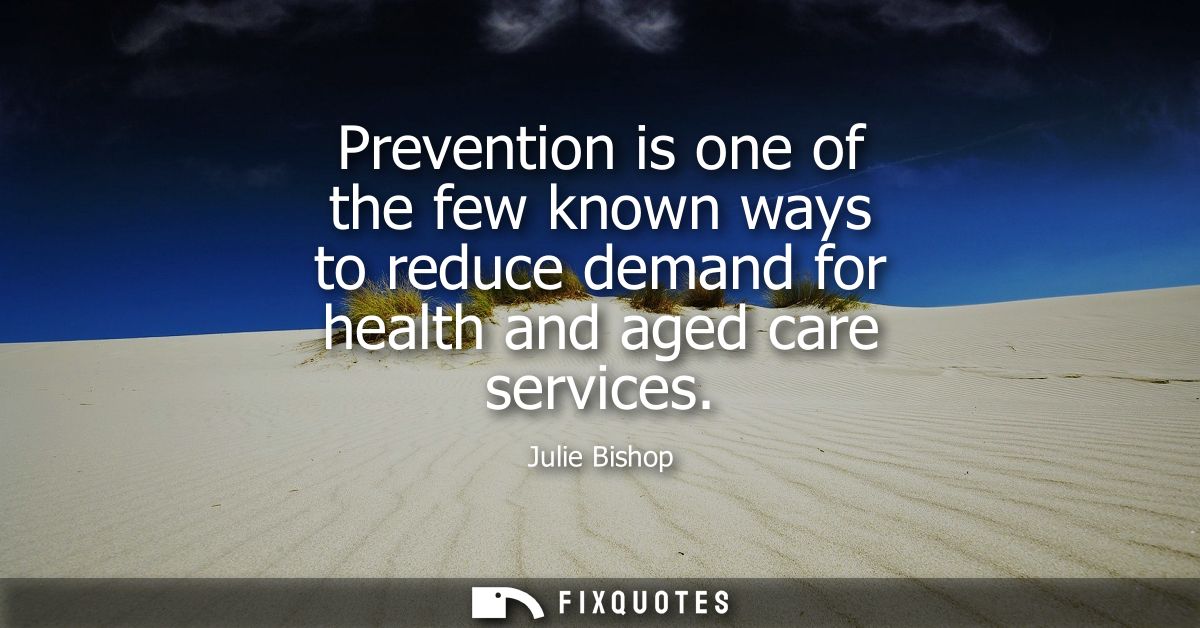
"Prevention is one of the few known ways to reduce demand for health and aged care services"
About this Quote
The subtext is managerial, almost CFO-like: demand is treated as a volume problem, services as a supply chain, and people as future users whose needs can be deferred. That’s not cynical so much as revealing. In contemporary politics, the moral language of care often competes with the budget language of sustainability. Bishop’s sentence lets the latter wear the former’s clothes. “Reduce demand” sounds benign, even humane, but it also signals a shift away from expanding capacity (more beds, more staff, more facilities) toward shaping behavior and risk upstream.
Context matters: prevention is the rare policy space where governments can promise both compassion and restraint. It flatters voters with agency (eat better, exercise, screen early) while implicitly preparing them for limits downstream (“we can’t fund everything forever”). The line works because it’s a promise and a warning in the same breath - a pitch for smarter health, and a justification for harder choices.
Quote Details
| Topic | Health |
|---|---|
| Source | Help us find the source |
| Cite |
Citation Formats
APA Style (7th ed.)
Bishop, Julie. (2026, January 16). Prevention is one of the few known ways to reduce demand for health and aged care services. FixQuotes. https://fixquotes.com/quotes/prevention-is-one-of-the-few-known-ways-to-reduce-90980/
Chicago Style
Bishop, Julie. "Prevention is one of the few known ways to reduce demand for health and aged care services." FixQuotes. January 16, 2026. https://fixquotes.com/quotes/prevention-is-one-of-the-few-known-ways-to-reduce-90980/.
MLA Style (9th ed.)
"Prevention is one of the few known ways to reduce demand for health and aged care services." FixQuotes, 16 Jan. 2026, https://fixquotes.com/quotes/prevention-is-one-of-the-few-known-ways-to-reduce-90980/. Accessed 19 Mar. 2026.