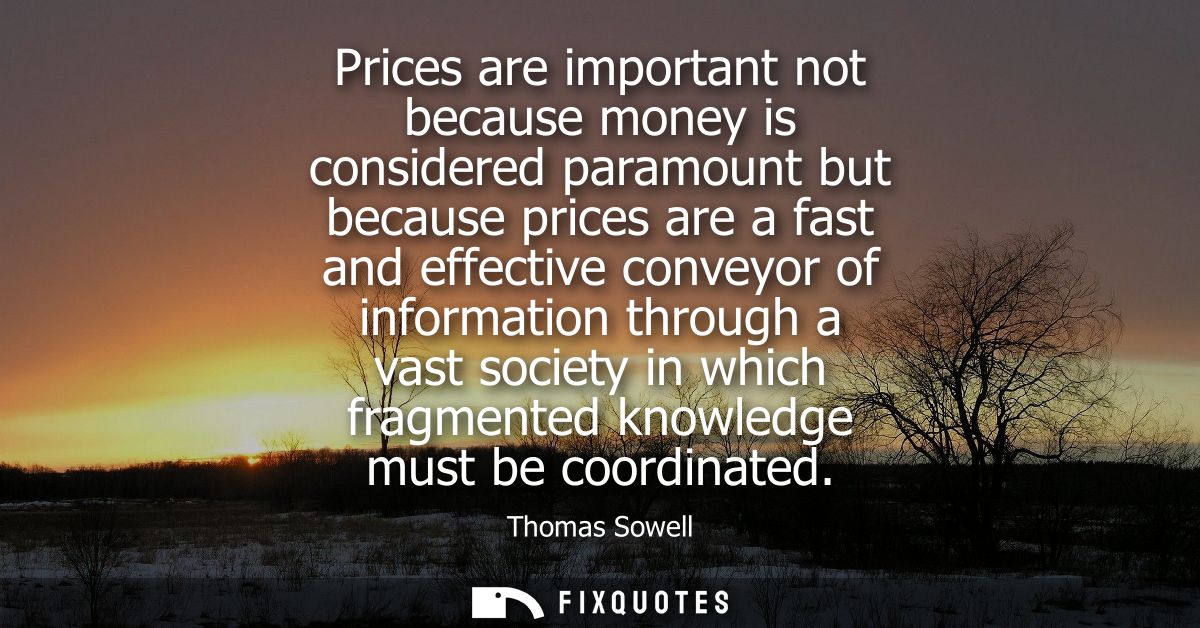
"Prices are important, not because money is considered paramount, but because prices are a fast and effective conveyor of information through a vast society in which fragmented knowledge must be coordinated"
About this Quote
The craft here is the pivot: “not because” denies the accusation (money worship) while “but because” installs a different logic (information). He’s smuggling in Hayek’s argument about dispersed knowledge: no central planner, committee, or well-meaning expert can hold the localized, constantly changing facts that sit in shop inventories, harvest yields, shipping bottlenecks, and household budgets. Prices compress all that chaos into a number you can act on. High prices are a flare: something is scarce relative to demand; conserve it, find substitutes, produce more. Low prices are a shrug: we can afford to use more, or producers should stop wasting effort here.
The subtext is skeptical of moralized economics. If you want outcomes like affordability or stability, Sowell suggests, you don’t get there by wishing away the “cold” mechanism; you either work with it or you build an alternative coordination system that can match its speed. Historically, that’s a shot across the bow at price controls and command economies, where muffling the signal often creates the very shortages that then demand more control.
Quote Details
| Topic | Money |
|---|---|
| Source | Help us find the source |
| Cite |
Citation Formats
APA Style (7th ed.)
Sowell, Thomas. (2026, February 20). Prices are important, not because money is considered paramount, but because prices are a fast and effective conveyor of information through a vast society in which fragmented knowledge must be coordinated. FixQuotes. https://fixquotes.com/quotes/prices-are-important-not-because-money-is-10482/
Chicago Style
Sowell, Thomas. "Prices are important, not because money is considered paramount, but because prices are a fast and effective conveyor of information through a vast society in which fragmented knowledge must be coordinated." FixQuotes. February 20, 2026. https://fixquotes.com/quotes/prices-are-important-not-because-money-is-10482/.
MLA Style (9th ed.)
"Prices are important, not because money is considered paramount, but because prices are a fast and effective conveyor of information through a vast society in which fragmented knowledge must be coordinated." FixQuotes, 20 Feb. 2026, https://fixquotes.com/quotes/prices-are-important-not-because-money-is-10482/. Accessed 27 Mar. 2026.