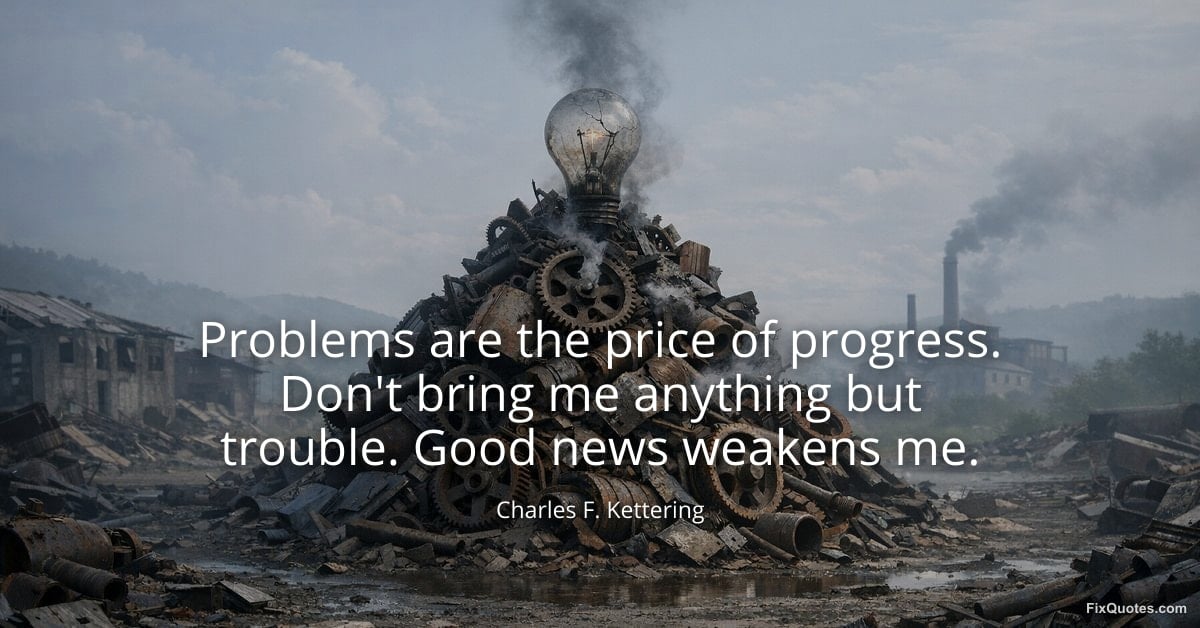
"Problems are the price of progress. Don't bring me anything but trouble. Good news weakens me"
About this Quote
“Don’t bring me anything but trouble” is managerial theater with a practical edge. Kettering isn’t romanticizing chaos; he’s filtering for signal. Trouble is actionable. It forces decisions, redirects resources, exposes weak assumptions. In a lab or factory, “good news” can be the most expensive narcotic: it lulls teams into protecting the current plan, congratulating themselves, and mistaking stability for momentum.
“Good news weakens me” is the line that gives away the subtext: progress is an adversarial sport. He’s building an identity around intolerance for complacency, almost a cultivated allergy to reassurance. There’s a subtle power move here, too. Leaders who only want “trouble” position themselves as indispensable problem-eaters, the person who thrives where others stall. It’s motivating, but it’s also a warning: if you’re always optimized for crises, you may quietly start depending on them.
In the early 20th century, when electrification, automobiles, and industrial R&D were rewriting daily life, Kettering’s stance fit the moment. Innovation wasn’t inspiration; it was organized discomfort.
Quote Details
| Topic | Overcoming Obstacles |
|---|---|
| Source | Later attribution: The Essential Book of Business and Life Quotations (2023) modern compilationISBN: 9781839984402 · ID: diqjEAAAQBAJ
Evidence:
... Problems are the price of progress . Don't bring me anything but trouble . Good news weakens me : Kettering , Charles Franklin ( 1876–1958 ; American inventor and business executive , best known as the founder of Delco , and head of ... |
| Featured | This quote was our Quote of the Day on February 6, 2026 |
| Cite |
Citation Formats
APA Style (7th ed.)
Kettering, Charles F. (2026, January 13). Problems are the price of progress. Don't bring me anything but trouble. Good news weakens me. FixQuotes. https://fixquotes.com/quotes/problems-are-the-price-of-progress-dont-bring-me-23007/
Chicago Style
Kettering, Charles F. "Problems are the price of progress. Don't bring me anything but trouble. Good news weakens me." FixQuotes. January 13, 2026. https://fixquotes.com/quotes/problems-are-the-price-of-progress-dont-bring-me-23007/.
MLA Style (9th ed.)
"Problems are the price of progress. Don't bring me anything but trouble. Good news weakens me." FixQuotes, 13 Jan. 2026, https://fixquotes.com/quotes/problems-are-the-price-of-progress-dont-bring-me-23007/. Accessed 19 Feb. 2026.