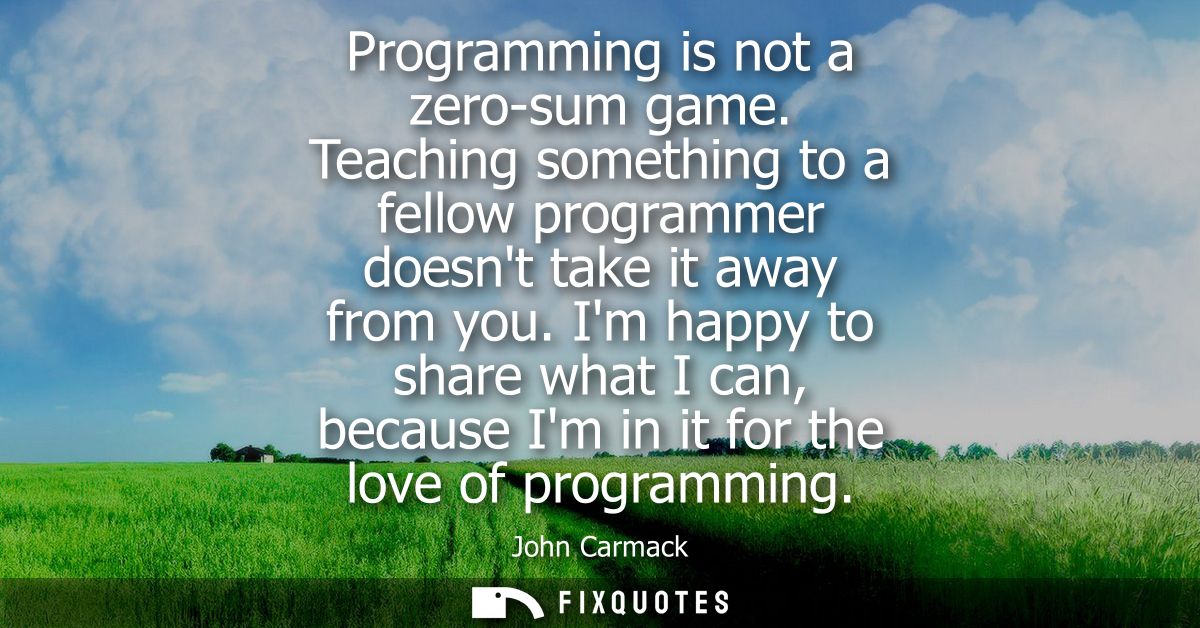
"Programming is not a zero-sum game. Teaching something to a fellow programmer doesn't take it away from you. I'm happy to share what I can, because I'm in it for the love of programming"
About this Quote
Carmack’s line reads like a corrective to the most persistent insecurity in tech: the fear that knowledge is a scarce resource and that your value collapses the moment someone else learns your trick. Calling programming “not a zero-sum game” smuggles in an economic metaphor to puncture that myth. Code isn’t gold in a vault; it’s closer to a language. You don’t become less fluent because someone else learns to speak.
The intent is practical and moral at once. Practically, software is built in teams, ecosystems, and decades-long toolchains; hoarding know-how slows everyone down, including the hoarder. Morally, Carmack frames teaching as an identity choice: you’re either in programming for leverage or for the work itself. That last clause, “because I’m in it for the love of programming,” isn’t sentimental so much as reputational. It signals a posture of craftsmanship, the old-school hacker ethic where status comes from building and explaining, not gatekeeping.
The subtext carries Carmack’s cultural context: a figure shaped by game engine development and, later, VR R&D, fields where iteration is ruthless and breakthroughs quickly become someone else’s baseline. In those environments, generosity is less altruism than strategy: sharing creates better collaborators, sharper critiques, and faster collective progress. It also pushes back against the proprietary reflex that dominated much of commercial software. Carmack isn’t pretending competition disappears; he’s arguing that the real edge comes from curiosity and execution, not secrecy.
The intent is practical and moral at once. Practically, software is built in teams, ecosystems, and decades-long toolchains; hoarding know-how slows everyone down, including the hoarder. Morally, Carmack frames teaching as an identity choice: you’re either in programming for leverage or for the work itself. That last clause, “because I’m in it for the love of programming,” isn’t sentimental so much as reputational. It signals a posture of craftsmanship, the old-school hacker ethic where status comes from building and explaining, not gatekeeping.
The subtext carries Carmack’s cultural context: a figure shaped by game engine development and, later, VR R&D, fields where iteration is ruthless and breakthroughs quickly become someone else’s baseline. In those environments, generosity is less altruism than strategy: sharing creates better collaborators, sharper critiques, and faster collective progress. It also pushes back against the proprietary reflex that dominated much of commercial software. Carmack isn’t pretending competition disappears; he’s arguing that the real edge comes from curiosity and execution, not secrecy.
Quote Details
| Topic | Coding & Programming |
|---|
More Quotes by John
Add to List